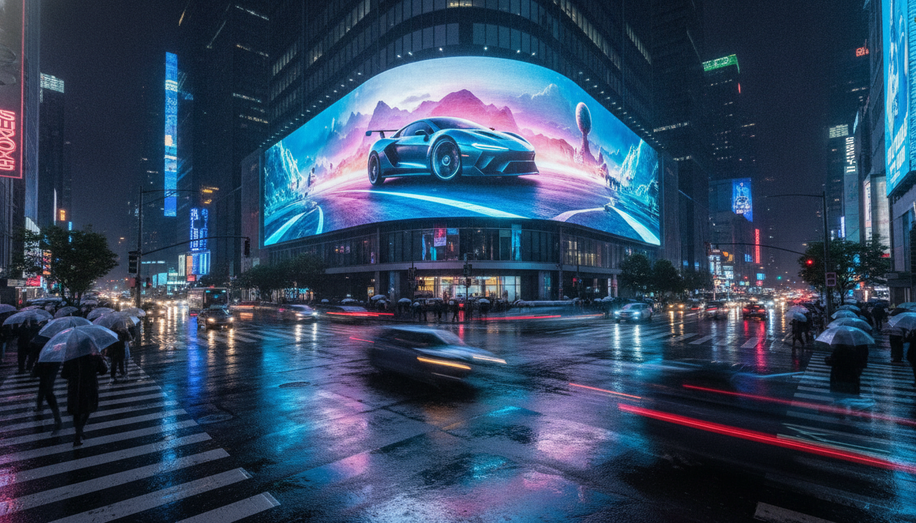

Designing and pitching Out-of-Home (OOH) campaigns has historically suffered from a major visual disconnect, as static 2D files rarely capture how a billboard will actually look in the wild. Today, a new wave of AI-powered mockup and visualization tools is transforming this workflow, helping creative agencies and media planners instantly place their designs onto hyper-realistic 3D streetscapes. These platforms allow teams to evaluate visual scale, test localized environmental context, and build highly persuasive pitches that bridge the gap between creative concept and real-world execution.
1. AdQuick’s “Visualize Your Brand”
Integrating directly into the platform’s extensive creative database, AdQuick and its “Visualize Your Brand” tool leverage generative artificial intelligence to instantly project campaign assets onto real-world, localized street-level listings. Instead of relying on stock templates, creative directors can browse thousands of actual OOH placements across various global markets and formats—from urban bus shelters to high-impact highway bulletins—and let the AI automatically warp, scale, and adjust their creative to fit the exact perspective of those real sites. This capability bridges the gap between media planning and creative execution, giving agencies a fast, automated way to evaluate readability and contextual impact before pitching to clients. Furthermore, it allows teams to easily collaborate, share mockups, and run high-fidelity simulations that drastically compress the timeline from initial concept to live campaign.
2. Artboard Studio
As a dedicated online graphic design and scene-generation platform, Artboard Studio offers one of the most robust, designer-friendly AI billboard mockup generators on the market today. It stands out by allowing creative agencies to place static or video assets onto 3D, AI-generated urban environments—ranging from rainy night-time transit shelters to sunny highway rooftops—and edit them directly via native Figma and Adobe Express plugins. The tool’s AI scene generator can dynamically adjust environmental variables like shadows, reflections, and ambient lighting to match the exact context of the ad, ensuring that digital OOH (DOOH) videos and static graphics blend seamlessly into the physical streetscape. This powerful combination of cloud-based design controls and AI-powered localization makes it an indispensable asset for creative teams crafting high-end, believable client pitches and case study portfolios.
3. Scenario
Recognized for its cutting-edge generative AI capabilities, Scenario provides a specialized AI Billboard Mockup Generator engineered to build photorealistic outdoor advertising previews in seconds. By inputting custom text prompts or uploading reference images, agency designers can command the AI to generate entirely custom, high-fidelity urban backdrops—from a bustling Tokyo intersection to a cozy suburban strip mall—where their billboard creatives are seamlessly integrated with correct perspective, depth, and atmospheric weathering. This rapid scene-generation capability allows media planners to test how different colors, typography scales, and visual hierarchies interact with various architectural styles and weather conditions. Ultimately, it serves as a highly efficient visual sandbox where creative directors can validate their hypotheses and steer client expectations without the overhead of manual 3D modeling or tedious Photoshop work.
4. Artificial Studio
Built for maximum speed and simplicity, Artificial Studio features an automated AI Billboard Mockup Generator that turns raw creative assets into stunning, real-world streetscape simulations in a single click. Users simply upload their vertical or horizontal ad layouts, and the platform’s underlying neural networks automatically identify, map, and warp the creative onto high-quality, pre-curated city billboards without requiring any manual editing or 3D knowledge. This tool is specifically tailored to address the “blank page” and fast-turnaround hurdles that creative agencies face during rapid pitching cycles, transforming flat layouts into highly persuasive visual narratives. By presenting campaigns in a believable, tangible context, agencies can quickly demonstrate scale, visibility, and real-world contrast to clients, accelerating the approval workflow while avoiding costly production errors.
5. expoze.io
Going beyond basic aesthetic placement, expoze.io uses sophisticated, neuroscience-backed artificial intelligence to predict exactly where human eye-tracking attention will land on an OOH mockup within the first crucial seconds of exposure. Developed and validated in partnership with research teams from Erasmus University and MIT, the platform generates highly accurate heatmaps and “areas of interest” (AOI) metrics for both static images and dynamic video formats without the need for human participants. Creative agencies can upload their newly generated AI billboard mockups to verify whether core branding elements, logos, and calls to action stand out against the visual noise of a crowded city street or transit hub. This objective, data-driven feedback loop empowers media planners to scientifically optimize layout hierarchy, font contrast, and copy placement before any media budget is committed or physical assets are printed.
By integrating these advanced AI mockup and visualization tools into their daily workflows, creative agencies can transform how they conceptualize, pitch, and validate physical-world advertisements. Replacing speculative, flat design files with hyper-realistic, localized simulations and predictive attention metrics ensures every campaign starts with a clear understanding of its real-world impact. Ultimately, embracing this technological shift not only accelerates client sign-off but also guarantees that modern out-of-home creatives are engineered to capture attention on the streets.