
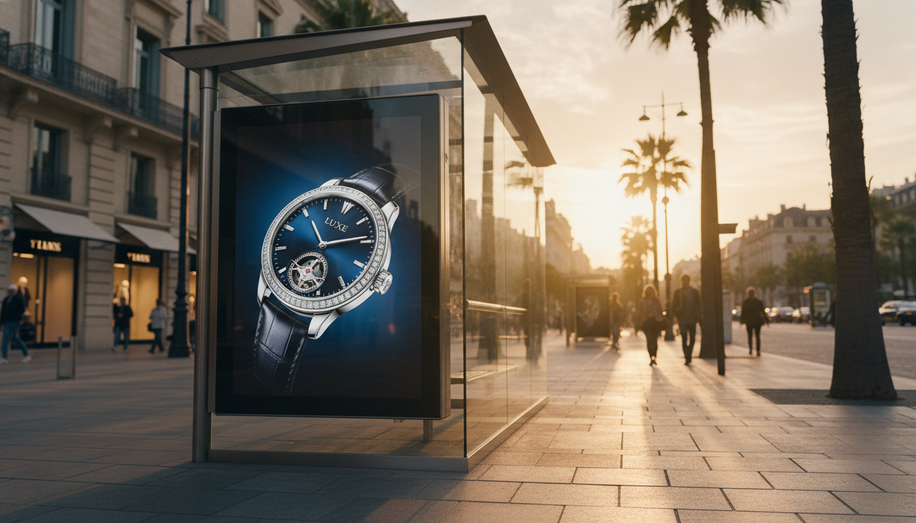

For luxury brands, visibility has never been about being seen by everyone. It is about being seen by the right people, in the right places, in precisely the right way. Out-of-home (OOH) and its digital counterpart (DOOH) are evolving into powerful stages for this performance, allowing high-end labels to craft exclusivity in public spaces without sacrificing scarcity or mystique.
The paradox for luxury marketers is clear: the category thrives on scarcity, yet brand equity depends on broad cultural presence. OOH resolves part of that tension by offering high-impact visibility in tightly curated environments. Airport terminals, first-class lounges, luxury shopping districts, five-star hotel corridors and flagship urban sites function almost like physical extensions of a brand’s boutique network. These are not mass-market billboards; they are premium placements with built-in audience qualification, where the probability of reaching affluent, travel-hungry and brand-conscious consumers is significantly higher.
Airports, in particular, remain a focal point. As international travel rebounds, luxury brands are doubling down on large-format airport media and digital screens in duty-free zones to capture consumers in a mindset of indulgence and spend. The location itself signals status; appearing at the gateway to global cities reinforces a brand’s international stature. In city centers, hand-picked sites—iconic intersections, luxury retail streets, and landmark buildings—give campaigns an air of permanence and prestige. A hand-painted mural on a historic façade or a towering digital screen overlooking an elite shopping avenue can feel less like an advertisement and more like a cultural installation.
But placement alone is no longer enough. To maintain an aura of exclusivity, the creative must embody the codes of luxury: restraint, craftsmanship and storytelling. Luxury OOH advertising tends to avoid cluttered layouts and aggressive calls to action. Instead, it leans into minimalism and detail, using negative space, subdued color palettes or deep blacks, and typography reminiscent of high-end editorial design. The message is often implicit rather than explicit, inviting the viewer to interpret rather than be told. This sense of understatement signals confidence and aligns with the way affluent audiences prefer to be addressed.
Storytelling is central to that approach. OOH spaces are increasingly treated as chapters in a broader narrative about heritage, artistry and innovation. Static large-format executions focus on brand legacy, craftsmanship and provenance: a close-up of hand-stitching on a leather bag, a watchmaker’s tools on a workbench, or archival imagery juxtaposed with modern product photography. DOOH screens, meanwhile, offer an opportunity to deepen the narrative with motion and soundless video—gliding camera movements through ateliers, slow-motion shots of materials in production, or atmospheric scenes that underscore the brand’s philosophy.
The strongest campaigns treat OOH as a portal into a larger ecosystem of content. A digital film on a landmark screen may echo the storyline of a global brand campaign while also nudging viewers to discover more via mobile or social. Research has shown that mobile click-through rates for luxury brands rise significantly when supported by OOH; when a striking visual is already in a consumer’s memory, a subsequent mobile ad feels less intrusive and more like a familiar invitation. Strategically, this means luxury OOH should be conceived from the outset as part of an integrated journey—reinforcing narratives that also play out in print, digital, social and in-store experiences.
Digital out-of-home specifically is reshaping how exclusivity is engineered at scale. The DOOH market is growing rapidly, driven in part by the format’s flexibility and targeting capabilities. Luxury brands use direct buys to secure marquee screens and contextual environments, then layer programmatic DOOH to extend reach in a controlled way. This allows campaigns to be pulsed around fashion weeks, art fairs, major sporting events or local cultural moments, ensuring that the brand is visible when and where its target audience is most active. Dayparting, audience-based targeting and dynamic creative optimization can all be applied without diluting the prestige of the media environment.
Crafting exclusivity also means embracing rarity within the OOH plan. Some high-end labels choose “larger-than-life” one-off executions—a spectacular projection on a museum façade, an immersive 3D anamorphic display in a luxury district, or a time-limited takeover of an airport concourse—to create a sense of occasion. These moments can become destinations in their own right, driving organic social amplification as consumers photograph and share them. The paradox of using public media to create private-feeling experiences is resolved through controlled exposure: few placements, but each with outsized cultural impact.
Influence and endorsement play a subtle but important supporting role. Luxury brands often integrate ambassadors, celebrities or influential creatives into OOH campaigns, but the emphasis is on alignment rather than reach. The individuals selected are already part of the brand’s cultural universe—artists, athletes, musicians or tastemakers whose own personas embody the brand’s values. In OOH, they are depicted less as salespeople and more as protagonists in the brand story, deepening credibility among discerning audiences who are skeptical of overt endorsement.
Ultimately, effective OOH for luxury is about disciplined selectivity. It requires resisting the temptation to flood markets with impressions and instead curating a media presence that feels as thoughtfully designed as a flagship boutique. Premium placements, elegant creative and clever integration with digital channels allow high-end brands to be omnipresent in the moments and locations that matter, while remaining rare enough to be coveted. In a landscape crowded with noise and ubiquity, the brands that master this balance will continue to command attention—and aspiration—on the world’s most visible stages.