
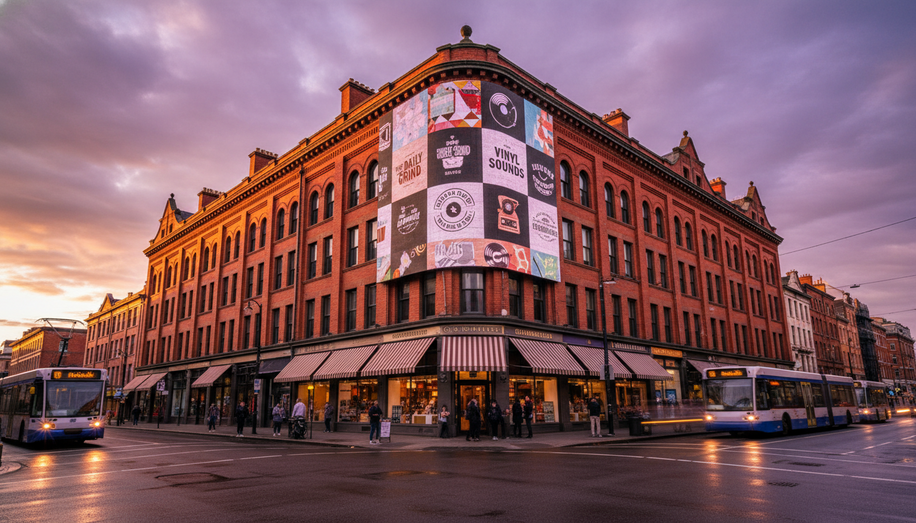

On a muggy July afternoon in downtown Atlanta, a digital billboard outside a neighborhood grocery doesn’t just advertise a national soda brand. It flashes a countdown to the local high school’s homecoming game, promotes a nearby block party, and features first names of loyalty-app users who live within a mile. The creative is tied to a tight geofence around the store and the school’s stadium. Foot traffic data later shows a measurable lift on game days. This is hyperlocal out-of-home in action—proximity-based, community-aware, and increasingly central to how brands earn attention in specific neighborhoods rather than across broad markets.
Hyperlocal OOH campaigns hinge on precision: not just who you’re reaching, but exactly where and when. Instead of treating a city as a monolithic DMA, planners are slicing it into micro-zones—corridors around transit hubs, clusters of streets near clinics, gyms, schools, or cultural venues. The aim is to match messaging to the lived reality of the people who pass a given screen or poster every day. That often starts with building tight geofences, sometimes as narrow as 1,000–1,500 feet around high-traffic locations, and layering in mobility and demographic data to understand who is actually moving through that radius.
This proximity layer allows advertisers to anchor campaigns around community rituals: farmer’s markets, school drop-off times, religious services, payday patterns, and evening commutes. A pharmacy chain can serve flu-shot reminders on digital street furniture within walking distance of suburban clinics during weekday mornings, while a QSR brand can use the same network to push limited-time offers to late-night commuters near transit nodes. Timing is as local as geography. Dayparting—changing creative by hour or day—turns static locations into dynamic neighborhood touchpoints, with breakfast messages for early risers, lunch prompts for office workers, and “see you tomorrow” copy after store close.
What distinguishes impactful hyperlocal OOH from mere geo-precision is the way creative taps into community identity. Local references matter. Campaigns that mention neighborhood nicknames, highlight nearby landmarks, or reference local sports teams tend to feel less like generic advertising and more like a familiar voice. Operators and agencies are encouraging brands to co-create creative with neighborhood stakeholders: featuring local artists’ work on digital billboards, spotlighting community events, or using vernacular language that residents actually use. For national advertisers, this can mean versioning a master concept into dozens of locally inflected executions—an investment that often pays off in both recall and goodwill.
Digital screens amplify this effect by enabling responsive, real-time hyperlocal storytelling. Weather triggers can swap in “cool down nearby” copy during heatwaves or “warm up here” on cold nights, directly tied to a nearby coffee shop or convenience store. Event-based triggers allow screens within a set radius of a stadium or festival to pivot their content as crowds arrive or disperse. Some campaigns even integrate user-generated content—photos tagged within a geofence or check-ins on social platforms—subject to brand safety controls. The result is an OOH presence that feels less like a billboard and more like a live feed from the neighborhood itself.
Crucially, hyperlocal OOH doesn’t operate in a vacuum. The most effective campaigns treat the physical touchpoint as the anchor of an ecosystem that includes local search, social media, and mobile. A passerby who sees a hyperlocal poster for a new bakery in their block may immediately search the brand; if the bakery’s Google Business Profile, Yelp listing, and location-specific landing page are optimized and consistent, the OOH impression converts into a digital journey. Conversely, mobile ads can retarget people who were exposed to a specific panel or screen, reinforcing the message with offers valid only at that neighborhood location. In many markets, advertisers are extending this loop into hyperlocal platforms like Nextdoor or Waze, turning brand presence on the street into conversations in local feeds and directions in navigation apps.
Measurement is evolving to keep pace with this granularity. Rather than relying solely on modeled impressions, planners are increasingly using aggregated, privacy-compliant mobility data to estimate visits to stores within a geofence before, during, and after a campaign. Coupon redemptions tied to specific creatives, QR scans from individual frames, and localized web-traffic spikes provide further signals. The goal isn’t just to prove that a billboard on a certain corner was seen, but that it helped drive engagement in that specific neighborhood—more diners at the local franchise, higher attendance at a community event, or repeat visits from existing customers.
With more power to micro-target comes a heightened responsibility to respect the communities being addressed. Hyperlocal OOH that lands well tends to be additive: it promotes local causes, supports small businesses, and reflects the diversity of the people it’s talking to. Some brands are reserving screen time for local nonprofits near their stores or giving space to public-service messaging during emergencies, recognizing that credibility in a neighborhood is earned over time. Others are using OOH to communicate sustainability initiatives or hiring drives specific to that community, demonstrating that proximity isn’t just a media tactic but a commitment to being present.
As OOH networks become more programmatic and data-rich, the temptation is to view hyperlocal simply as another optimization lever. Yet the campaigns that stand out are those that treat proximity as an invitation to engage—with nuance, cultural sensitivity, and a genuine interest in what makes each neighborhood distinct. A well-placed, well-timed message on the right street corner can do more than drive a single visit; it can help a brand become part of the fabric of everyday life in that community.