
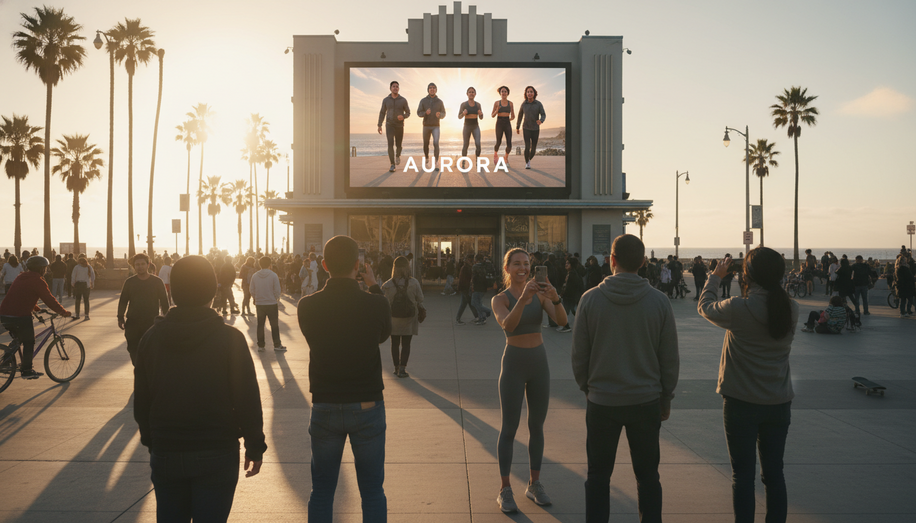

As performance marketing costs climb and cookie-based targeting erodes, direct-to-consumer brands are rediscovering an old medium with new teeth: out-of-home advertising. Once seen as a blunt awareness tool, billboards, transit shelters, kiosks, and digital place-based screens are now quietly powering acquisition funnels, driving web traffic, and making digital media work harder for growth-minded DTC marketers.
The shift is partly economic. Social CPMs have surged and attribution has become murkier after privacy updates from Apple and Google. DTC brands built on precise digital targeting are finding that an extra dollar on paid social simply does not stretch as far as it did five years ago. OOH, by contrast, offers high-impact reach, relative price stability, and increasing measurability thanks to mobile location data and digital screens that can be bought programmatically.
For emerging DTC brands, the first strategic opportunity lies in reframing OOH as a performance channel, not just a brand play. That starts with location. Instead of buying generic high-traffic boards, marketers are zeroing in on “high-intent” environments: neighborhoods with dense clusters of existing customers, key retail partners, or category-relevant behaviors. A cookware brand can surround grocery stores and urban food districts; an athleisure label can target gym corridors, running routes, and commuter hubs. Case studies from DTC brands using EV charging stations, for example, show how format plus context matter: long dwell times in parking lots have translated into meaningful lifts in website visits and conversions when QR codes and clear calls to action are present.
The second shift is creative discipline. OOH forces ruthless simplicity. People are moving, glancing up for a second or two at most. The DTC brands that win treat OOH creative as a visual hook that pushes customers to a mobile action, not as a full funnel pitch. That means a striking image, a single sharp line of copy, and a URL or QR code that feels worth scanning. Overloading a board with multiple offers and product benefits may satisfy internal stakeholders, but it kills real-world performance. Data from OOH platforms consistently shows that the best-performing creatives are bold, legible at distance, and anchored to one clear outcome: “Scan for 20% off your first order,” “Try the pan that broke the internet,” or “Sleep better in 3 nights or your money back.”
To make OOH work in a competitive digital landscape, DTC marketers are increasingly connecting offline impressions to online behavior using first-party data. Brands with robust CRM programs can upload customer segments to OOH partners, mapping where their most valuable buyers live, commute, and shop. Campaigns are then planned to saturate those high-value corridors while conquesting lookalike areas. After the campaign, mobility data and web analytics help reveal uplift in site visits, store locator usage, and conversions from exposed geos compared with control regions. Rather than relying solely on modeled reach and frequency, marketers are tracking changes in cost per visit and cost per acquisition attributable to OOH.
This data-driven approach is also changing how brands think about timing. OOH no longer needs to be a three-month brand flight locked in six months ahead. Digital out-of-home inventory can be turned on and off around product drops, paydays, or seasonal peaks, and scheduled by daypart. A skincare brand can run heavier in the evenings near pharmacies and beauty retailers; a meal kit company can dominate commute routes on Sundays and Mondays when weekly planning happens. When synced with digital campaigns—retargeting devices seen near OOH placements with social or search ads—brands build what some practitioners call “OOH plus one”: a real-world impression reinforced by a digital touch, dramatically increasing recall and response.
Measurement remains a sticking point, but it is improving rapidly. Beyond simple brand lift surveys, DTC advertisers are using a suite of KPIs that mirror their digital dashboards. Foot traffic increases at pop-ups or retail partners near OOH placements, spikes in direct and organic traffic from exposed markets, QR scan volume, promo code redemption, and social chatter around specific creatives all feed into effectiveness assessments. Aggregated and anonymized mobile location data provides visit-lift metrics: how much more likely someone exposed to the campaign was to visit a site or store than someone who was not. While not as deterministic as last-click attribution, these methods are becoming robust enough for performance-minded CFOs.
For challenger brands facing incumbents with deeper pockets, OOH can act as a credibility amplifier. Seeing a DTC logo on a massive roadside board or dominating a subway station confers a sense of scale and permanence that no Instagram ad can match. That perception matters when asking consumers to try a new mattress, cookware line, or financial app. The most sophisticated brands lean into this by integrating OOH into PR and social strategies: using stunts, witty creative, or interactive installations that people photograph and share. OOH becomes not just media, but content—fuel for earned impressions.
The final strategic layer is budget integration. OOH should not be an afterthought funded by leftover dollars. Brands that see outsized returns typically treat OOH as a core channel and set clear, quantifiable objectives upfront: raise unaided awareness by a certain percentage in a key city, lower blended CAC in targeted markets, or accelerate payback periods on customer acquisition. They run geo-based experiments, launching in a few markets while holding others as controls, then shifting spend based on results. Over time, OOH becomes a lever they can pull to stabilize CAC when digital platforms get more expensive or less predictable.
In a world where digital performance alone no longer guarantees growth, DTC brands that ignore OOH are leaving both attention and efficiency on the table. By pairing the medium’s mass reach with the precision of first-party data, disciplined creative, and rigorous measurement, marketers can move beyond the buzz and turn out-of-home into a reliable engine for awareness, traffic, and customer acquisition.