
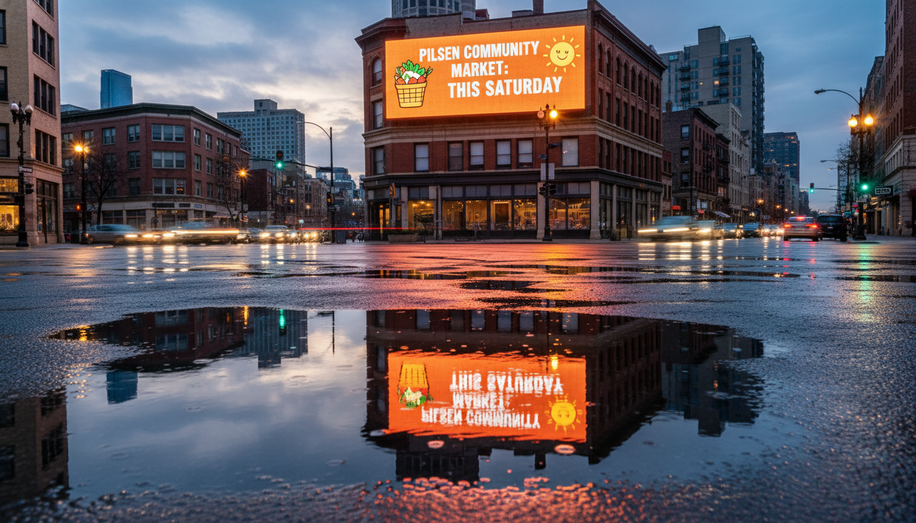

At rush hour on a downtown corner, two billboards stand side by side. One pushes a generic “summer savings” message to anyone passing through. The other features a local streetball legend, a nearby court, and a QR code to sign up for a neighborhood tournament sponsored by a sportswear brand. Both reach hundreds of people. Only one feels like it belongs there.
That is the promise of micro-targeted out-of-home: moving beyond broad urban, suburban, or rural buckets to speak directly to the lived reality of specific blocks, cultural enclaves, and community pockets. As brands chase relevance in an increasingly fragmented media landscape, OOH is evolving from blunt instrument to precision tool, powered by data, context, and a deeper understanding of place.
The first shift is conceptual. Traditional OOH plans often think in terms of coverage—how many impressions across how large a geography. Micro-targeting instead begins with community definition: Who actually lives, works, or lingers in this specific radius? What are their daily routines, their cultural touchpoints, their unspoken rules? A two-block stretch in a “young professional” neighborhood might contain a Latino grocery that anchors one micro-community, a queer-friendly café serving another, and a mosque drawing yet another. A single “millennial urbanites” message will miss all three.
To get granular, planners are leaning heavily on geospatial data and mobility analytics. Anonymized mobile location data, transit card swipes, and point-of-interest clustering can reveal patterns far more nuanced than census tracts or ZIP codes. Instead of “Downtown,” a brand might see a lunchtime cluster of hospital workers on three streets, a late-night concentration of gig workers along a rideshare corridor, or weekend surges of families around a playground. Add in weather, event schedules, and retail footfall, and a static map turns into a living portrait of how micro-communities actually move.
But data alone does not make a campaign feel local; creative does. The most compelling micro-targeted OOH work borrows from hyperlocal journalism. It references landmarks people see every day, uses the language they actually speak, and reflects the pride and tensions of the neighborhood. A health campaign aimed at new parents in a high-trust environment like a pediatric clinic waiting room reads very differently from one aimed at night-shift warehouse workers along a freight corridor, even if the core message is identical. One might lean into gentle reassurance and family imagery; the other might emphasize convenience, late-night services, or cost.
Cultural nuance is especially critical in ethnic enclaves and subcultural pockets. In a Little Ethiopia corridor, a bank promoting small business services might feature local restaurant owners, use Amharic copy alongside English, and reference community festivals. In a skatepark’s vicinity, a brand targeting young skaters will resonate more by sponsoring a local contest and featuring neighborhood skaters’ faces on digital panels than by pushing a generic youth message. Here, brands are increasingly partnering with micro-influencers and “local heroes”—artists, athletes, activists—who hold real credibility within that micro-community.
Format choice is another lever. Static panels remain powerful for anchoring long-term neighborhood presence, but digital OOH enables layers of micro-targeting that go beyond geography. Time-of-day and day-of-week sequencing let advertisers mirror local rhythms: language-school promotions on bus shelters when students commute, health messaging near clinics during appointment windows, community event promotion in the days leading up to a festival. Dynamic creative can swap visuals based on weather, game days for beloved local teams, or transit disruptions that change traffic flows on a specific corner.
Social and mobile integrations are bridging the gap between physical and digital micro-communities. Instagram campaigns targeted at niche interests—retro gamers, plant parents, trail runners—can be mirrored in OOH placements where those communities congregate in the real world. A retro gaming brand might run carousel ads online while wrapping the arcade bar and adjacent transit shelter with creative that echoes the same 8-bit aesthetic, turning a city block into an extension of a niche digital feed. QR codes, NFC tags, and short URLs allow the physical message to feed data back into digital retargeting, closing a loop between specific locations and specific interest groups.
For all its data-driven sophistication, micro-targeted OOH still depends on old-fashioned fieldwork. Walking the neighborhood, talking to local business owners, attending a community event—these observations can prevent missteps that algorithms miss. A location that looks perfect on a heat map might sit in the shadow of a controversial development project, making a luxury housing ad tone-deaf. A park that spikes with weekend foot traffic might host mostly youth sports leagues whose parents have very different needs than the demographic profile suggests. The best plans combine hard data with lived insight.
Measurement is evolving to keep pace. Instead of evaluating success solely on reach and frequency, micro-targeted OOH campaigns are judged on depth: uplift in store visits within a few blocks, increases in localized search volume, QR scan rates, or engagement from specific zip-plus-four areas. Brands are running A/B tests between broad city-wide messaging and hyperlocal creative to quantify the lift in awareness, consideration, and conversions within micro-communities. Early evidence suggests that while the addressable audience is smaller, engagement and conversion rates are significantly higher, improving return on media spend.
There are ethical considerations, too. The more granular the targeting, the more important it becomes to respect privacy and avoid exploitative messaging. Sensitive categories—health, financial hardship, immigration status—require discretion, particularly when campaigns are aimed at vulnerable groups in defined geographies. Transparent data practices, adherence to industry standards, and a focus on providing genuine value to communities are essential to maintaining trust.
For OOH practitioners, the pivot to micro-targeting is less about abandoning mass reach than about layering precision on top of it. Broad campaigns will still build brand fame; hyperlocal efforts will deepen relevance. The opportunity lies in orchestrating both: a national creative platform that flexes at the neighborhood level, a regional buy that includes tactical executions tailored to specific corridors, a city-wide presence punctuated by block-by-block storytelling.
On that downtown corner, the generic billboard and the hyperlocal one will continue to coexist. But as brands, agencies, and media owners embrace geospatial intelligence, cultural nuance, and community partnerships, the future of OOH is more likely to look like the latter: not just on the way to somewhere else, but firmly rooted on the block where it stands.
Achieving this level of precision demands robust technological support. Platforms like Blindspot empower advertisers with the location intelligence, audience analytics, and programmatic DOOH capabilities to pinpoint micro-communities, deliver dynamically relevant creative, and measure localized ROI with unprecedented accuracy, ensuring every impression truly resonates. Learn how to transform your OOH strategy at https://seeblindspot.com/