
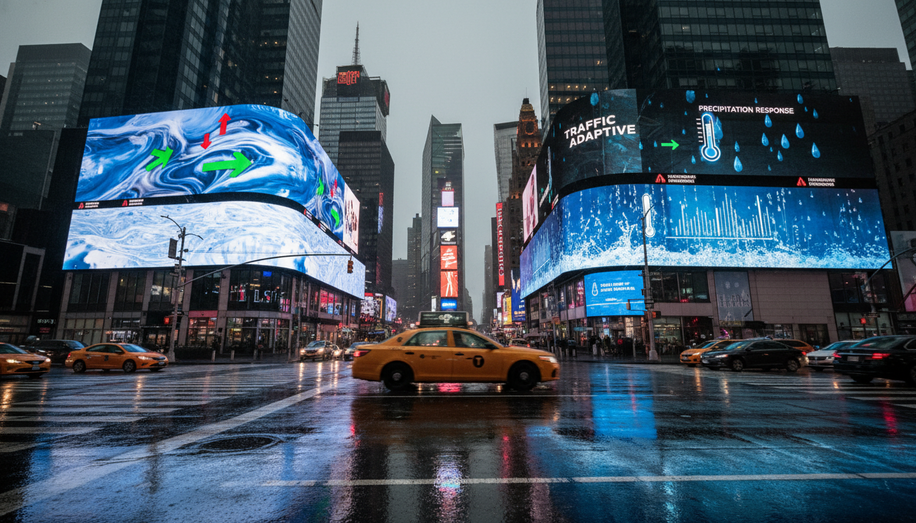

Rush-hour commuters in a sudden downpour glance up to see umbrellas and hot coffee steaming across digital billboards. An hour later, as the clouds clear, those same screens flip to sunglasses and iced drinks. This is not just clever creative rotation; it is a glimpse of how real-time data is transforming out-of-home into a dynamic, addressable medium that behaves more like the web than a static poster on a wall.
For years, OOH success depended on smart placement and broad demographic assumptions. Now, digital OOH (DOOH) and programmatic DOOH are recasting the medium as a live, data-driven canvas. Screens respond not only to who is nearby, but also to what is happening around them: weather shifts, traffic patterns, sports scores, inventory levels, even breaking news. The result is a new era of responsive campaigns where creative, messaging and even ad delivery can adapt moment by moment.
At the heart of this evolution is the fusion of location intelligence and real-time data feeds. Audience demographics, mobility patterns and dwell time inform which panels are most likely to deliver a brand’s desired impressions. Mobile location data and geospatial platforms allow planners to score inventory, simulate coverage and avoid wasteful overlap. Instead of buying “a busy junction,” advertisers can buy against a quantified flow of their priority audience segments at specific hours of the day, and then layer environmental triggers on top.
Weather is the most obvious and widely adopted signal. Because it changes frequently and has a direct impact on consumer needs, it’s a natural driver of dynamic creative. Quick-service restaurants can pivot from promoting soups to smoothies as temperatures rise. Apparel brands can spotlight raincoats when storms roll in and sandals when the sun comes out. According to industry surveys, consumers not only notice this contextual shift, they find it more helpful and relevant than generic messaging. DOOH’s ability to ingest live meteorological data and update creative in real time makes these campaigns both efficient and intuitive.
Traffic and mobility data add another layer of responsiveness. Roadside digital billboards can adjust messaging based on congestion levels, average speed or even route disruptions. A rideshare platform might push “Beat the jam” creative when traffic slows to a crawl, while an entertainment brand could extend teaser content when dwell time is higher at busy intersections. Inside transit hubs, passenger volume, flight delays and platform crowding can guide dayparted messaging to match traveler mindset and stress levels.
The same principles apply to news and live events. Real-time sports scores on nearby screens can be paired with tactical brand messages: a food delivery service offering celebratory deals after a home-team win, or a sportswear brand reacting to a star player’s standout performance. Concerts, festivals and cultural events can trigger location-specific creative that acknowledges what audiences are experiencing at that very moment. The screen becomes less of a static poster and more of a live participant in the local narrative.
Programmatic pipes and Dynamic Creative Optimization (DCO) are what make this responsiveness scalable. With DCO, creatives are modular: images, copy and offers can be swapped automatically based on the data signals configured in advance. Brands define decision trees or AI-driven rules that determine which combination appears when particular conditions are met. A grocery retailer, for example, can link its DOOH campaign to real-time product availability and sales trends, promoting items that are actually in stock and performing strongly in that specific region. The creative logic is set once, but the output is continuously refreshed as the data changes.
Crucially, the same data infrastructure powering responsive campaigns is also elevating measurement. Sensors, mobile data and geolocation technologies enable more accurate impression counts tied to actual audience presence rather than static traffic estimates. Advertisers can see not just how many people passed a screen, but how many of those exposed later visited a store, opened an app or completed a purchase. Proof-of-play platforms verify that the correct creative ran at the correct times and locations, while attribution providers deliver footfall lift analysis in the weeks following a campaign. The effect is to bring OOH much closer to the accountability standards of digital channels.
For agencies and brands, this data-rich environment is reshaping planning and budgeting. OOH is increasingly bought as part of an omnichannel strategy, with exposure to a screen triggering retargeting on mobile or connected TV. Real-time dashboards allow marketers to monitor impressions, reach and performance while a campaign is live and tweak their approach on the fly. Underperforming screens can be dropped; high-intent zones can receive additional budget; creative variants can be A/B tested and optimized mid-flight rather than after the fact.
Yet the shift to real-time responsiveness is not just a technological challenge; it is a creative and operational one. Teams need to develop flexible creative frameworks that can accommodate multiple data-driven variations without diluting brand consistency. Legal and compliance processes must be agile enough to approve dynamic rules and content updates. Privacy is another critical consideration: while OOH increasingly leans on mobile and location data, the industry relies on aggregated, anonymized datasets and strict safeguards to ensure individuals are not personally identifiable.
The opportunity, however, is profound. As cities become smarter and more connected, OOH inventory is evolving from static placements into an intelligent layer woven into the urban fabric. Screens that once broadcast the same message to everyone can now reflect the zeitgeist of a neighborhood in real time, reacting to the rhythms of weather, traffic and culture. For marketers, this means the chance to speak to people at precisely the right moment with the right message, in a way that feels less like advertising and more like timely information.
In this new landscape, the most successful OOH campaigns will not be the ones that shout the loudest, but the ones that listen the best. By harnessing real-time data, brands can turn the physical world into a responsive storytelling platform—one where every screen is a dynamic canvas, and relevance is updated as frequently as the world outside.