
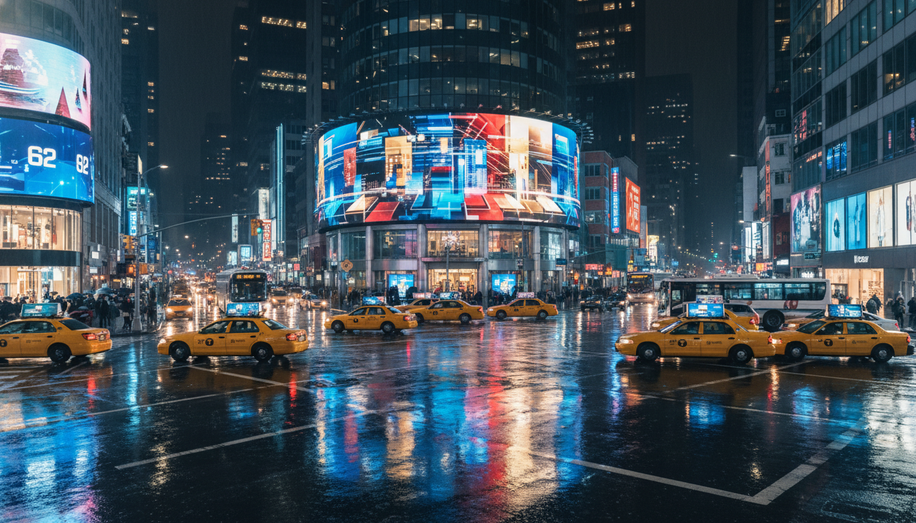

Out-of-home advertising has long been the steady percussion in the media mix: ever-present, hard to ignore, and reliably beating out impressions in high-traffic environments. But in a fragmented media landscape where consumers shuttle between screens and spaces in seconds, OOH is no longer just background rhythm. When integrated intelligently with digital, social, TV, and radio, it becomes the conductor—amplifying every other channel and creating a true symphony of media.
At its core, OOH delivers what digital platforms increasingly struggle to guarantee: broad, real-world reach with high viewability and low fraud. Billboards, transit shelters, street furniture, and digital screens in public spaces command attention in heavily frequented areas. That presence doesn’t exist in isolation; it sets the stage for the rest of the media plan. Industry research consistently shows that adding OOH to a campaign lifts the performance of online channels, with some studies citing double-digit increases in the effectiveness of online display, paid social, and search when OOH is in the mix. The reason is simple: once a brand is made “famous in the real world,” every subsequent impression across other media feels more credible and familiar.
The most obvious and increasingly sophisticated pairing is OOH with digital. OOH typically delivers the first, high-impact contact: a bold, simple message that cuts through the noise of the street. Digital then takes over to deepen the story, personalize offers, and drive measurable action. QR codes, custom URLs, and short memorable domains now act as bridges from physical surfaces to mobile screens. Mobile retargeting can identify devices exposed to specific OOH locations and serve follow-up creative, ensuring that the audience who saw a billboard on their commute later encounters aligned messaging on their phone or laptop. When timing and messaging are synchronized, this creates an omnipresent brand experience—on the highway, on the sidewalk, and inside the feed.
Social media supercharges that effect by turning OOH into shareable content. An arresting mural, a clever digital board, or a stunt in an iconic location doesn’t just reach the people physically nearby; it invites them to become distributors. Surveys show that a significant portion of adults report sharing OOH ads on social platforms at least occasionally, and nearly half say OOH influences their decision to follow brands online. Hashtags, social handles, and clear engagement prompts on OOH placements encourage user-generated content, while social listening tools allow marketers to monitor sentiment and conversation in real time. The result is a feedback loop: OOH sparks social chatter, social amplifies the OOH creative far beyond its physical footprint, and those online interactions inform how the campaign evolves in both environments.
Digital OOH (DOOH) makes this interplay even more dynamic. Programmatic buying, dayparting, and context-responsive creative let brands align DOOH messaging with trending topics or local conditions, then mirror or extend those messages instantly on social. A weather-triggered DOOH spot for iced coffee can be paired with geo-targeted social ads in the same neighborhood. A countdown to a product launch on a city-center screen can climax alongside a social reveal, flooding both the physical and digital spheres simultaneously. The screen on the street becomes one node in a coordinated, cross-platform storytelling arc.
Television, still a powerhouse for reach and emotional storytelling, finds a natural ally in OOH. TV can introduce complex narratives, characters, and brand worlds; OOH then reinforces those stories with simple, iconic visuals in the real world. This extends the life and frequency of TV campaigns without the cost of additional GRPs. A viewer who has seen a TV commercial multiple times experiences a sense of fluency and trust when encountering the same brand promise on a large-format billboard or transit wrap. OOH also localizes national TV efforts, allowing marketers to tailor copy or offers by city, neighborhood, or even specific venues while maintaining a consistent visual identity. When a big TV flight is accompanied by a visible OOH presence, the campaign feels bigger than the media spend alone would suggest.
Radio and OOH, both sometimes labeled “traditional,” are in fact one of the most potent combinations for modern campaigns. Radio excels at intimacy and detail: voices, music, and sound design convey nuance, promotions, and calls to action during drives, work, or at home. OOH complements that with unmissable visuals anchored in the same daily journeys. Research from organizations like the Advertising Research Foundation indicates that campaigns using radio and OOH together can achieve significantly higher recall than single-channel efforts. The multisensory effect is critical: hearing an offer on the radio while also seeing a billboard along the same commute creates layered memory traces. Moreover, radio and OOH often reach slightly different segments and dayparts, so their combined coverage boosts overall reach and frequency more efficiently than doubling down on either alone.
Underpinning all these synergies is a strategic shift: treating OOH not as a standalone buy but as the structural backbone of a holistic media plan. That means aligning creative across channels so that each touchpoint feels like a movement in the same composition. OOH introduces or anchors the core idea; TV and video bring emotional weight; radio and audio deliver detail and repetition; digital and social provide interactivity and personalization. Timing matters as much as messaging. Launching OOH and online campaigns together amplifies impact, especially around key moments such as product launches, events, or seasonal spikes. Staggered waves can then use OOH to maintain presence while digital budgets flex to chase performance.
Measurement, once a weak spot for OOH, has also evolved in ways that make integration more actionable. Location data, mobile panels, and attribution models now allow marketers to correlate OOH exposure with online behavior—from website visits and app installs to search queries and store footfall. These insights close the loop: brands can identify which OOH locations and creative variants most effectively lift digital engagement or drive sales, then reallocate spend and refine messaging across the entire channel mix.
As media consumption patterns continue to blur, the campaigns that stand out are those that feel cohesive from street corner to smartphone screen. OOH’s physical presence, credibility, and broad reach make it uniquely suited to serve as the throughline in that experience—a constant visual anchor that amplifies the impact of every other medium. When planners think of OOH not as an add-on but as a central instrument in a carefully orchestrated ensemble, the result is more than incremental lift. It is a genuine symphony of channels, with OOH ensuring the whole is far greater than the sum of its parts.