
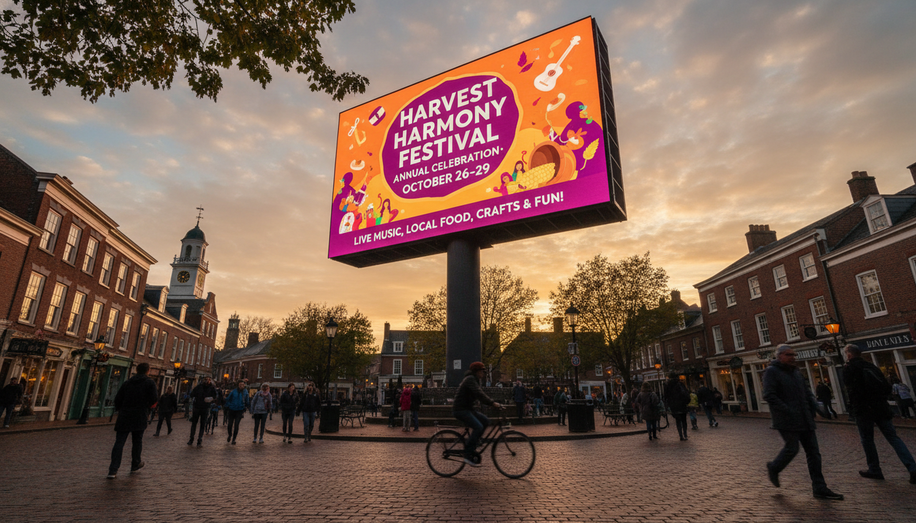

For years, out-of-home advertising has been associated with the visual noise and scale of mega-cities: the dense billboard corridors, transit hubs, airport concourses and digital spectaculars that define a high-traffic urban market. But the next phase of OOH growth may be unfolding elsewhere. In tier 2 and tier 3 cities, where media saturation is often lower and local identity runs stronger, OOH is finding room to do what it does best: become part of the everyday landscape while delivering measurable commercial impact.
That shift matters because mid-sized markets are changing quickly. Regional cities are adding population, retail development, healthcare infrastructure, education hubs and new entertainment districts. As these places expand, so does the need for brands to connect with audiences in the rhythms of daily life, whether that means the route to work, the school run, the shopping district or the highway connecting neighboring towns. OOH is uniquely suited to these environments because it meets people where they already are, not where algorithms decide they should be.
In smaller urban markets, one of OOH’s greatest advantages is visibility without clutter. In major metros, advertisers are often competing for attention in an environment crowded with messages. In a tier 2 city, a well-placed roadside billboard, transit shelter, retail display or municipal screen can dominate its immediate surroundings. That does not just increase reach; it increases memorability. When fewer brands are fighting for the same mental real estate, each impression carries more weight. For local businesses, that can translate into faster recognition and stronger top-of-mind awareness. For national brands, it offers a way to build familiarity in markets that may otherwise be underserved by broad media plans.
Community engagement is another reason OOH is gaining strategic relevance beyond the largest cities. In mid-sized markets, residents often have a closer relationship with the places they live, shop and gather. Local sports teams, festivals, public transit systems, retail corridors and civic events can all become meaningful media environments because they are embedded in shared community life. A campaign that reflects local landmarks, neighborhood pride or seasonal routines can feel less like advertising and more like participation in the city’s identity. That kind of resonance is difficult to replicate in digital channels alone, especially when targeting is separated from physical context.
This local connection also makes OOH a practical tool for brands looking to build trust. Outdoor placements are visible, public and hard to ignore, which gives them a credibility that can be especially valuable in markets where consumers prefer familiar, established businesses. A strong OOH presence can signal permanence and legitimacy, particularly for newer entrants in banking, telecom, healthcare, education and retail. In cities where word-of-mouth still carries significant influence, that public proof can support both brand reputation and consideration.
The economics of tier 2 and tier 3 markets also make them attractive. Media costs are often lower than in the country’s largest urban centers, but the opportunity to build scale can still be substantial because populations are concentrated and commuter patterns are predictable. A campaign can achieve efficient frequency without the same level of spend required in a mega-city. For regional advertisers, that opens the door to broader visibility. For national advertisers, it creates a way to stretch budgets while maintaining geographic relevance. OOH’s ability to work with local density, rather than only with massive urban scale, is one of the reasons it fits so well in these markets.
Digital out-of-home is amplifying that opportunity. Programmatic buying, dynamic creative and data-informed site selection are making it easier to tailor messages to local conditions, from weather and traffic to retail activity and event calendars. In tier 2 and 3 cities, this flexibility can be especially powerful because it allows campaigns to stay relevant to smaller, more defined audiences without losing the speed and adaptability that modern marketers expect. A message promoting a store opening, a weekend sale or a regional service launch can be updated quickly and distributed across the exact set of locations that matter.
What is changing most is the perception of what counts as a high-value OOH market. The future is not only in the largest skylines and busiest interchanges. It is also in the arterial roads, district centers, commuter routes and commercial clusters of growing regional cities. These are places where people are building routines, businesses are expanding and communities are still forming strong habits around local spaces. OOH thrives in that environment because it is both public and proximate, both scalable and rooted.
As advertisers look for growth beyond oversaturated metros, tier 2 and tier 3 markets are no longer the backup plan. They are becoming a strategic frontier, offering a blend of community connection, cost efficiency and visible impact that digital channels alone cannot match. For brands willing to think beyond the mega-city, the opportunity is not just to be seen, but to become part of the local fabric.