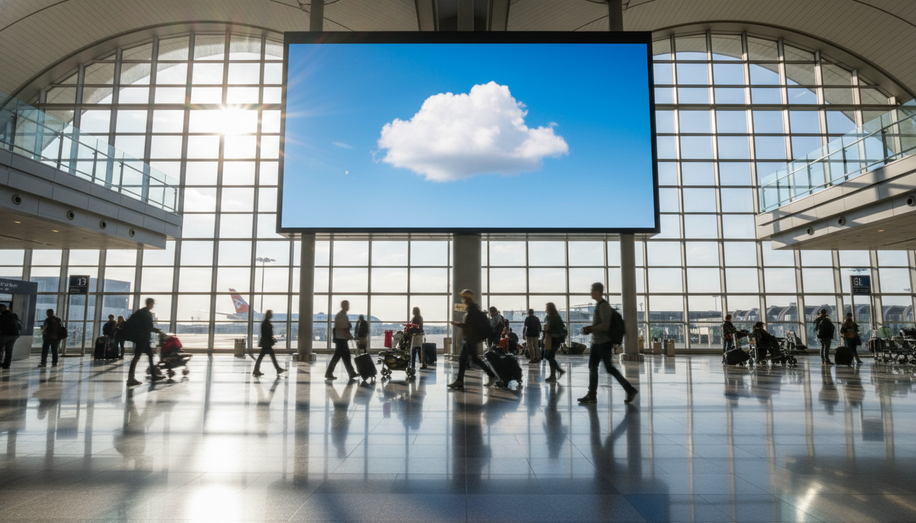

In the fast-paced world of out-of-home (OOH) advertising, where billboards flash by in mere seconds and commuters barely glance up from their screens, minimalism has emerged as a revolutionary force. Far from being a fleeting trend, it’s a deliberate design philosophy that strips away excess to deliver maximum impact. Brands embracing this “less is more” ethos are not just capturing attention—they’re etching their messages into the collective memory of audiences bombarded by visual noise daily. The secret lies in brevity of copy and simplicity of visuals, principles that transform fleeting exposures into lasting impressions.
Consider the cognitive overload drivers and pedestrians face on urban highways or city streets. Research from design psychology underscores that the human brain processes simple images up to 60,000 times faster than complex ones, making minimalist OOH campaigns ideally suited to this environment. Cluttered ads, packed with logos, taglines, and fine print, often blur into oblivion. In contrast, minimalist designs leverage negative space, bold typography, and singular focal points to pierce the chaos. A prime example is Apple’s iconic “Shot on iPhone” billboards, which feature a single, stunning photograph with minimal text—often just the product name and a subtle credit line. This approach doesn’t overwhelm; it invites curiosity, prompting viewers to linger mentally long after passing by.
The power of brevity in copy cannot be overstated. Effective minimalist OOH hinges on phrases that are punchy, poetic, even provocative, distilled to their essence. Take Spotify’s Wrapped campaign billboards, which boil user data into hyper-personalized snippets like “Sara listened to bad bunny 847 times this year.” Clocking in at under 10 words, these ads feel intimate and shareable, turning passive viewers into active participants who screenshot and post. Similarly, Nike’s “Just Do It” endures not despite its simplicity, but because of it—three words that encapsulate a lifestyle, rendered in stark white text against a black backdrop. Data from OOH analytics firms like True Impact Media reveals that such concise copy boosts recall rates by up to 40%, as the brain effortlessly decodes and retains the core message without distraction.
Visual simplicity amplifies this effect, adhering to core design tenets like hierarchy, contrast, and whitespace. Minimalist OOH eschews layered graphics for clean lines, monochromatic palettes, or a single evocative image that symbolizes the brand. Luxury watchmaker Omega’s campaigns exemplify this: a vast expanse of sky-blue negative space framing one elegant timepiece, with the brand name in understated elegance. No arrows, no discounts, no urgency—just pure product poetry. This restraint creates a halo of sophistication, aligning with consumer aspirations in premium categories. Billboard specialists at Whistler Billboards note that such designs perform exceptionally in high-speed contexts, where peripheral vision dominates; a cluttered ad risks being dismissed as visual spam, while simplicity ensures instant legibility from 50 meters away.
Yet minimalism’s triumph in OOH extends beyond aesthetics to strategic versatility across formats—from static billboards to digital spectaculars and transit wraps. In video-enabled OOH, like those on Times Square jumbotrons, steady, composed shots with sparse scripting maintain focus amid motion. Audio integrations, such as transit announcements, pair crisp narration with ambient sounds, never overwhelming the listener. Brands like YouTube TV have mastered this, deploying subway ads with a lone red play button against white, accompanied by a single question: “Cable-free?” The result? Higher engagement metrics, with Nielsen studies showing minimalist OOH yielding 23% better brand lift than traditional formats.
Critics might argue that minimalism risks ambiguity, leaving too much unsaid. But when executed masterfully, it sparks intrigue, encouraging deeper interaction via QR codes or social extensions. Disney+’s launch billboards, featuring one iconic character silhouette and the tagline “It’s all here,” masterfully teased without spoiling, driving app downloads and subscriptions. This calculated restraint aligns with modern consumer behavior: in an era of short attention spans—averaging 8.25 seconds per OOH exposure, per recent Geopath data—minimalism doesn’t just cut through clutter; it redefines it.
Ultimately, the art of minimalism in OOH design proves that effectiveness stems from subtraction, not addition. By focusing on what truly matters—a compelling visual hook and unforgettable copy—campaigns achieve timeless resonance. As advertising landscapes grow denser, brands that master this discipline won’t just be seen; they’ll be remembered, proving that in the high-stakes arena of OOH, less is unequivocally more for maximum impact.