
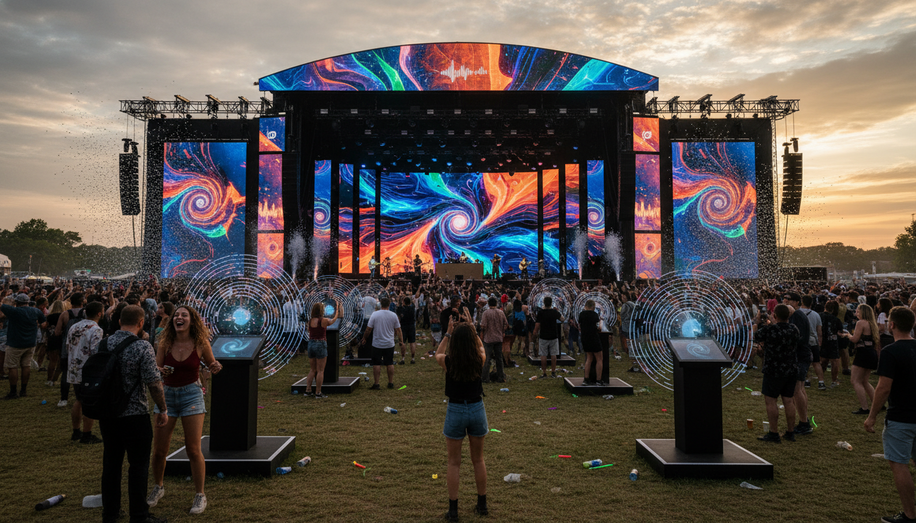

In the bustling streets of major cities, where digital screens flicker endlessly and commuters rush by, out-of-home (OOH) advertising has long served as a bold visual anchor. Yet, as consumer attention fragments across endless scrolls and skips, brands are rediscovering a potent evolution: fusing these static displays with live experiential marketing. This integration transforms passive billboards into dynamic gateways, drawing audiences into tangible brand worlds that linger far beyond a fleeting glance. Pearl Media’s recent campaigns illustrate this shift, where proximity-based OOH targeting not only boosted store visits by over 1.3 million but paired digital retargeting with on-site activations, yielding 2-3x higher engagement than isolated efforts.
The magic lies in contextual synergy. Effective strategies begin with high-visibility OOH placements timed to peak traffic—think rush-hour transit hubs or festival circuits—then layer in experiential elements that interrupt the everyday. Billups emphasizes inserting ads into the audience’s path, making them environmental fixtures rather than interruptions. A billboard teasing a pop-up installation nearby doesn’t just advertise; it invites. For instance, a beverage brand might erect a massive LED replica of its product on a downtown artery, its glowing facade synced to passing pedestrian data via Bluetooth beacons. As viewers approach, their phones buzz with an augmented reality filter, turning the static ad into a personalized scavenger hunt leading to a live tasting station. This seamless blend engages sight, sound, and touch, forging multisensory memories that static OOH alone can’t match.
Experiential activations amplify OOH’s reach through shareability. Elevate Media Services notes how these campaigns spark user-generated content, with consumers snapping selfies at interactive installations and flooding social feeds. A tech company, for example, parked custom glass trucks—transparent vehicles revealing product demos—outside conference centers, their exteriors mirroring nearby OOH murals. Passersby didn’t just see the ad; they stepped inside for hands-on trials, emerging with branded swag and Instagram posts that extended the campaign’s footprint exponentially. Data from such efforts reveals 4x more earned media and 75% higher brand recall, per Pearl Media, as participants become unwitting ambassadors. The key is cohesion: OOH creatives must telegraph the activation clearly, using QR codes or geotagged calls-to-action that bridge physical exposure to digital follow-through.
Mobile and guerrilla tactics take this integration further, injecting unpredictability into planned OOH landscapes. Lime Media highlights touring activations like branded Airstreams on college campuses during homecoming, positioned under synchronized digital billboards. These aren’t random; they’re routed via data analytics to align with audience behaviors, such as office workers near corporate parks or festival-goers at entry points. The Remnant Agency champions guerrilla extensions—flash mobs erupting beneath OOH screens or ambient projections on urban surfaces—that surprise and delight, fostering emotional bonds. A rideshare service, as profiled in The Drum, adapted OOH creatives to tentpole events, with event-tied billboards directing crowds to pop-up lounges offering free rides and branded games, seamlessly weaving the brand into the moment.
Measurement has evolved to validate these hybrids. Cross-channel attribution tracks OOH impressions to experiential footfall via mobile retargeting and geofencing, revealing 65% higher conversions. Brands leverage analytics for real-time tweaks: if social buzz spikes at one activation, amplify it with proximate OOH extensions. Sustainability adds another layer; eco-conscious installations using recycled materials resonate in 2026’s green-focused market, enhancing ROI through positive sentiment.
Challenges persist—permits, logistics, and weather can disrupt live elements—but full-service experiential partners mitigate these, handling fabrication from giant replicas to staffed pop-ups. The payoff? Deeper connections in an ad-saturated world. As Forty4 Design observes, experiential invites participation where traditional ads intrude, turning one-off views into lasting loyalty.
Ultimately, integrating OOH with experiential marketing redefines advertising as an ecosystem of encounters. Brands that master this—blending bold visuals with immersive live touchpoints—don’t just capture eyes; they capture hearts, proving that the most memorable campaigns are those consumers live, share, and remember.
Navigating this complex integration of OOH and experiential demands sophisticated tools for strategic planning and real-time validation. Blindspot empowers brands to master this ecosystem, leveraging location intelligence for optimal OOH placement and programmatic management, while providing robust ROI measurement and cross-channel attribution to validate the deeper connections forged through these immersive experiences. With Blindspot, marketers can precisely orchestrate and prove the impact of campaigns that truly capture hearts and minds. https://seeblindspot.com/