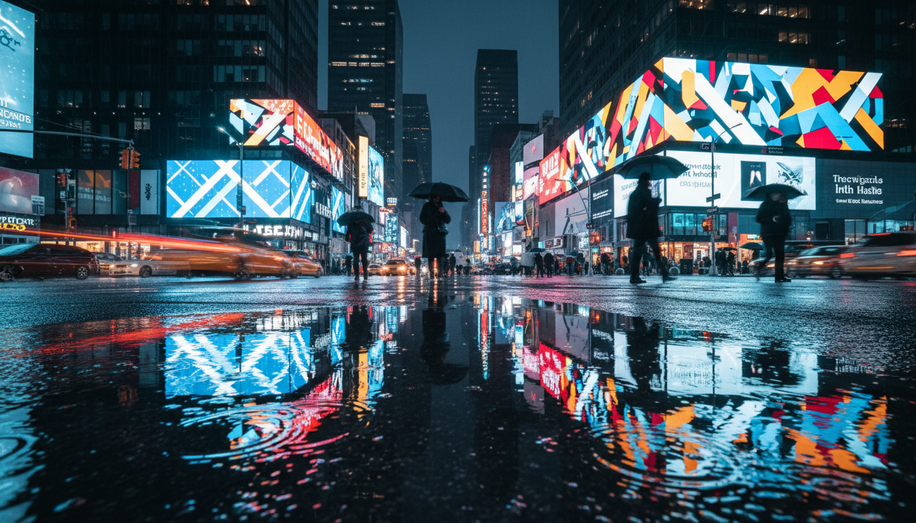

In the fleeting seconds a driver or pedestrian glances at a billboard, the human brain processes an astonishing array of visual cues, deciding almost instantly whether to engage or dismiss. This split-second judgment hinges on fundamental psychological principles like color theory, visual hierarchy, iconography, and image choice, which advertisers harness to shape perception and lodge messages into long-term memory. Far from mere aesthetics, these elements tap into innate cognitive biases, ensuring out-of-home (OOH) visuals don’t just catch the eye—they influence emotions, build trust, and drive retention in ways digital ads often can’t match.
Color theory stands as the cornerstone of effective OOH design, wielding a profound influence over mood and behavior without a single word. Red, for instance, spikes heart rates and conveys urgency, making it ideal for clearance sales or time-sensitive promotions, as it triggers the brain’s fight-or-flight response. Blue, conversely, evokes trust and reliability, a go-to for tech brands seeking to project calm professionalism amid urban chaos. Green signals health and tranquility, aligning perfectly with organic products that promise natural wellness. These associations stem from evolutionary wiring and cultural conditioning, where high-contrast color pairings further amplify attention by activating the brain’s reticular activating system (RAS), filtering out visual noise to spotlight the ad. In high-traffic environments like busy highways or city streets, such strategic hues ensure the message pierces through the sensory overload, priming subconscious associations that linger long after the viewer has passed.
Visual hierarchy orchestrates this impact by guiding the eye through a deliberate path, prioritizing information based on how the brain naturally processes visuals. Bold, oversized headlines dominate first, leveraging the primacy effect—our tendency to anchor memories to initial impressions—before subtler elements like logos or calls-to-action follow. Simplicity reigns supreme here, rooted in cognitive load theory: clutter overwhelms working memory, leading to poor recall, while sparse designs with ample white space allow quick comprehension at 60 miles per hour. High-contrast typography and strategic scaling create a funnel effect, drawing focus from the most critical message downward, much like a storyteller building suspense. This hierarchy not only boosts retention but fosters familiarity through repetition; the mere exposure effect means repeated sightings of a streamlined OOH ad breed liking and trust, transforming passive viewers into brand loyalists.
Iconography elevates this framework by distilling complex ideas into universal symbols, bypassing language barriers and accelerating recognition. Simple icons—like a checkmark for approval or an arrow for direction—exploit our brain’s preference for pattern recognition, embedding meaning in milliseconds. These visual shorthand tools draw on subliminal cues, planting emotional seeds that prime positive perceptions; a heart icon might subtly evoke affection for a charity campaign, while a flame signals excitement for energy drinks. In OOH, where exposure lasts mere seconds, icons amplify social proof too—think crowd silhouettes implying popularity, tapping into our herd mentality and fear of missing out (FOMO). Unlike verbose digital banners, these potent symbols cut through literacy divides, making campaigns globally resonant and memorable.
Image choice seals the psychological pact, forging emotional bonds that facts alone can’t achieve. Humans are hardwired to fixate on faces, especially those making eye contact, which activates mirror neurons and simulates personal connection, outperforming faceless ads by wide margins. Compelling imagery—be it a joyful family picnic or a dramatic landscape—stirs the amygdala, the brain’s emotion center, routing visuals to long-term storage via the hippocampus. Visual metaphors and storytelling take this further: a wilting flower for eco-degradation or a soaring bird for freedom narrates without narration, imprinting narratives that evoke nostalgia, happiness, or urgency. Vibrant, real-world photos outperform illustrations by stimulating sensory engagement, bridging the ad’s physical presence with viewers’ realities for deeper immersion.
Yet, the true power emerges in synthesis. A billboard blending red accents for urgency, a hierarchical headline over a gazing face, supportive icons, and an emotive image doesn’t just advertise—it engineers perception. Premium placements amplify this, linking brand credibility to desirable locales via halo effects. Studies affirm OOH’s edge: emotional visuals yield superior recall, with repetition solidifying trust in ways skippable online ads falter. As urban landscapes evolve with digital OOH screens, mastering these principles remains paramount, turning transient glances into lasting loyalty.
In an era of ad fatigue, effective OOH visuals prove there’s indeed more than meets the eye—they’re precision tools reshaping consumer minds, one calculated glance at a time.