
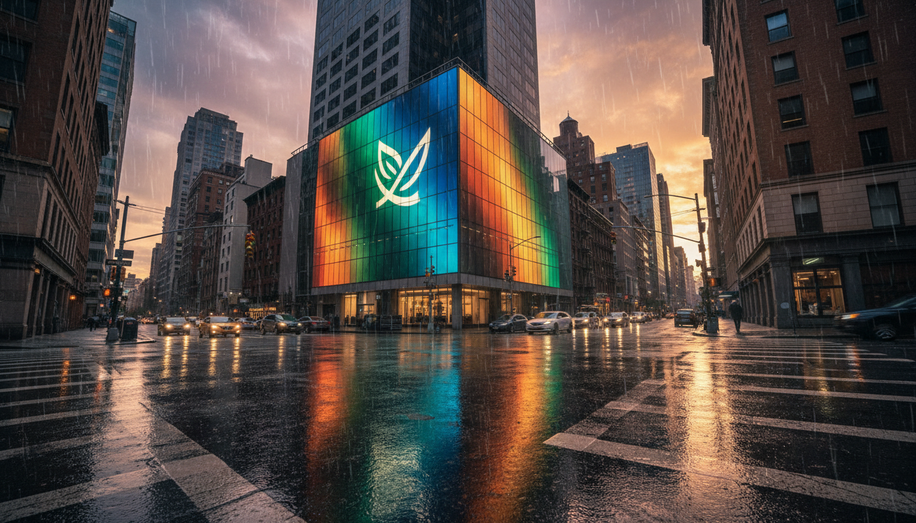

The out-of-home advertising industry stands at an inflection point. While digital screens have revolutionized the medium over the past two decades, transforming it from a static, one-dimensional channel into a dynamic platform that now represents 42% of total OOH revenue, the next frontier extends far beyond traditional display technology. The future of OOH lies in the seamless integration of advertising into the fabric of urban architecture and smart infrastructure itself, where the boundary between the built environment and branded messaging dissolves entirely.
Today’s digital out-of-home innovations already hint at this trajectory. Anamorphic creative and augmented reality experiences are inviting audiences to step directly into brand stories, while motion sensors trigger interactive animations on dynamic digital screens. Yet these remain, fundamentally, screens—distinct objects placed within environments. The emerging paradigm reimagines advertising as an intrinsic component of urban spaces themselves.
Consider smart building materials that could function as display surfaces without requiring dedicated screen installations. Imagine responsive architectural elements—façades, pavements, or street furniture—that activate contextually based on real-time data inputs. A storefront could shift its visual presence based on foot traffic patterns, time of day, or weather conditions. A building’s exterior might communicate through subtle color changes or dynamic textures rather than traditional screens, maintaining aesthetic integrity while delivering targeted messages. This approach aligns with 2026’s emphasis on context that connects without being intrusive, delivering helpful, location-aware messaging that feels relevant rather than creepy.
The integration of advertising into smart infrastructure represents another frontier. Urban environments increasingly embed sensors, connectivity, and intelligence into their physical systems. OOH advertising can leverage this infrastructure to deliver hyper-contextual experiences. Transit systems with embedded sensors could display messages synchronized to passenger flow patterns. Street-level displays could respond to air quality data or public safety information. Parking structures might showcase advertisements that adapt based on vehicle types or driver demographics. Unlike invasive location tracking, these integrations would operate within transparent, infrastructure-first frameworks that prioritize public benefit alongside commercial messaging.
Material science opens additional possibilities. Self-illuminating materials, photochromic surfaces, or programmable textiles could transform ordinary urban elements into advertising platforms. Bus shelters, bike racks, and public seating could incorporate these materials, creating a distributed network of brand touchpoints that feels organic rather than imposed. Sustainability considerations would be paramount—materials would need to balance advertising functionality with durability, environmental responsibility, and visual harmony with surrounding spaces.
Programmatic capabilities will be essential to enabling this architectural integration. As the industry prioritizes transparency and efficiency, increased adoption of programmatic buying methods will make more inventory available through advertising platforms, allowing advertisers to reserve placements in advance and manage diverse, distributed formats through unified systems. This infrastructure would need to extend from traditional digital screens to these emerging architectural integrations, creating a coherent ecosystem where a brand can orchestrate campaigns across multiple integrated formats simultaneously.
The success of these innovations depends critically on maintaining trust and respecting public space. Research indicates that 55% of people already find OOH campaigns relevant to them, and this perception is built on a foundation of content that entertains, informs, or adds value rather than intrudes. Emerging architectural integrations must honor this implicit contract. The most successful implementations will likely emphasize cultural relevance, emotional resonance, and genuine utility—advertising that feels like a natural part of the urban experience rather than an aggressive commercial imposition.
As OOH continues to evolve, the channel’s future strength will lie not in creating more sophisticated screens, but in dissolving the distinction between advertising and environment entirely. When branded messaging becomes woven into the architectural and infrastructural fabric of cities themselves, OOH transcends its current definition and becomes something more fundamental: a conversation between brands and cities that enhances urban life rather than interrupts it. This is the future beyond screens and billboards—one where advertising achieves true integration into the spaces we inhabit.