
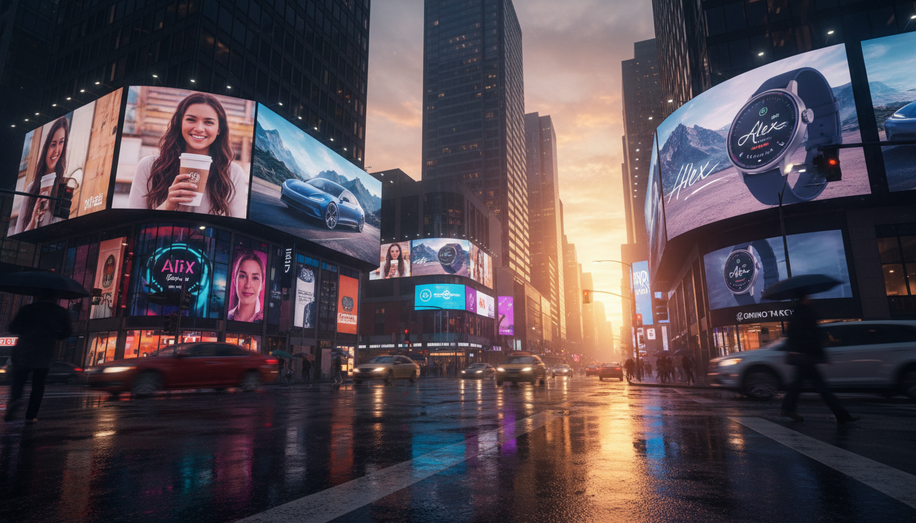

In the fast-evolving landscape of out-of-home (OOH) advertising, artificial intelligence is emerging as a game-changer, transforming static billboards into dynamic creative studios capable of generating, optimizing, and personalizing content at unprecedented speed. Once reliant on lengthy agency processes and manual iterations, OOH campaigns now leverage AI tools to bridge the gap from initial concept to real-time execution, enabling brands to deliver hyper-relevant visuals that captivate audiences on the move.
At the heart of this shift is generative AI, which empowers creators to produce tailored visuals almost instantaneously, adapting to variables like location, weather, time of day, and audience demographics. Platforms such as EMPIQ, launched by Empirical Productions specifically for OOH and experiential marketing, exemplify this capability by converting briefs into fully fleshed-out campaigns. These tools accelerate concept development, generate creative rationales backed by effectiveness data, and even provide ballpark costing and timelines, allowing agencies and in-house teams to iterate rapidly without sacrificing production realities like screen aspect ratios or location-specific constraints. For instance, DOOH.com’s mapping of the UK’s digital inventory, in partnership with JCDecaux, has demonstrated how AI can orchestrate thousands of contextual creatives for a single campaign, as seen in their award-winning Coca-Cola “Virtual Vending Machine” activation that enabled dynamic, two-way communication at scale.
Optimization takes this further, with AI analyzing vast datasets to refine visuals for maximum impact. Machine learning algorithms sift through historical performance, real-time foot traffic, environmental factors, and consumer engagement metrics to suggest design tweaks—such as color schemes, layouts, or messaging—that boost attention in seconds-long exposures. Dragonfly AI’s predictive analytics platform, for example, evaluates how creative elements perform across channels and markets, optimizing message clarity while accounting for environmental context like urban clutter or lighting conditions. This data-driven refinement extends to A/B testing, where AI enables swift comparisons of ad variants, identifying winners in real time and allowing brands to pivot instantly. StreetMetrics highlights how such insights reveal which visuals drive higher interaction, feeding back into future iterations for continuous improvement.
Personalization represents the pinnacle of AI’s influence, turning OOH from mass-market blasts into individualized conversations. By integrating mobile geolocation, social media patterns, and third-party data, AI platforms dynamically alter content to suit passing audiences. Container company PODS harnessed this for a dynamic billboard campaign that generated over 6,000 hyperlocal messages, resulting in a 60% surge in website visits and 33% more quote requests in just one week. Automaker Kia similarly deployed AI-driven ads at electric vehicle charging stations, achieving an 8% sales lift through contextually relevant creatives. Charel MacIntosh, Global Head of Business Development at Clinch, notes that AI powers “creative automation at scale,” personalizing thousands of screens effortlessly while linking exposures to outcomes like foot traffic and conversions. Programmatic buying amplifies this, automating ad deployment based on algorithms that respond to live conditions, making DOOH more agile and accountable.
From concept to execution, these AI-powered studios streamline the entire workflow. Brainstorming begins with tools that propose ideas grounded in market dynamics and audience behavior, evolving into video generation and media planning. Execution benefits from real-time performance tracking via geospatial sensors and connected devices, replacing estimate-based impressions with precise metrics on views and actions. Predictive analytics forecasts campaign resonance, optimizing inventory allocation—such as prioritizing digital billboards during peak events or adverse weather. Yet challenges persist: while genAI excels at scale, ensuring creative authenticity amid production costs and regulatory hurdles remains key, as does balancing personalization with privacy.
Brands embracing these tools are already reaping rewards. AI not only democratizes access through programmatic digital OOH (DOOH) platforms but elevates creative strategies, ensuring billboards deliver single, powerful visual punches amid urban noise. As infrastructure like smart kiosks, airport displays, and EV stations proliferates, AI’s role will deepen, fostering interactive, memorable campaigns that blend OOH’s broad reach with digital precision. The result is an industry where creativity is no longer constrained by time or budget, but amplified by intelligence, positioning OOH as a vital, future-proof channel in the marketing mix.
For brands looking to fully leverage this AI-driven evolution, platforms like Blindspot provide the essential backbone, offering real-time campaign performance tracking, precise audience measurement, and robust ROI attribution. This empowers advertisers to manage programmatic DOOH campaigns with unparalleled agility, ensuring every creative iteration is not only intelligent but also demonstrably accountable, translating exposures into measurable outcomes. Discover how at https://seeblindspot.com/