
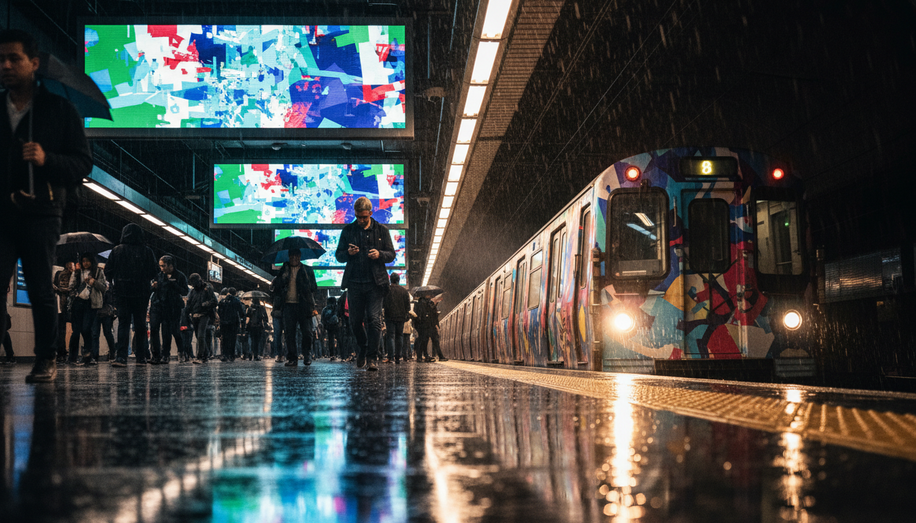

In the pulsating arteries of modern cities, transit advertising has emerged as a powerhouse for brands seeking urban dominance and deep audience engagement. As commuters and tourists navigate buses, subways, trains, and taxis, these mobile canvases deliver messages with unmatched frequency and precision, turning everyday journeys into prime advertising real estate. Valued at USD 3,962.9 million globally in 2025, the transit segment is surging at a 6.5% CAGR through 2033, outpacing broader outdoor advertising growth and underscoring its role as the fastest-expanding channel amid urbanization and digital upgrades.
Bus wraps exemplify this dynamic format’s versatility, transforming entire vehicles into rolling billboards that command attention across cityscapes. These full-body graphics, often static for sustained visibility, blanket urban routes, exposing ads to drivers, pedestrians, and passengers alike. In high-density areas, a single wrapped bus can generate millions of impressions daily, leveraging predictable paths to target specific demographics like rush-hour professionals or weekend shoppers. Brands appreciate the format’s longevity—campaigns run for months without fading impact—while recent digital integrations allow for dynamic content swaps, boosting relevance through weather-tied or event-specific messaging. For tourists, wraps on airport shuttles or sightseeing loops provide instant brand immersion, blending mobility with high dwell-time exposure.
Subway ads take this intimacy further, infiltrating the underground networks where millions converge daily. Platform posters, train interior wraps, and digital screens inside cars create a captive audience environment, with riders averaging 20-30 minutes per trip—ample time for storytelling. Predictability is key: agencies align buys with peak commuting windows, optimizing cost per thousand impressions as stations become data-rich hubs via GPS and traffic analytics. In North America, which holds 34.70% of global outdoor revenue, subway placements thrive on digitization, enabling programmatic trading for real-time bidding and hyper-local targeting. Tourists, navigating unfamiliar systems, linger longer at maps and escalators, making these spots ideal for hospitality and retail promotions that guide foot traffic directly to destinations.
Train station placements amplify reach at major interchanges, where commuters and travelers pause amid the rush. Dominating concourses, these ads—ranging from spectacular digital walls to static panels—benefit from extended dwell times upward of 60 minutes at premium hubs, rivaling airports’ affluent profiles. Modernization efforts, including LED retrofits, propel 5.88% CAGR for transit units, as connected screens feed into automated platforms for daypart pricing and audience measurement. Stations serve dual audiences seamlessly: locals gain repeated exposure for habit-forming brand recall, while tourists absorb directional messaging amid wayfinding. This format’s strength lies in its scalability, from urban rail nodes to high-speed lines, fostering urban dominance through sheer volume and reinforcement.
Taxi tops, meanwhile, offer agile, above-the-fray visibility tailored for bustling streets. These rooftop digital or static displays cut through traffic, visible to elevated vantage points like overpasses and second-story offices, while geo-targeting pins ads to neighborhood-specific routes. In a digital era, taxi-top screens rotate multiple creatives, adapting to time-of-day or events, and drive measurable lift—studies show 46% of viewers search brands post-exposure. For tourists hailing cabs from landmarks, the format delivers hyper-local endorsements, steering them toward nearby experiences. Costs vary widely—a premium airport taxi top dwarfs a suburban run—but ROI shines through mass reach and credibility, with transit’s assisted conversions amplifying digital campaigns.
Collectively, these formats harness transit’s unique benefits: massive scale, frequency capping natural repetition, and audience predictability that static roadside can’t match. Commuters, representing broad daily reach, encounter ads dozens of times weekly, embedding messages subconsciously, while tourists—affluent and exploratory—extend engagement during discovery phases. Digitization accelerates this edge, with 5.71% annual growth in digital OOH enabling interactive elements like QR codes and AR triggers, blending physical presence with online action. Programmatic pipes and data integration further refine targeting, from zip-code precision to behavioral overlays, ensuring ads resonate amid smart city expansions.
Challenges persist—static formats still dominate at 55.30% of revenue due to legacy infrastructure—but transit’s momentum is undeniable, fueled by retail growth and healthcare’s 5.08% spend uptick. Brands combining bus wraps with station digitals create omnichannel synergy, dominating skylines while engaging minds in motion. In 2026, as outdoor markets hit USD 41.62 billion, transit isn’t just advertising; it’s the engine propelling brands through urban veins, capturing attention where life accelerates. For advertisers eyeing dominance, the message is clear: go mobile, go frequent, and watch engagement soar.