

When Jared Bell first displayed large, colorful circus posters in New York City in 1835, he set in motion an advertising revolution that would transform the American landscape. These pioneering 50-square-foot advertisements marked the birth of outdoor advertising as we know it, yet the technology behind them—lithographic printing perfected in 1796—remained largely unchanged for nearly two centuries. Today, as the billboard industry stands at another technological crossroads, the medium’s evolution from paste-ups to pixels tells a story of adaptation, innovation, and an enduring commitment to capturing public attention.
The early billboard era was characterized by manual labor and entrepreneurial energy. By 1867, businesses had begun leasing billboard space, and within three years, approximately 300 sign-painting and bill-posting companies were in operation across America. This explosive growth reflected the medium’s proven effectiveness, but standardization came slowly. The industry’s real turning point arrived in 1900 when a standardized billboard structure was established, enabling national brands like Coca-Cola, Kellogg, and Palmolive to execute coordinated advertising campaigns across the country. This structural uniformity transformed billboards from local expressions into instruments of national marketing power.
For the next seven decades, the billboard remained fundamentally unchanged—a static display mounted on a standardized frame. Paint gave way to vinyl in the 1970s, improving durability and allowing for more sophisticated graphics, but the core concept remained: stationary advertisements designed to capture the attention of passersby. The medium’s effectiveness, however, was never in question. In 1975, when the Outdoor Advertising Association conducted what would become an iconic effectiveness study featuring newly crowned Miss America Shirley Cochran displayed on billboards nationwide, the results proved stunning: her name recognition soared by 940 percent. This dramatic outcome validated what advertisers had long suspected—billboards possessed an almost unmatched power to move consumer awareness.
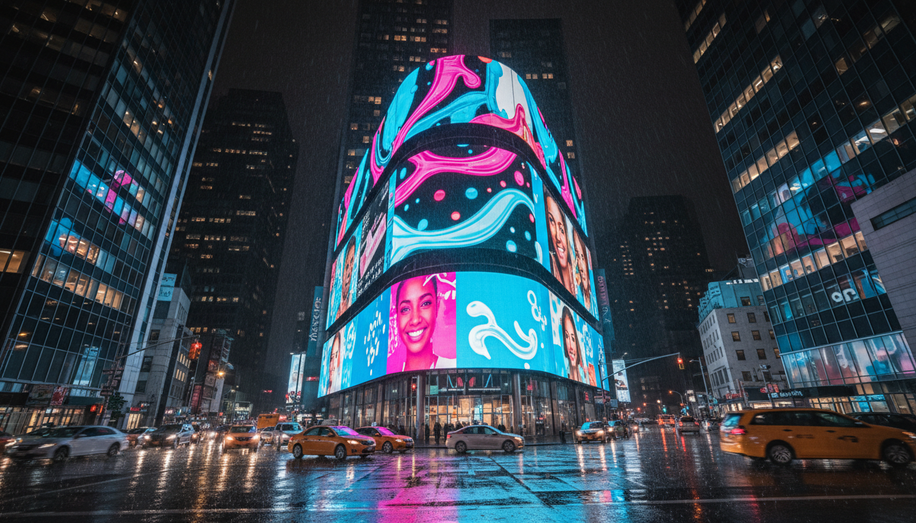
The real transformation began in the 1990s when digital technology first entered the industry. Initially, digital billboards were limited to basic LED displays and digital screens, but technological advancement accelerated rapidly. What started as a supplementary technology has become increasingly central to outdoor advertising strategy. Modern digital billboards now offer capabilities that would have seemed impossible just decades ago: real-time content updates, location-based targeting, weather-responsive advertisements, and even integration with mobile devices.
Today’s digital billboards represent a fundamental reimagining of the medium’s potential. Where traditional billboards are static statements, digital displays are dynamic conversations. Advertisers can now rotate multiple messages across a single billboard throughout the day, targeting different audiences at different times. A restaurant billboard might display breakfast promotions in the morning, lunch specials at midday, and dinner offerings in the evening—all on the same structure. This flexibility, combined with data analytics that measure viewer engagement, dwell time, and demographic patterns, has transformed billboard advertising from an art of creative placement into a science of precision targeting.
Yet this digital evolution hasn’t rendered traditional billboards obsolete. Many outdoor advertising professionals recognize that the most effective strategies often blend both technologies. Static billboards offer permanence and simplicity; they’re designed to be absorbed in seconds by drivers traveling at highway speeds. Digital billboards offer dynamism and relevance; they adapt to context and circumstance. Together, they form a more comprehensive outdoor advertising ecosystem.
As technology continues advancing, emerging innovations promise further transformation. Augmented reality-enabled billboards, programmatic purchasing systems that optimize ad placement in real time, and integration with autonomous vehicle networks represent the next frontier. Yet even as pixels replace paste-ups, the fundamental principle established by Jared Bell nearly two centuries ago endures: billboards succeed by capturing attention in unexpected places and creating memorable impressions that drive consumer behavior. The medium evolves, but its purpose remains constant—transforming public space into marketplace, one frame at a time. As the OOH landscape grows increasingly data-driven and dynamic, platforms like Blindspot are critical for navigating this technological evolution. By enabling real-time campaign performance tracking, audience measurement, and programmatic DOOH campaign management, Blindspot empowers advertisers to transform creative placement into a science of precision targeting and measurable ROI. Explore these capabilities at https://seeblindspot.com/