
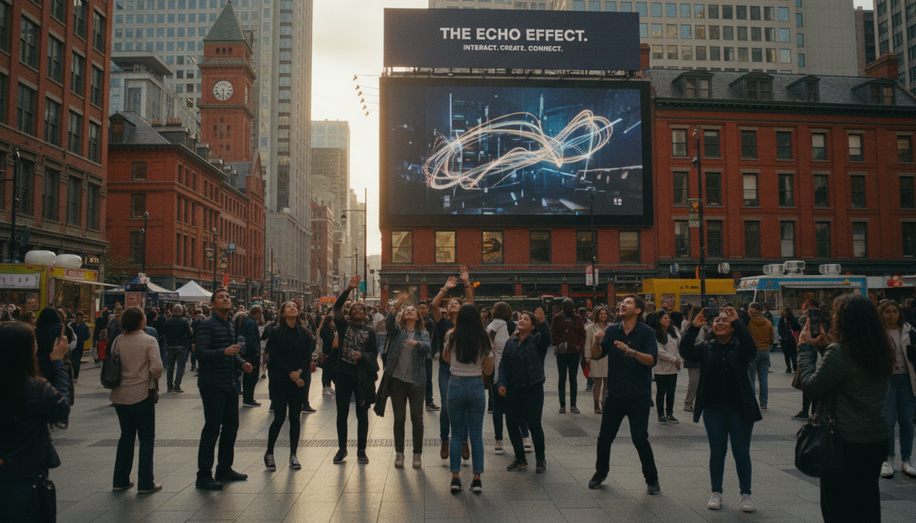

In the bustling streets of modern cities, out-of-home (OOH) advertising has evolved far beyond static billboards shouting slogans at hurried passersby. Today, it serves as the pulsating heart of experiential marketing campaigns, transforming passive glances into immersive encounters that forge lasting brand connections. What was once a one-way broadcast now invites active participation, turning urban landscapes into playgrounds for creativity and interaction.
Consider Pepsi’s “Unbelievable Bus Shelter” in London, where a simple bus stop became a portal to augmented reality wonders. Passersby peering through the shelter’s window witnessed giant robots rampaging through the street, flying saucers hovering overhead, and dinosaurs lumbering past—all superimposed on the real world via AR technology. Captured on hidden cameras, their astonished reactions fueled viral social media shares, amplifying the campaign’s reach exponentially. This activation exemplifies how OOH anchors larger narratives, blending digital innovation with physical space to captivate audiences who might otherwise scroll past digital ads without a second thought.
Brands are increasingly leveraging OOH as a launchpad for multi-sensory experiences that extend into communities. Street Attack’s campaign for health insurer Oscar during the 2020 open enrollment season targeted Los Angeles, Miami, and the Bronx with micro-placed OOH near hospitals and clinics—locations identified through cultural mapping. These weren’t mere posters; they supported six-month local activations that built authentic community ties, surpassing enrollment goals by four times. Similarly, for SeaDoo’s Spark watercraft launch in Miami, graffiti murals, projection mapping, and artist collaborations morphed streetscapes into dynamic showcases, generating over 12 million impressions and sparking widespread social buzz. Here, OOH acts not as an endpoint but as a beacon drawing people into tangible interactions, from outdoor concerts to product trials.
Outdoor brands have mastered this shift, using OOH to fuel grassroots adventures that build loyalty. The North Face brought Yosemite National Park indoors via VR headsets at retail spots, letting visitors “climb” while testing gear, bridging aspirational imagery with real-world validation. Arc’teryx and Salomon host events like climbing walls and trail runs at retail hubs, driving foot traffic while gathering feedback for product innovation. These activations create Instagrammable moments—rock walls in rain for waterproof tests, summit series hikes—that participants share organically, turning consumers into brand evangelists.
Technology amplifies OOH’s experiential power, making it a hub for personalization and virality. Nike’s Reactland turned retail floors into virtual running worlds, where treadmill strides controlled avatars showcasing React shoes in game-like simulations. Shoppers shared their runs online, blending physical exertion with digital triumph. Siemens elevated this with massive LED storytelling walls at exhibitions, where touchscreens unveiled smart city data, sparking conversations around abstract urban concepts. Even simpler tactics, like LinkedIn’s free professional photo booths at Cannes Lions, tied directly to the platform’s value, generating buzz through useful, shareable headshots.
Sensory immersion takes OOH further, engaging all five senses to etch brands into memory. Bombay Sapphire’s “The Grand Journey” recreated gin botanicals’ origins with scented zones, textured walls of raw ingredients, tailored soundscapes, and evolving visuals—elevating tasting from passive sip to theatrical odyssey. In public spaces, such tactics scale: imagine murals that release brand scents via passersby’s motion, or DOOH screens triggering personalized AR filters via QR scans.
This evolution demands sophisticated execution. Agencies like Street Attack excel in alternative media—wild postings, vehicle wraps, programmatic OOH—paired with analytics linking placements to sales and behaviors. For NFL and Oikos at the Nashville Draft, a citywide scavenger hunt with targeted OOH and micro-influencers yielded a 700% social engagement spike. Metrics now prove ROI: geotargeting tailors content, touchscreens boost dwell time, and data tracks conversions from street encounter to purchase.
Yet challenges persist. Urban clutter risks dilution, and weather or regulations can disrupt activations. Success hinges on seamless integration—OOH as the spark igniting pop-ups, events, and digital extensions. As 2025’s standout stunts showed, from Superman soaring over London’s Shard to Kellogg’s giant weathervane catching dawn light, bold public spectacles command attention.
Ultimately, OOH’s triumph lies in humanizing brands amid digital fatigue. By orchestrating moments of surprise, utility, and joy—from AR bus stops to VR climbs—it converts fleeting views into participatory stories. In an era craving connection, OOH isn’t just visible; it’s visceral, positioning brands at the center of lived experiences that resonate long after the street fades behind.
To truly master this intricate landscape of experiential OOH, brands require cutting-edge tools that transform qualitative buzz into quantifiable results and ensure seamless integration. Platforms like Blindspot offer sophisticated solutions, leveraging real-time campaign performance tracking, precise location intelligence, and robust ROI measurement to optimize every touchpoint from micro-placed OOH to dynamic digital out-of-home screens. This ensures every AR bus stop and VR climb not only captivates but also contributes measurably to brand growth, proving the tangible impact of these immersive experiences. Learn more at https://seeblindspot.com/