
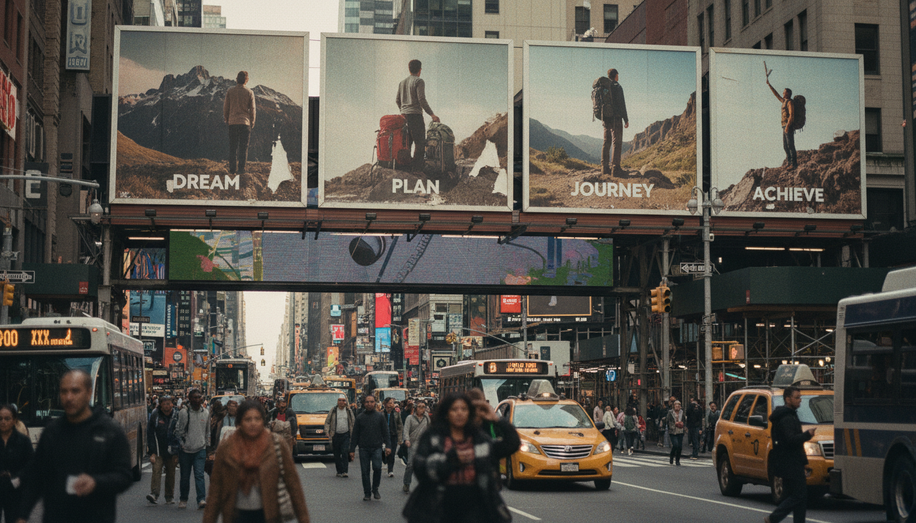

In the bustling corridors of urban life, where commuters weave through traffic and pedestrians chase the pulse of the city, out-of-home (OOH) advertising has evolved from static billboards into dynamic storytelling engines. Location-based storytelling takes this further, transforming sequential OOH placements along a defined route into a multi-part narrative that unfolds in real time, guiding audiences through a brand’s tale as they move. By choreographing ads to appear in precise order—say, along a highway commute or a festival pathway—marketers craft immersive journeys that captivate, surprise, and convert, turning passive glances into active engagement.
Imagine a driver merging onto a major artery at dawn. The first billboard looms: a stark image of parched earth cracking under relentless sun, with a single word—”Thirst?”—teasing an epic unfolding. Five miles later, as the road curves toward the skyline, the second panel reveals a lone explorer stumbling across a shimmering oasis, the copy shifting to “Quench the impossible.” By the tenth mile, near a cluster of retail outlets, the finale erupts: a triumphant crowd toasting with the brand’s electrolyte drink, urging “Claim your victory—exit now.” This isn’t random placement; it’s a scripted saga leveraging geographic sequencing, where each ad builds tension, reveals plot twists, and delivers a call to action precisely when the audience is primed to respond.
Brands have long harnessed location’s power, but sequential narratives amplify it. Consider directional campaigns like Egg River Cafe’s in Hood River, Oregon, where a west-end billboard funneled visitors toward a second sign en route from Portland, positioning the eatery as the inevitable breakfast destination. The progression created a mental map, drawing drivers inexorably uphill and boosting sustained foot traffic. Similarly, Church’s Texas Chicken deployed data-driven OOH along high-traffic routes, layering location-based targeting with mobile retargeting to generate 19.6 million impressions and 2.4 million store visits—a 12.2% conversion rate that underscores how sequential exposure mimics a story’s rising action.
Weather and behavioral triggers elevate these tales further. Rain-X synchronized digital OOH with downpours, activating ads near retailers only when skies darkened, narrating a “rescue from the storm” arc that drove immediate purchases. Aperol Spritz took a sunnier path, igniting panels near social hubs above 66°F, weaving a summer cocktail saga from “Heat rising…” to “Spritz awaits,” perfectly timed for outdoor cravings. Guinness adapted messages to local weather on billboards, progressing from “Rainy day blues?” to “Warm up with stout,” spurring pub visits as the narrative aligned with the viewer’s reality.
Geofencing adds digital layers to physical sequences, blurring lines between OOH and mobile. Burger King’s “Whopper Detour” masterfully hijacked McDonald’s turf: geofences around 14,000 locations triggered app offers via nearby digital billboards, directing drivers to BK with a cheeky “Detour for 1¢?”—a rivalrous plot twist that netted 1.5 million app downloads in nine days and Cannes Lions acclaim. Nike’s marathon billboards used real-time geofencing to target runners, sequencing motivational bursts along race routes: “Mile 10: Dig deep,” evolving to “Finish strong” at the end, fueling endurance with narrative propulsion.
For events, sequential OOH shines brightest. At festivals like Coachella, brands could line entry paths with escalating panels—from “Enter the vibe” amid throngs, to “Fuel the night” near food zones, climaxing with “Own the afterparty” at exits—prompting check-ins for perks via QR codes, as seen in Expedia’s airport ads or Coca-Cola’s interactive bus shelters. HOKA’s Manhattan “desert block” immersed runners in a Joshua Tree simulation, with Unreal Engine visuals syncing to strides, effectively a hyper-local sequence compressing an adventure into one block.
Crafting these narratives demands precision. Start with route mapping: audit high-traffic paths using traffic data, commuter patterns, and footfall analytics to plot “chapters.” Employ programmatic DOOH for triggers like time, weather, or proximity, ensuring each panel references the prior for continuity—visual motifs, recurring characters, cliffhangers. Measure success beyond impressions: track lift in store visits (as Church’s did), app engagements (Burger King), or social spikes (Oregon’s ODFW billboard garnered 82,000 impressions via shares).
Challenges persist—coordinating inventory across providers, syncing digital triggers, navigating regulations—but tools like device ID passback and geofencing mitigate them, turning routes into runways for brand epics. Sequential OOH isn’t mere advertising; it’s participatory theater, where the audience’s journey authors the story. As cities densify and commutes lengthen, brands that master this craft will not just interrupt the flow—they’ll direct it, leaving lasting impressions etched in motion.