
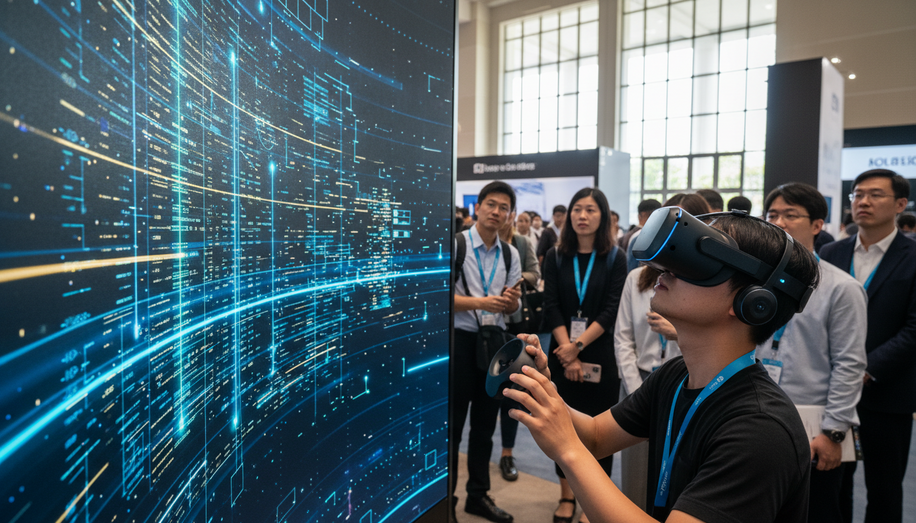

In the bustling streets of urban landscapes, where billboards once commanded attention through sheer scale, a new frontier is emerging: the fusion of out-of-home (OOH) advertising with virtual reality (VR). This intersection promises to redefine audience engagement, turning passive glances into fully immersive journeys that linger long after the moment passes. Brands are pioneering campaigns that layer VR experiences atop physical OOH structures, inviting passersby to step into alternate realities via smartphones, headsets, or even DOOH screens, blending the tangible world with boundless digital possibility.
Consider Nike’s “Reactland” campaign, a trailblazing example that merged physical exertion with VR immersion. Participants donned AR goggles—bridging into VR territory—while running on treadmills, navigating vibrant virtual landscapes that highlighted the responsive cushioning of Nike React shoes. Displayed on large screens in high-traffic OOH settings, this setup transformed public spaces into personal adventure zones, fostering memorable product interactions. Such innovations extend beyond fitness; they capitalize on OOH’s ubiquity to democratize VR access, requiring minimal equipment beyond a mobile device.
Verizon took this concept further in 2024 with Augmented Reality Mural Storefronts in Miami, powered by platforms like BrandXR and Snapchat’s WebAR. Murals in neighborhoods like Hialeah, Midtown, and Coconut Grove depicted local motifs—skyscrapers, greenery, cultural portraits—that sprang to life when scanned. Users witnessed 3D creatures emerging, cityscapes pulsing with lights, or digital vines entwining circuit boards, all reinforcing Verizon’s narrative of connectivity. These VR-adjacent experiences, accessible without apps, drove viral sharing and foot traffic, proving OOH’s potential as a launchpad for extended reality.
Pepsi Max’s “Unbelievable Bus Shelter” in London exemplifies the surprise factor. Commuters at DOOH-enabled shelters encountered AR illusions—a rampaging tiger or invading robot—projected via screens and mobile scans, evolving into VR-like depth with interactive elements. This not only halted foot traffic but amplified reach through social media, as stunned viewers captured and shared the spectacle. Similarly, Vodafone’s AR billboards in high-traffic areas deploy dynamic portals: static visuals morph into 3D games, weather-tied animations, or localized promotions when viewed through a phone, creating hyper-personalized VR immersion amid everyday commutes.
Even competitive stunts harness this power. Burger King’s “Burn that Ad” campaign in Brazil weaponized rivals’ billboards against them. Scanning a competitor’s OOH ad via the BK app ignited a virtual flame, replacing it with a Whopper coupon and branded VR overlay—turning adversaries’ real estate into BK’s interactive playground. BON V!V Spiked Seltzer echoed this in Los Angeles and San Diego, where QR codes on murals summoned tappable 3D vending machines in WebAR, allowing users to “dispense” virtual drinks and unlock offers, seamlessly blending OOH visibility with VR tactility.
Travel brands are equally adept at this blend. Visit Panama City Beach’s 360° VR tour, promoted via OOH channels, lets users virtually soar over piers and beaches, evaluating destinations from afar before booking. Integrated into digital billboards and murals, it evokes wanderlust by transporting viewers into fully rotatable VR environments, bridging physical ads with escapist digital realms. These cases illustrate a shift: OOH no longer competes with digital screens but enhances them, using VR to forge emotional bonds through multi-sensory feedback—visuals, audio, even simulated haptics—that static media can’t match.
The mechanics are straightforward yet revolutionary. QR codes or image recognition on OOH assets trigger VR layers via WebAR or apps, enabling real-time analytics on dwell time, interactions, and shares. Campaigns like Electrifly Detroit’s 15 AR murals embedded audio narratives and 360° explorations, turning streets into evolving galleries that brands could update remotely for sustained relevance. This data-driven approach yields tangible ROI: higher recall, organic virality, and direct conversions via embedded calls-to-action, such as coupons or store directions.
Challenges persist, from technological accessibility to privacy concerns in public scanning. Yet, as VR headsets slim down and 5G proliferates, integration with DOOH—think interactive screens evolving into VR portals—will accelerate. Extended reality (XR), encompassing VR and AR, is already transforming static OOH into dynamic ecosystems. Brands embracing this, through creative storytelling and local resonance, position themselves at the vanguard.
Looking ahead, the intersection heralds an era where every bus shelter, mural, or billboard becomes a gateway to branded universes. Nike, Verizon, and Vodafone demonstrate that VR-infused OOH doesn’t just captivate—it converts fleeting encounters into lasting loyalty, reimagining public spaces as collaborative canvases between advertiser and audience. As costs drop and tools like BrandXR scale deployment, expect this hybrid model to dominate, proving that the most compelling ads are those that pull us in, quite literally, to another dimension.