
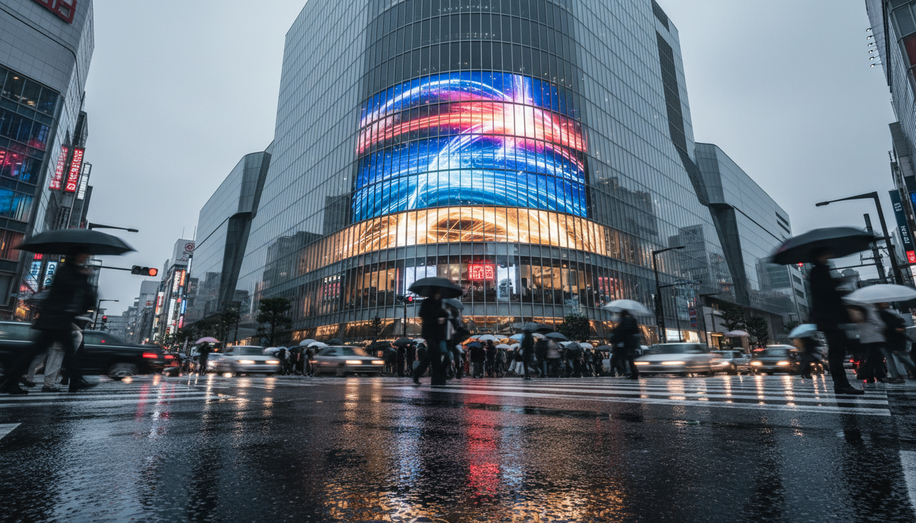

In the neon-drenched heart of New York City’s Times Square, architecture and advertising have fused into towering spectacles that redefine urban landmarks. Massive LED screens, curved and seamless, wrap around high-rise facades like the Marriott Hotel’s L-shaped display, spanning 1,600 square meters with 25 million pixels to deliver hyper-realistic 3D visuals that make brands leap from the building itself. These aren’t mere billboards; they are architectural innovations where structural engineering amplifies commercial messaging, turning skyscrapers into interactive canvases that draw crowds, cameras, and social media shares.
Times Square exemplifies this evolution. Building 1’s four enormous LED screens cover over 13,000 square feet, forming an advertising tower that hosts global events like the New Year’s Eve Ball Drop, blending spectacle with permanence. The American Eagle outpost integrates 12 screens across 1,393 square meters, its facade a rented canvas for international brands, while the Digital Godzilla screen stretches 15,000 square feet from 45th to 46th Streets, its corner curvature creating illusions of depth that have gone viral online. Coca-Cola’s vivid campaigns and Samsung’s high-definition tech demos further cement these structures as icons, their architectural boldness matching the district’s relentless energy.
Beyond flat panels, creative designs exploit geometry for immersion. BMW’s XM SUV launch on a curved LED screen above the Edition Hotel depicted the vehicle sliding down a hillside and teetering off the edge, garnering 1.3 million YouTube views by leveraging the screen’s arc to mimic perilous motion. HBO’s House of the Dragon brought a fire-breathing dragon, Caraxes, to life on a 60-foot-wide by 30-foot-tall curved display, flames spilling across the bend in a two-week prelude to the 2022 premiere, co-sponsored by LG to tout its OLED TVs. Dior’s inaugural 3D outing animated luxurious fashion in high-resolution, merging artistry with the screen’s monumental scale to evoke haute couture drama.
This architectural ingenuity extends globally, proving OOH displays can anchor city identities. In London’s Piccadilly Circus, Meta’s Quest 2 holiday takeover on the curved Piccadilly Lights opened virtual portals into festive realms, extending digital environments into physical space during peak shopping. Tokyo’s Shinjuku Station, thronged by 3.6 million daily commuters, hosted Nike’s Air Max Day with giant sneakers bursting from boxes on the Cross Shinjuku Vision screen, amassing 50 million social views in a week. Samsung’s Lunar New Year tigers prowled Times Square and beyond, paws reaching toward Galaxy logos in culturally timed leaps across five cities. Even horizontal expanses shine: Universal Studios’ Super Nintendo World promo in downtown Los Angeles unfurled Mario Kart racers across a 50-foot-high, 300-foot-long canvas, its 6:1 aspect ratio simulating real motion to lure Southern California drivers.
These examples reveal a shift from static signage to dynamic architecture. Early icons like Los Angeles’ Hollywood Sign, born as a real estate ad, evolved into cultural bedrock, much as Times Square’s dense LED walls now symbolize New York’s pulse. Chick-fil-A’s 3D cows playfully nod to this heritage, their humorous volumes turning highways into attractions. Yet modern innovations push further, with cantilevered impossibilities in Henkel’s Fester concrete ads—underwater hotels and overhanging homes—showcasing how advertising renderings celebrate structural daring.
Engineers achieve seamlessness through specialized tech: curved corner screens splice without gaps, pixel densities soar for naked-eye 3D, and content calibrates to irregular geometries. The result? Displays that function as landmarks, photogenic hubs where tourists flock not just for brands but for the thrill of architectural spectacle. Spirit Halloween’s animated horrors and SKY Play’s Nasdaq Building dynamism during holidays amplify this, creating seasonal fervor.
Critically, these hybrids boost engagement. Brands like BMW and HBO report millions in views, while locations like Times Square thrive on the symbiosis—architecture provides the frame, advertising the life. As LED tech advances, expect more: inflatable landmarks or channel letters scaling to icons, as seen in neon evolutions that draw travelers. In OOH’s future, buildings won’t just host ads; they’ll embody them, reshaping skylines into perpetual storytelling machines where commerce and creativity stand indistinguishable.