
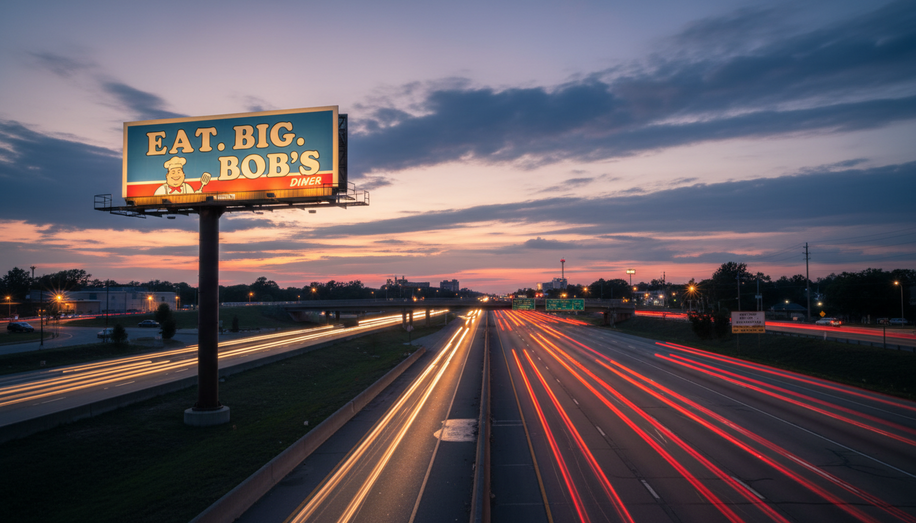

In the fast-paced world of out-of-home advertising, where drivers glance at billboards from highway speeds and pedestrians spare only a fleeting moment for transit ads, the power of words hinges on precision. Effective OOH copy must seize attention in seconds, delivering a crystal-clear message that lingers long after the viewer passes by. Drawing from industry experts, the golden rule is brevity: aim for seven words or fewer, ensuring readability from afar with large, high-contrast fonts and minimal text. This “3-second rule” demands that every syllable counts, transforming a static display into a memorable call to action.
Crafting such copy starts with simplicity. Use everyday language that anyone can grasp instantly, shunning jargon, complex vocabulary, or convoluted wordplay that risks confusion amid motion. For instance, “Fresh Coffee. Next Exit” outperforms “Exquisite artisanal brew awaits at the forthcoming interchange,” as the former lands immediately while the latter evaporates unread. Experts emphasize pairing this conciseness with bold visuals—high-quality imagery and heavyweight fonts that integrate branding seamlessly, often placing logos prominently at the top for instant recognition. A strong brand identity reinforces the message without overwhelming it, turning passive exposure into active recall.
Context is king in OOH, tailoring copy to the environment for maximum relevance. Place a sunscreen promotion near beaches or a coffee ad in morning commuter zones to exploit “contextual relevance,” making the pitch feel personal and timely. Scout locations firsthand to verify readability: test from actual viewing distances, accounting for vehicle speeds, foot traffic, and angles to avoid hidden text or obscured views. Digital out-of-home (DOOH) adds layers, like timing messages for peak moments—a “hot cup of coffee” at dawn or “ice cold beer” at dusk—while adapting dwell time: shorter loops for quick glances demand bigger fonts and punchier phrasing.
Incorporate a compelling call to action (CTA) that prompts immediate response, such as “Exit 22 Now” or “Scan for 20% Off,” directing viewers to the next step without ambiguity. Emotional appeal amplifies impact; evoke humor, urgency, or aspiration to connect viscerally, as humans respond more to feelings than facts in split-second encounters. Local references further boost engagement—”Voted #1 Pizza, Downtown”—signaling research and affinity, fostering trust in an era skeptical of digital noise. Yet boldness tempers with responsibility: avoid innuendos, insensitive imagery, or anything offending diverse audiences exposed without filters.
Common pitfalls abound for the unwary. Overloading copy with details dooms it; if it’s too long or intricate, viewers process nothing amid the blur. Fancy script fonts or decorative styles falter at speed—stick to sans-serif clarity for legibility. Neglecting integration across channels wastes potential: OOH shines when echoing online campaigns, sparking social shares and amplifying reach organically. Failing to learn from data, like impression estimates or social mentions, repeats mistakes; past projects reveal what resonates.
Ultra-creativity elevates the craft without excess. Brainstorm freely, capturing every wild idea before refining to the essence—minimalism that surprises, like leveraging surroundings (a gym screen pitching protein shakes) for immersive storytelling. Professional development invests in this: allocate budget for experts who navigate nuances, from unit selection (billboards for highways, transit for urbanites) to omnichannel cohesion.
Ultimately, masterful OOH copy distills a brand’s voice into a lightning strike—short, bold, relevant, and actionable. Brands mastering these principles, from concise phrasing to site-specific savvy, not only cut through clutter but drive measurable lifts in awareness and foot traffic. In an oversaturated media world, where OOH’s unskippable presence commands premium attention, honing this skill remains a competitive edge.