
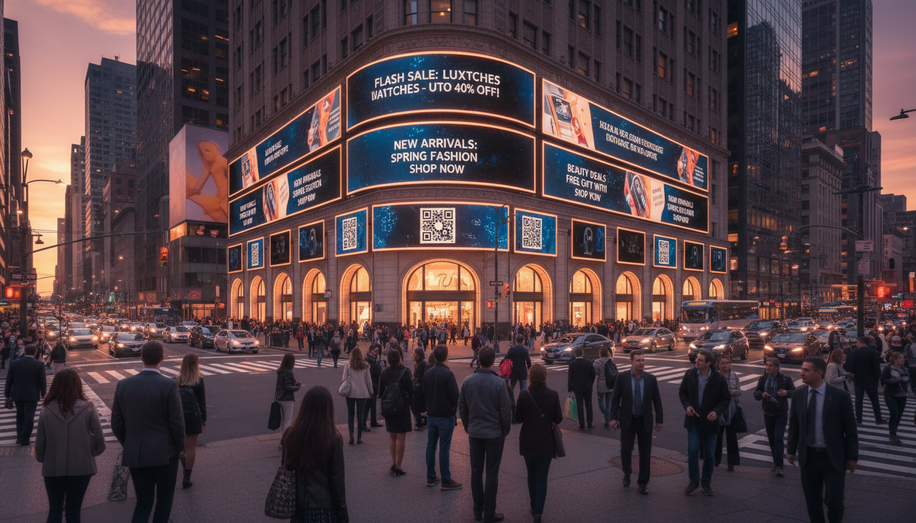

In the bustling retail landscapes of 2026, out-of-home (OOH) advertising and retail media networks (RMNs) are forging powerful alliances that transform passive glances into immediate purchases. Retailers like Albertsons and Sainsbury’s are expanding in-store digital screens—now numbering in the thousands—to deliver targeted promotions at the point of sale, while OOH placements outside stores and along shopping routes prime consumers for those critical buying moments. This synergy leverages OOH’s massive reach with RMNs’ precise shopper data, driving measurable sales uplifts of up to eight percent in brands’ in-store performance.
The evolution stems from OOH’s shift from standalone visibility plays to integrated campaign anchors. Brands no longer treat billboards or transit ads as isolated bursts; instead, they align them with RMNs to create seamless consumer journeys. For instance, programmatic digital OOH (DOOH) near retail hubs syncs with in-store screens via geofencing and mobile retargeting, ensuring a shopper who spots a dynamic billboard en route receives personalized offers upon entering the store. Projections show in-store retail media ad spending surging to nearly one-fifth of total ad budgets by 2027, with RMNs fueling 55.9 percent of DOOH growth through 2029, as these networks integrate with programmatic platforms for real-time optimization.
Retailers are at the forefront, building expansive media ecosystems that blur indoor and outdoor boundaries. Sainsbury’s Nectar 360 network, for example, now boasts 2,500 screens across stores, integrated with a new ad platform called Pollen that unifies audience insights, planning, and measurement—extending reach to OOH formats in parking lots and access areas. Similarly, in Spain, Carrefour is rolling out indoor-outdoor media across 91 shopping centers, optimizing national campaigns with local effectiveness to boost foot traffic and conversions. These setups turn retail environments into high-engagement ad zones, where large-format screens at checkouts and entrances flash flash sales or event announcements, directly influencing impulse buys.
OOH’s contextual precision amplifies this impact. Niche placements near transit points, malls, and experiential venues capture audiences in high-intent zones, with technologies like QR codes, NFC tags, and AR overlays bridging the physical-digital divide. A global beverage brand’s AR-enabled billboards, for one, delivered a 30 percent recall lift by encouraging social sharing that fed into retail media activations. Retailers report that such integrations—pairing outdoor visibility with in-store digital triggers—yield higher dwell times, engagement, and ROI, as weather-triggered content or real-time social feeds on DOOH screens guide shoppers straight to product displays.
Programmatic buying supercharges the partnership, enabling automated, data-driven decisions across channels. With global programmatic DOOH spend projected to top $33.3 billion by year’s end, brands access RMN screens near checkouts and aisles alongside outdoor inventory, attributing sales lifts to specific exposures. StackAdapt notes that activating RMNs for in-store DOOH captures shopper behavior insights at the point of purchase, turning aisles into precision marketing arenas. This measurability addresses past OOH critiques, proving its role in omnichannel strategies where outdoor impressions boost site traffic, app downloads, and store visits.
Real-world examples underscore the sales potential. Albertsons’ “Add-It” offsite format lets digital shoppers add promoted products to carts with one click, complementing OOH campaigns that drive initial awareness. Gamelife’s alliance with Sky Media uses proprietary data for targeted ads in high-engagement environments, mirroring how OOH near retail parks funnels traffic into data-enriched RMN experiences. Industry voices like Elliot Ward of Excite OOH emphasize that thoughtful OOH integration sparks immediate purchase behaviors and long-term recall, amplified by immersive tech like holograms and AI-optimized content in smart city settings.
Challenges remain, including fragmented measurement across channels, but advancements in cross-channel attribution are closing the gap. IoT-connected screens and AI content optimization allow real-time tweaks based on traffic or demographics, ensuring OOH and RMNs deliver timely, relevant messages. As urbanization swells outdoor time and retail footfall, this combination positions OOH as the connective tissue in media mixes, with RMNs providing the conversion muscle.
Ultimately, the OOH-RMN fusion redefines retail advertising as a holistic engine for growth. Brands doubling down on these collaborations—evident in rising ad spends and proven uplifts—are not just enhancing in-store sales; they’re crafting immersive, accountable experiences that dominate 2026’s competitive landscape. With OOH evolving into a global operating system, its retail media ties promise sustained momentum, turning every street view and shelf glance into a revenue opportunity.