
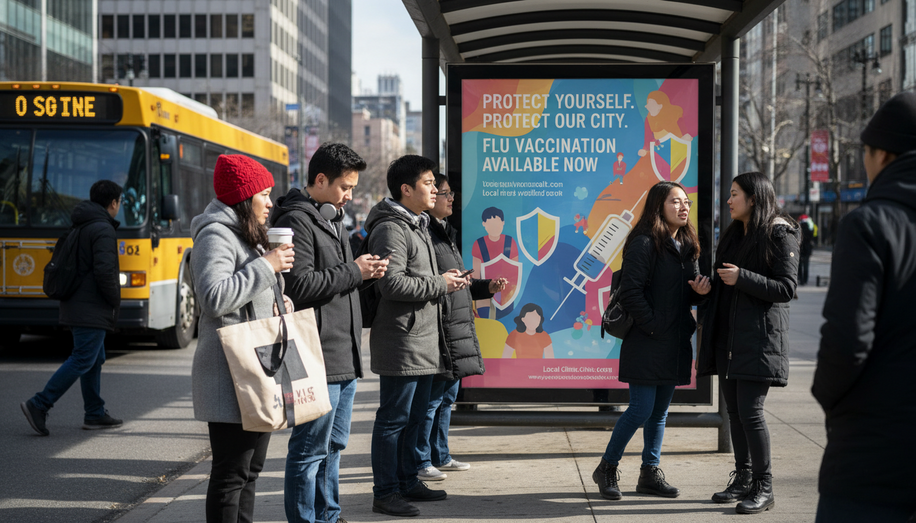

Out-of-home advertising has emerged as a powerful tool for health campaigns, enabling organizations to deliver critical health messages exactly when and where audiences are most receptive. By strategically positioning advertisements in high-traffic locations and leveraging real-time data, health brands and organizations have achieved remarkable results in driving awareness, behavioral change, and measurable health outcomes.
One compelling example comes from an over-the-counter allergy medication brand that capitalized on seasonal timing to reach consumers at their moment of greatest need. Running from March 24th through April 28th, 2024, the campaign utilized digital out-of-home panels across Los Angeles, Boston, and other major cities, with most screens positioned in high-traffic shopping centers and outdoor locations where allergy sufferers were already experiencing symptoms. The campaign split into two targeted tracks: one focusing on adults aged 24 to 34 and 45 to 54, and another targeting parents aged 35 to 54 interested in pediatric allergy solutions. The results demonstrated OOH’s effectiveness in this space, achieving 33 million impressions and a notable 11 percent increase in purchase intent among the 25 to 34 age group, along with a 16.7 percent increase in brand favorability.
What made this campaign particularly effective was its integration of real-time contextual data. By advertising during peak allergy season and placing messages directly in consumers’ daily routines, the brand met audiences when they were actively seeking solutions. The use of social media-style video content featuring trendy messaging further enhanced engagement, demonstrating that healthcare messaging need not sacrifice creativity for effectiveness.
Place-based targeting has proven equally successful in other health contexts. A leading healthcare organization deployed a comprehensive anti-smoking campaign across their hospital and clinic network using strategically positioned digital displays in waiting rooms, elevators, and high-traffic areas. This approach leveraged the captive audience already in a health-conscious mindset, complemented by a mobile app that connected patients with cessation resources. The captive nature of the healthcare setting dramatically increased receptiveness to the message, resulting in significant awareness gains and a notable rise in patients seeking smoking cessation services.
Childhood obesity awareness represents another successful vertical. A national nonprofit placed large-format billboards and digital screens near grocery store entrances and high-traffic areas, using engaging visuals and interactive QR codes to direct parents toward educational resources and nutritious recipes. By intercepting parents and caregivers within their shopping routines, the campaign successfully raised awareness and sparked meaningful conversations about dietary choices.
Healthcare providers have also leveraged mobile targeting within OOH campaigns to achieve precise audience engagement. Esse Health, a physician network in the St. Louis area, deployed mobile ads targeting millennial parents, pharmacy frequenters, and medical insurance holders within a five-mile radius of a new physician’s office. During a four-week campaign, the effort generated over 105,000 mobile impressions and 523 clicks, achieving a 0.50 percent click-through rate—67 percent above the mobile advertising benchmark. The tangible outcome: the new physician increased patient visits to four per week.
The CDC’s “Tips From Former Smokers” campaign illustrates how emotional storytelling within OOH frameworks can drive behavioral change. By featuring real narratives from individuals affected by smoking-related illnesses, the campaign moved beyond abstract health warnings to deliver raw human impact, motivating millions of smokers to attempt quitting and contributing to measurable declines in smoking rates.
Integration across channels amplifies OOH’s impact. Huntington Hospital combined outdoor advertising with social media, digital advertising, and streaming radio to strengthen its community presence and reinforce its mission. This multi-channel reinforcement ensures messages reach audiences through complementary touchpoints, increasing both frequency and retention.
These case studies reveal several consistent success factors: precise audience targeting, strategic placement timing, integration with actionable resources, and alignment between message and location context. Whether reaching allergy sufferers during peak season, intercepting parents in grocery stores, or targeting health insurance holders near medical offices, successful health campaigns recognize that OOH’s power lies not merely in reach, but in relevance. As healthcare organizations increasingly recognize the medium’s ability to drive awareness and behavioral change, out-of-home advertising continues cementing its role as an essential component of modern health communications strategy.