
For decades, the creative rules of out-of-home advertising barely shifted: one big idea, a few bold elements, high contrast, minimal words. Those fundamentals still matter, but the way great OOH creative is conceived, tested, and tailored is changing fast. Artificial intelligence is moving from a back-office planning tool into the heart of the creative process, reshaping how teams write copy, design layouts, and adapt executions to specific screens and environments.
The most obvious change is in copy development. Generative AI models trained on vast libraries of language can now spin out dozens of headline variations in seconds, each tuned to a different audience segment, time of day, or contextual trigger. For OOH, where you need a message that can be processed at a glance, this isn’t about surrendering the craft of writing to a machine. Instead, creative teams are using AI as a rapid ideation engine: feeding it a core proposition, brand voice guidelines, and constraints like character limits or reading distance, then mining the output for lines worth refining.
This is particularly powerful in digital out-of-home environments where messaging can change dynamically. A retailer running screens near multiple store locations, for example, can ask AI systems to generate variations that reference local neighborhoods, weather conditions, or live sports scores, while still adhering to a master template. AI tools can help enforce that consistency, checking for on-brand language and filtering out phrases that may carry unintended meanings in specific regions. That blend of speed and control is essential as marketers push toward “right message, right place, right moment” at scale.
Alongside language, AI is increasingly being used to shape the visual side of OOH creative. Computer vision models can analyze static or animated layouts and predict which elements are most likely to attract attention in the first seconds of viewing. By simulating the human visual journey across a design, these tools highlight whether the viewer’s eye will hit the brand, the call to action, or a distracting background element first. For a medium that relies on split-second comprehension from drivers, commuters, and pedestrians, those insights are reshaping the design process.
Instead of relying solely on instinct and post-campaign learning, creative teams can now A/B test concepts before they ever go live. Upload two billboard treatments to an AI-powered attention analytics platform and it will flag issues such as low contrast, cluttered compositions, or poor hierarchy. It can quantify how likely the main message is to be noticed at different viewing distances and angles. The result isn’t a radical departure from long-standing OOH best practices; it’s a data-driven way to enforce them and push them further. Designers who once had to wait for weeks of campaign performance data to justify a cleaner layout can now walk into internal reviews armed with predictive metrics.
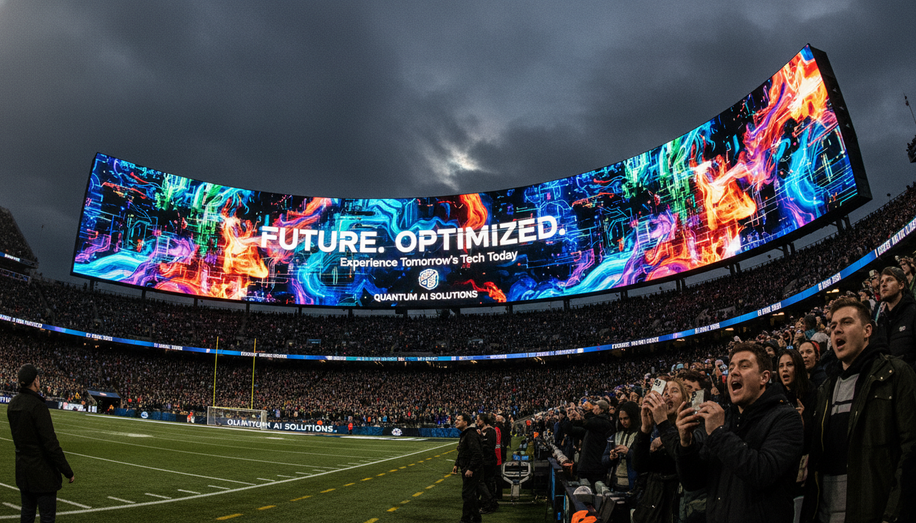
The combination of generative and analytic AI is where OOH creative starts to stretch beyond traditional boundaries. Media owners and brands are using AI not only to generate and optimize individual assets, but also to orchestrate entire creative systems tailored to specific placements. A campaign may start with a master key visual, but AI can automatically adapt that creative to hundreds of different screens and formats, adjusting aspect ratios, copy length, color balance, and focal points for each environment.
In digital networks that tap into real-time data feeds—traffic density, local events, flight delays, or even social media trends—AI systems can decide which creative variation to serve at any given moment. A food delivery brand might emphasize convenience during the evening commute, value messaging in budget-conscious neighborhoods, and indulgence near entertainment districts on Friday nights. The underlying creative building blocks are still crafted by humans, but AI manages the combinatorial explosion of possibilities, ensuring that each impression is as contextually relevant as possible without requiring manual scheduling for thousands of scenarios.
Personalization in OOH, by necessity, looks different from one-to-one targeting online. Regulations and consumer expectations limit how granular advertisers can get with public-facing messaging, and the idea of a billboard that “knows” you personally still raises concerns. Instead, AI-driven personalization in OOH tends to focus on aggregating anonymized data from mobile devices, geolocation, and historical patterns to infer the likely audience at each screen. Creative then flexes to match those broader audience profiles—commuter vs. tourist, weekday vs. weekend, pre-game vs. post-game—rather than individual identities.
That raises an important creative challenge: how to make context-aware ads that feel relevant without feeling invasive. AI can help by surfacing patterns that aren’t obvious from gut instinct alone. It might reveal that a particular transit hub skews more toward students late at night or that shoppers responding to certain promotions also over-index for sustainability messaging. Translating those insights into compelling, human-centered creative remains the job of strategists and designers, but AI is expanding the palette of inputs they can draw from.
As AI systems become more autonomous, however, the industry is learning that human oversight is not optional. The same tools that enable rapid adaptation can also generate awkward or tone-deaf messages if left unchecked. Early experiments with fully automated “adaptive” creative for digital billboards have shown that context triggers can be misread or combined in ways no one anticipated. Agencies and media owners are responding by implementing strict guardrails: approval workflows, brand safety filters, and limited sets of pre-vetted copy and imagery for AI to remix rather than inventing entirely from scratch.
The creative process itself is also evolving. Brainstorms now routinely include AI prompts alongside mood boards. Designers are experimenting with generative image models to explore alternative compositions and styles before committing to a direction. Copywriters are spending less time on first drafts and more time on refining, curating, and stress-testing lines against different contexts. The teams that get the most out of AI are treating it as an extension of their craft, not a replacement: a collaborator that can surface unexpected options, challenge assumptions, and accelerate iteration, while humans still define the strategy, emotion, and risk tolerance.
In the end, AI’s impact on OOH creative may be less about futuristic spectacle and more about invisible precision. The best AI-enabled billboards won’t necessarily call attention to their technology; they’ll simply feel sharper, more timely, and more attuned to the lives of the people walking or driving past them. The core creative principles of out-of-home—clarity, boldness, simplicity—aren’t going away. But as AI tools spread from the media planner’s dashboard into the designer’s and writer’s toolkit, they are giving the medium new ways to live up to those principles in an increasingly dynamic, data-rich world.