
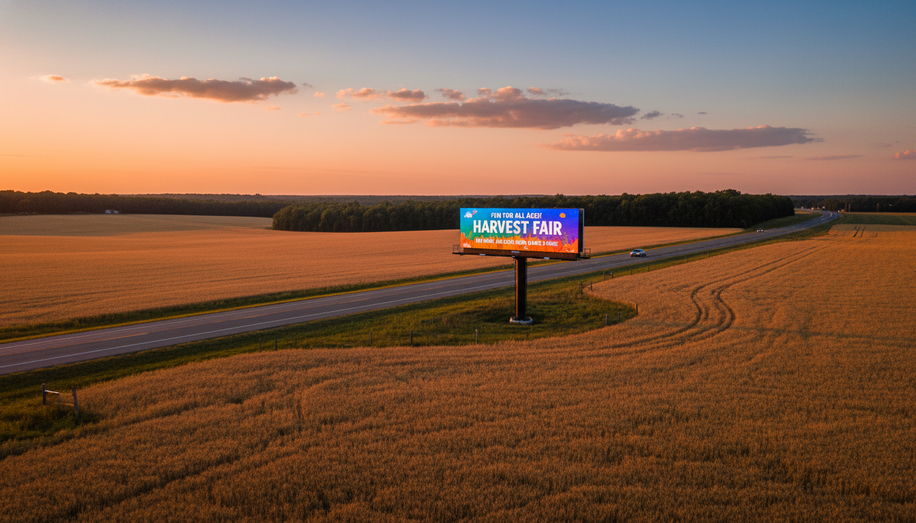

For years, out-of-home advertising has been synonymous with dense urban cores: towering digital screens at busy intersections, subway dominations, and cluttered cityscapes where brands shout to be heard. Yet beyond the city limits lies a vast, often underleveraged canvas. Rural and suburban markets may lack skyscrapers and subway tunnels, but they offer something just as valuable to advertisers: attention, time, and trust.
The first shift in mindset is recognizing that “non-urban” is not a single audience. Suburban corridors are defined by commuter patterns, retail hubs, and school zones, while rural areas revolve around highways, small-town main streets, agricultural routes, and regional gathering spots. What they share is a lower ad density than major metros, which means each placement has the potential to stand out more sharply—if it is strategically chosen and contextually relevant.
Location selection in rural and suburban areas starts with understanding how people actually move. In rural regions, high-traffic arteries typically mean state highways, key junctions, and the main entrances into town. These roads carry a mix of local residents, delivery trucks, and long-distance travelers, delivering consistent impressions despite a lower overall population density. In suburbs, the daily rhythm is tied to commuter routes into city centers, feeder roads to industrial parks, and the spokes connecting residential neighborhoods with shopping districts, schools, and medical centers. For OOH planners, GPS-based mobility data and DOT traffic counts are essential tools to pinpoint these patterns and quantify reach.
Once the right corridors are identified, the creative strategy has to respect the realities of the roadside environment. In non-urban locations, drivers are often traveling at higher speeds and viewing ads from greater distances than in crowded urban streets. That makes clarity a non-negotiable. Simple, high-contrast designs with minimal copy allow messages to land in a matter of seconds. Six to eight words, a bold visual, and a clear brand cue can be far more effective than a clever paragraph no one has time to read. Supporting visuals should be tailored to the setting: a rural financial institution might show a local farm scene or town landmark, while a suburban healthcare system might feature real staff or community sports imagery. The goal is immediate recognition and emotional proximity.
Relevance, in fact, is where rural and suburban OOH can dramatically outperform. These communities are tightly knit, with strong attachments to local institutions, traditions, and values. Campaigns that acknowledge local high school teams, county fairs, regional festivals, or community causes are more likely to be remembered and discussed. A national retailer promoting a store opening can boost impact by referencing the specific town name and partnering with local organizations. A healthcare provider can highlight its sponsorship of youth sports or farmer wellness initiatives. In rural markets especially, being perceived as “one of us” often matters as much as the product offer itself.
The available OOH formats in these environments are also evolving. Traditional static billboards remain a backbone, thanks to their durability and relatively low cost. But mobile billboards—digital displays mounted on trucks—are increasingly being used to add flexibility and precision. They can be routed to county fairs, regional concerts, weekend festivals, or even follow commuter flows during morning and evening peaks. For brands looking to test a market or support a short-term promotion, mobile units can deliver a burst of presence without the long-term commitments often associated with permanent structures.
Digital out-of-home is making similar inroads beyond cities. As screens become more affordable and connectivity more reliable, digital faces are appearing along major commuter routes into suburbs, at gas stations, in local grocery stores, and near big-box retail. For advertisers, this brings all the advantages of dynamic creative: dayparting messages for morning commuters, shifting promotions around weather or local events, and synchronizing rural and suburban messaging with concurrent digital campaigns. A campaign can, for example, run a brand-awareness message on billboards while mobile devices in the same region receive complementary social and display ads, all coordinated by programmatic buying platforms.
The cost-efficiency story is another compelling reason to look beyond urban cores. Inventory in rural and suburban markets typically carries lower CPMs than marquee locations in major cities, yet the dwell time and visibility can be superior. There is less visual clutter competing for attention and fewer distractions at eye level. A single dominant board on the primary road into a town can become part of the everyday landscape, reinforcing brand recall through repeated exposure. For regional brands, this can translate into substantial reach among their most important customers at a fraction of city-center rates.
This lower cost, however, should not be mistaken for lower expectations. Measurability and accountability are increasingly central to OOH in all markets. In rural and suburban environments, planners are leaning on mobile device data, geofencing, and survey-based attribution to close the loop between exposure and action. By analyzing movement patterns, brands can estimate how many unique devices passed a given board and can track subsequent behaviors, such as store visits or website traffic from exposed areas. When OOH is integrated into the broader media plan, it becomes both a reach driver and a catalyst for digital engagement.
Integration is, ultimately, where rural and suburban OOH can play its most strategic role. A campaign promoting a new retail location can combine highway billboards, mobile trucks circulating near opening events, and geo-targeted mobile ads that retarget exposed audiences with offers or directions. A political campaign in a rural district can reinforce TV and radio with high-visibility boards along farm-to-market roads, reminding voters daily of key messages near where they live and work. A regional tourism board can use eye-catching roadside creative to inspire spontaneous detours, while digital channels capture the interest of those who search for more information afterward.
Looking beyond the city limits is no longer a niche strategy; it is a competitive necessity for brands that want full-market coverage. As OOH evolves with data, digital capabilities, and mobile integration, rural and suburban markets offer a rare combination: relatively uncluttered environments, strong community identity, and cost-effective visibility. For advertisers willing to respect the local context, simplify their creative, and connect out-of-home with the rest of their media mix, these landscapes hold vast potential—mile after mile.