
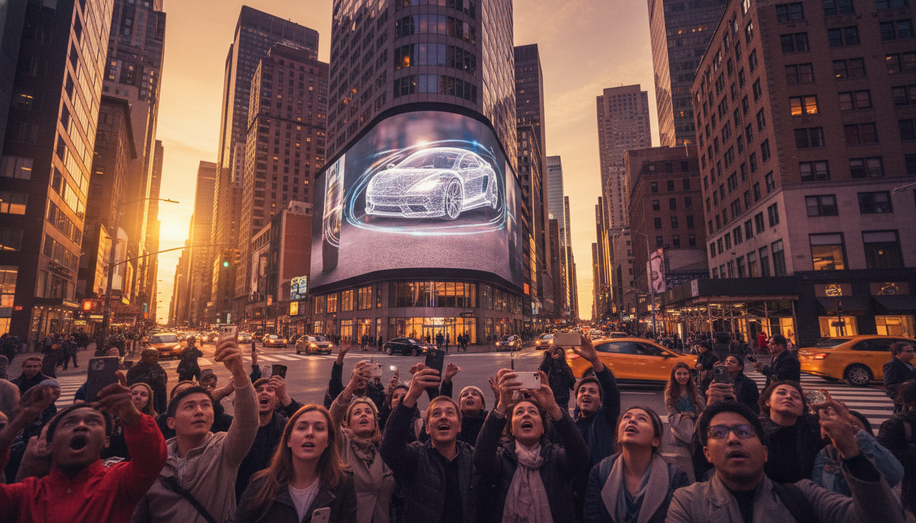

For decades, out-of-home advertising has relied on scale, location and repetition to make an impact. Now, a new layer is being added on top of those familiar posters, billboards and street furniture: augmented reality. By turning static surfaces into interactive portals, AR is redefining what OOH can do, blurring the line between physical media and digital experience and inviting audiences to participate rather than simply pass by.
At its simplest, AR-enabled OOH works through the device everyone already carries. A passer-by spots a poster with a clear visual cue or QR code, scans it, and is taken to a web-based AR experience in their mobile browser. Pointing the camera back at the ad unlocks animated 3D content that appears to emerge from or surround the physical creative. No app download, no specialist hardware – just a smartphone and a moment of curiosity. That moment, however, can stretch into 60 or 90 seconds of active engagement, a lifetime compared with the split-second glance most roadside ads receive.
The creative possibilities are expanding fast. Traditional static billboards can become interactive canvases where products burst out of frames, characters respond to users’ movements, or dynamic scenes unfold in real time. Transit formats, from bus shelters to subway platforms, can serve up mini-games, immersive brand worlds or context-aware promotions while commuters wait. In retail environments, posters can transform into virtual vending machines, as seen in campaigns where blank walls became interactive shelves, letting consumers explore products in 3D and tap through to purchase or redeem samples.
Brands are starting to demonstrate how AR can turn OOH into something closer to an event than an impression. Burger King’s “Burn That Ad” allowed users to point their phones at rival fast-food posters and watch them virtually ignite, rewarding participants with a free Whopper. Coke Zero’s UK “#TakeATaste” campaign combined digital OOH screens with mobile AR, letting people interact with landmark displays and claim both a virtual Coke and a real-world voucher. These executions fuse spectacle with utility: a playful mechanic tied directly to a measurable action such as store visitation or coupon redemption.
Critically, AR doesn’t just add novelty; it changes the nature of attention. Instead of passive viewing, audiences are asked to opt in, lift their phones and explore. That simple act of participation deepens involvement and creates a stronger memory trace. Studies from AR specialists suggest interactive campaigns can increase engagement time significantly, with users often spending over a minute inside an experience. For advertisers, that means the OOH site is no longer just a fleeting touchpoint but the gateway to a micro-experience that can tell a richer story, collect data and even close a sale.
The “blurred line” between physical and digital also enables more personalized and contextually relevant messaging. The printed or digital display hooks attention in the real world, while the AR layer can adapt per user. Time of day, location, weather or even proximity to a store can all inform what unfolds on the screen. A billboard promoting a new store, for example, can trigger AR navigation arrows pointing the exact route to the nearest branch, or show different creative at lunchtime than it does in the evening. As computer vision and spatial mapping improve, creative can respond not only to who is engaging, but where they stand and what surrounds them.
Web-based AR has been a key enabler of scale. Early AR efforts often relied on bespoke apps, limiting reach to the most motivated users. Now, platforms like WebAR allow audiences to enter experiences directly via the mobile browser with a single tap, dramatically lowering friction. For media owners, this unlocks the possibility of layering AR across networks of classic and digital sites without fundamentally changing the underlying infrastructure. The physical inventory remains the same; the value comes from the digital layer that can be refreshed, optimized and versioned almost in real time.
Measurement, long an evolving topic in OOH, also gains new dimensions with AR. Instead of relying solely on modeled impressions and traffic data, AR campaigns can track scans, dwell time, interaction types, shares and downstream actions such as redemptions or e-commerce conversions. When an AR billboard drives users to a microsite, a coupon or a map, that journey can be measured, providing a clearer line of sight between a physical placement and concrete outcomes. For brands seeking performance-style accountability from brand-building channels, this hybrid approach is particularly attractive.
Social amplification is another advantage. AR OOH experiences are inherently visual and often surprising, making them primed for sharing. When a mural explodes into animated life or a bus shelter becomes a safari portal filled with 3D animals and educational snippets, users are encouraged to record and post what they’re seeing. The most successful campaigns are designed with this in mind, incorporating moments worth capturing and ensuring that the AR layer looks as compelling on a phone screen as it does through the lens in real time. In effect, a single site can become the seed for a much wider online audience.
For the OOH industry, AR is not a replacement for physical impact but an augmentation of it. The real-world presence of a giant billboard or a dominantly placed 6-sheet still matters; it is what stops people in their tracks and signals brand stature. What AR adds is depth: more narrative, more interaction, more reasons for people to linger and, crucially, more data about what happens after they notice the ad. As 5G connectivity spreads, smartphone cameras improve and consumers grow more familiar with immersive experiences, the barrier to engagement will continue to fall.
The challenge now is creative ambition. The technology to overlay digital content on the built environment is already here and increasingly accessible. What distinguishes the standout campaigns is not the sophistication of the code but the clarity of the idea and the simplicity of the interaction. When executed well, AR in OOH can make city streets feel like stages for live brand experiences, where the poster is only the beginning and the real story unfolds in the space between the physical world and the glass of a smartphone screen.
As AR transforms OOH into interactive events, proving their impact beyond traditional impressions becomes paramount. Platforms like Blindspot address this by providing real-time campaign performance tracking and comprehensive ROI measurement for these hybrid experiences. This allows brands to gain granular insights into AR engagement, track downstream conversions, and attribute business outcomes directly to their innovative OOH placements, turning creative ambition into measurable success. Learn more at https://seeblindspot.com/