
On a grey London morning last year, commuters emerging from Tottenham Court Road station were met not with another glossy billboard, but with a sprawling, hand-drawn universe of characters and patterns. Kleenex’s collaboration with artist Mr Doodle, which transformed Outernet London into a living canvas, was more than a brand activation. It was a pointed signal of how out-of-home advertising is fusing with urban art to claim a more meaningful role in the public realm.
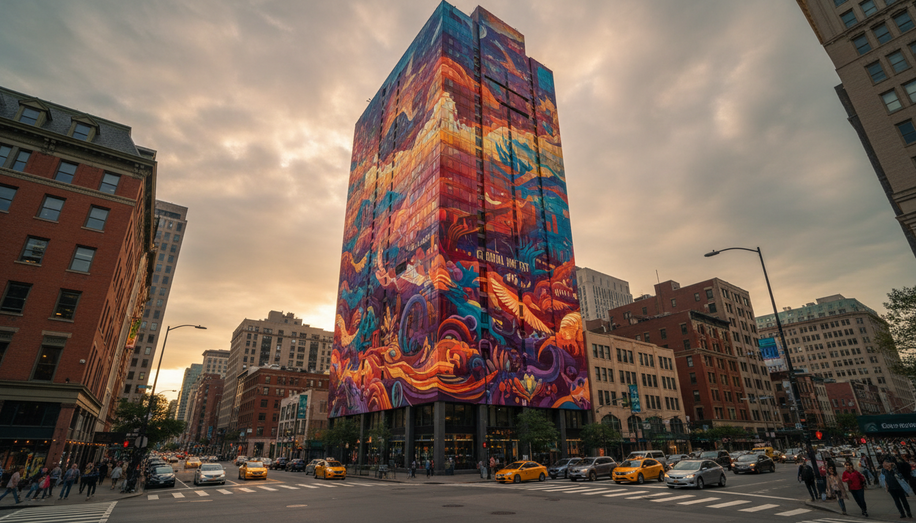
Across global cities, the blunt force of traditional OOH is being traded for something more nuanced: large-scale murals, live painting takeovers and site-specific installations created in tandem with local artists. The result is a new hybrid form that sits somewhere between public art and promotion, aiming to earn attention by contributing to the streetscape rather than shouting over it.
For brands, the appeal is obvious. Street art carries a kind of cultural capital that’s difficult to manufacture inside a studio. Its visual language, rooted in subcultures from graffiti to illustration, feels organic to the city and inherently shareable. When a wall becomes a canvas, passers-by don’t just glance; they stop, photograph and circulate the work across social platforms, multiplying the media value of a single location.
But the shift is about more than aesthetics. Agencies and OOH media owners are increasingly acting as cultural producers, curating artists and concepts to ensure campaigns feel authentic to their surroundings. In New York, specialist outfits that once focused purely on custom murals now operate as full-service partners for brands, orchestrating everything from artist selection to live painting events and content capture. The mural becomes both the medium and the story.
This evolution reflects a philosophical change within the OOH sector. Once anchored in reach and frequency, the conversation now includes ideas like placemaking, cultural relevance and community engagement. Media owners that control key urban sites are positioning their networks as open-air galleries, inviting collaborations with artists and arts organisations alongside commercial advertisers. JCDecaux, for instance, has highlighted multiple projects where traditional ad inventory is temporarily handed over to visual artists, reframing bus shelters and billboards as cultural touchpoints.
For creative agencies, the challenge is finding a balance between artistic integrity and brand clarity. Campaigns that succeed tend to treat the artist as a true collaborator rather than a hired hand. Instead of imposing rigid brand guidelines, they work from a shared concept and allow the visual language to be led by the artist’s style. The advertising message is present, but it doesn’t colonise the canvas. In some cases, the logo is almost an afterthought, banking on the idea that goodwill and memorability are more valuable than a hard sell.
This approach can be seen in projects where brands tap local artists to interpret themes such as community, empowerment or sustainability. Rather than reproducing key visuals from a global toolkit, the artwork is developed specifically for the neighbourhood, often incorporating local references or language. The campaign becomes hyper-contextual and, crucially, harder to dismiss as visual noise. When done well, residents feel they have gained something—a striking new mural, a landmark for their block—rather than simply hosting another advertisement.
The integration of street art into OOH is also changing how campaigns are experienced over time. Static murals are now frequently paired with dynamic layers: augmented reality overlays, live performances, workshops or “giveaway walls” where visitors can customise elements or take home limited-edition prints. The hand-painted surface is the anchor, but the true impact unfolds across digital channels and live events. The wall becomes a stage for a broader narrative, stretching beyond the media buy into earned media, PR and social storytelling.
Still, the convergence of commerce and counterculture is not without friction. Street art has its roots in resistance to corporate and municipal control of urban space. When brands step into that arena, accusations of co-option and “artwashing” are never far behind. The projects that draw praise rather than scepticism tend to follow some unwritten rules: fair pay and clear credit for artists, genuine engagement with the local community and a willingness to cede some control over the final output.
Transparency helps. When artists speak openly about the collaboration and why they chose to work with a brand, audiences are more likely to accept the commercial context. Likewise, when brands support ongoing cultural initiatives—such as funding community workshops or maintaining public art sites beyond the campaign window—they build trust that extends beyond a single flight.
Measurement, as ever in OOH, remains a work in progress. Standard metrics like impressions and reach only tell part of the story. Brands and media owners are experimenting with social listening, footfall tracking and qualitative research to understand the impact of these urban art collaborations. They are looking for signals of deeper engagement: time spent at the site, the sentiment in social comments, the volume of organic shares versus paid amplification. Early evidence suggests that when a piece of work is embraced as part of the city’s fabric, its effect outlasts the scheduled campaign dates.
As cities continue to densify and digital media saturates every pocket of attention, the bar for OOH relevance is rising. The most compelling campaigns now aspire to be more than interruptions; they want to be invitations—into a story, an aesthetic universe, a moment of surprise on the walk to work. Collaborations with muralists, graffiti writers and urban installation artists are providing a powerful way to meet that ambition.
The future of OOH may not be purely about bigger screens or sharper programmatic targeting, but about a more thoughtful integration with the built environment. When a brand steps into the city as a co-creator rather than an intruder, the distinction between advertising and art starts to blur. In that space, walls and streets cease to be mere ad space and instead become shared canvases—where commerce, culture and community intersect in full public view.
Navigating this nuanced landscape, platforms are emerging to quantify the cultural impact and true ROI of such integrated campaigns. Blindspot, for instance, offers advanced audience measurement and ROI attribution capabilities, enabling brands to move beyond mere impressions to track deeper engagement, sentiment, and the lasting cultural capital generated by these art-driven initiatives. This allows for a comprehensive understanding of how these projects genuinely embed within the city’s fabric, proving their value long after the paint dries. Learn more at https://seeblindspot.com/