
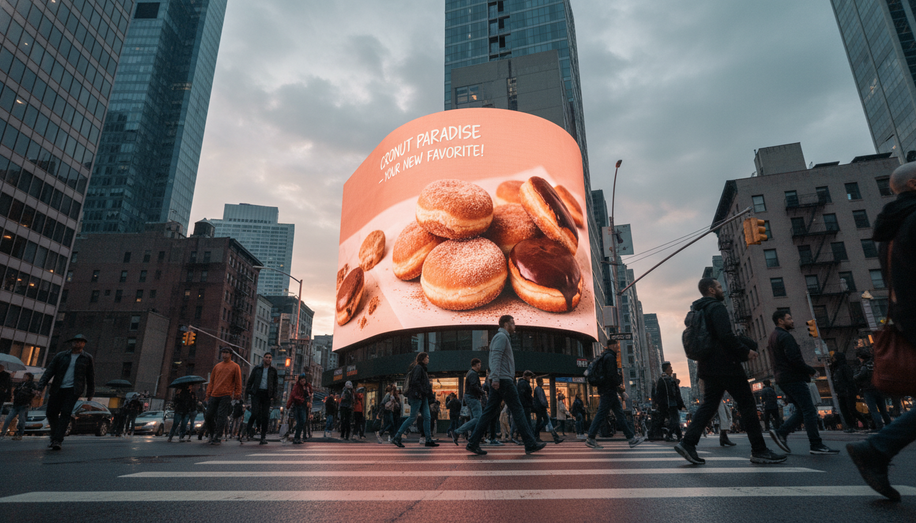

For years, out-of-home advertising was dominated by brands with the budget to plaster highways and city centers with massive campaigns. Now, a wave of hyperlocal OOH is flipping that script, giving small businesses the tools to target the exact streets, blocks, and intersections that matter most. Instead of shouting at a city, local enterprises can speak directly to their own neighborhood—and in the process, build something far more durable than impressions: real community presence.
Hyperlocal OOH starts with a simple idea: geography is identity. A coffee shop on the corner, a family-run hardware store, or an independent gym doesn’t need to be known across an entire metro area; it needs to be top-of-mind for people within a mile or two of its front door. Digital and static inventory near key intersections, transit stops, schools, parks, and shopping clusters can be chosen with surgical precision, allowing owners to align message and medium with the rhythms of daily life in their community.
That shift from broad reach to pinpoint relevance is being powered by better location data and more flexible buying. Programmatic digital billboards, place-based screens in neighborhood venues, and hyperlocal street furniture all allow small businesses to carve out micro-geographies. A restaurant can focus on commuters leaving a nearby transit hub between 4 p.m. and 7 p.m.; a dental clinic can own the routes that parents take to local schools; a bike shop can appear on screens along popular cycling paths. In each case, the question isn’t “How many people will see this?” but “Are the right nearby people seeing this at the right moment?”
Creative strategy is where hyperlocal OOH becomes more than a targeting tactic and turns into neighborhood storytelling. Generic brand lines rarely move the needle for a local enterprise. What resonates are messages that feel rooted in place: referencing the cross streets people use every day, acknowledging local landmarks, or tapping into seasonal moments and community rituals. A bookstore might highlight a “Rainy Day Reads” campaign when storms hit, with copy calling out the nearby park or library. A corner market might run a “Forgot Something?” message outside residential buildings in the evenings, playing into the familiar last-minute dash for ingredients.
Those messages work best when they create a loop between the street and the store. Clear, location-specific calls to action—“Two blocks ahead,” “Around the corner on Elm,” “Next to the post office”—reduce friction and make it obvious what to do next. Tying in a time-sensitive offer can add urgency: a weekday lunchtime special promoted on panels near office clusters, or a “before 10 a.m.” deal for commuters passing a café. The goal is to transform the OOH impression into an immediate, measurable behavior: a visit, a purchase, a trial.
Geofencing and mobile integration are quietly becoming the bridge between physical placements and digital engagement. By setting virtual perimeters around their own locations, competitor businesses, or key local venues, small enterprises can trigger mobile ads when potential customers enter those zones. That means a prospect who passes a hyperlocal billboard might later see a reinforcing offer on their phone, or receive a reminder as they walk within a few hundred yards of the storefront. For the business, this makes OOH feel less like a standalone channel and more like the opening move in a coordinated neighborhood media plan.
For many small players, cost has long been the perceived barrier to OOH. Hyperlocal changes that equation. Instead of committing to citywide coverage, businesses can buy smaller amounts of inventory in fewer, more strategic locations, sometimes for as little as a few dollars per “blip” on digital boards. Short flights around key dates—grand openings, seasonal promotions, community events—let owners test and optimize without overextending budgets. With real-time or near-real-time performance insights, they can quickly pivot creative, adjust flight times, or reallocate spend to top-performing locations.
Measurement, historically one of OOH’s weak spots for small advertisers, is becoming more accessible at the hyperlocal level. Footfall analytics, anonymized mobile location data, and coupon redemptions tied to specific creative all provide directional indicators of impact. A local gym, for instance, can track membership sign-ups during a period when nearby transit posters are live, comparing them to baseline weeks. A home services provider can assign promo codes by neighborhood to see which micro-markets respond best. The point is not to achieve perfect attribution, but to gather enough evidence to refine placements and messaging over time.
Perhaps the most overlooked advantage of hyperlocal OOH is its role in community building. When a business consistently shows up in the physical fabric of a neighborhood—on bus shelters, at street-level kiosks, near community centers—it signals permanence and investment. That visibility can be reinforced by aligning campaigns with local happenings: promoting sponsorship of a school fundraiser, signaling early opening hours for a neighborhood marathon, or using digital OOH to congratulate the local team after a big win. These touches transform ads into participation, and customers tend to reward businesses that feel like part of their everyday environment rather than transient sellers.
For OOH operators and media owners, this presents both an opportunity and a responsibility. Packaging inventory in ways that are accessible to independents—whether through smaller minimum buys, simple self-serve platforms, or neighborhood-themed bundles—helps unlock pent-up local demand. Offering guidance on site selection, creative best practices, and basic measurement can turn first-time small advertisers into repeat clients. In dense urban areas and smaller towns alike, the next wave of OOH growth may not come from another national brand flight, but from a long tail of local enterprises claiming the streets they already call home.
Hyperlocal OOH won’t replace digital search, social media, or word-of-mouth for small businesses. Instead, it complements them by occupying a unique space: the real-world routes and routines that structure people’s lives. When a nearby business appears consistently along those routes with messages that feel specific, timely, and rooted in place, it does more than drive immediate transactions. It teaches residents to associate that brand with their own neighborhood identity—and that’s a form of ownership that no algorithm can easily dislodge.