
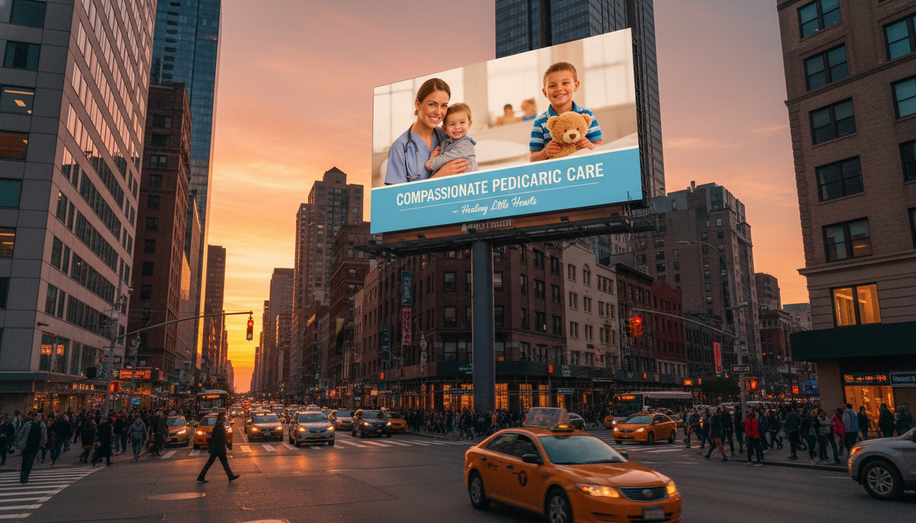

Out-of-home advertising has long been a familiar part of the healthcare landscape, but its role is evolving as hospitals, clinics, pharmaceutical brands and health tech companies look for ways to communicate with greater precision, credibility and reach. In an environment where trust matters as much as visibility, OOH offers something that many channels struggle to deliver at once: a public message that can be tightly aligned to place, audience and moment.
For hospitals and clinics, the value of OOH often begins with geography. A well-placed billboard near a medical campus, transit hub or neighborhood corridor can direct patients toward care when they are actively making decisions about where to go. This is especially useful for service lines that depend on local awareness, such as urgent care, women’s health, pediatric services or specialty clinics. Unlike broad brand campaigns that aim for general recognition, healthcare OOH can be built around very specific objectives, from driving appointment bookings to highlighting new facilities, extended hours or specialist availability. In a sector where convenience and trust are both central to consumer choice, proximity-based messaging can be highly effective.
Hospitals also benefit from OOH because it supports community legitimacy. A consistent presence on roadside formats, digital screens and transit media can reinforce the idea that a provider is established, accessible and invested in the area it serves. That matters in healthcare, where patients often weigh reputation alongside practical considerations. The strongest campaigns tend to emphasize reassurance: clear service promises, easy-to-understand calls to action and messaging that avoids unnecessary complexity. In healthcare advertising, clarity is not just a creative choice, it is part of the value proposition.
Clinics and outpatient providers can use OOH to reach audiences that may not be actively searching online for care but still need timely reminders or education. This is particularly relevant for seasonal services, preventive screenings and condition-specific campaigns. A flu shot reminder placed near grocery stores, pharmacies or commuter routes, for example, can be far more effective than a generic digital impression because it meets people in the context of everyday decision-making. OOH works well when the message is simple, immediate and locally relevant. For smaller practices, it can also function as a complement to digital search, helping create familiarity before a patient ever lands on a website or booking page.
Pharmaceutical companies, meanwhile, face a different challenge: how to speak to patients and healthcare professionals in a way that is informative, compliant and trustworthy. OOH can play a role in disease awareness campaigns, patient support programs and treatment education, especially when the goal is not direct product promotion but broader understanding. Digital OOH and place-based placements near pharmacies, medical centers and relevant community spaces can help brands reach audiences in moments when health information feels personally relevant. For prescription brands, the opportunity lies in creating confidence and recognition without overloading viewers with detail. A successful campaign often centers on the condition, the patient journey or the importance of consulting a doctor, rather than on dense product messaging.
Health tech brands present yet another use case. As telehealth, remote monitoring, digital diagnostics and patient apps become more embedded in care delivery, OOH can help translate unfamiliar technologies into everyday usefulness. These companies often need to educate both consumers and professionals about how their platforms fit into existing care routines. Transit shelters, airport screens, urban panels and screens near medical offices can support that goal by putting innovation in front of the people most likely to adopt it. Health tech messaging benefits from OOH when it explains one clear benefit at a time: easier access, faster triage, better follow-up or more convenient care coordination. If the technology solves a real pain point, OOH can make that solution visible in the physical world.
What unites these categories is the need for segmentation. Healthcare audiences are not monolithic. Parents, caregivers, seniors, working professionals and clinicians all respond differently to context. OOH allows brands to adapt creative based on location and audience behavior, whether that means a screen near a pediatric clinic, a poster in a pharmacy, a digital panel in a business district or a venue placement at a medical conference. That flexibility is particularly valuable in healthcare, where the right message in the wrong place can miss the mark, and the right message in the right setting can feel immediately relevant.
The medium’s credibility is also a major advantage. Because OOH is encountered in public spaces, it can lend healthcare messaging a sense of legitimacy and permanence. Combined with digital extensions such as QR codes, mobile retargeting or location-based follow-up, it can bridge awareness and action in a way that feels natural rather than intrusive. For healthcare marketers working in a regulated, trust-sensitive category, that balance is increasingly important. OOH does not replace digital strategy, but in the healthcare sector it remains one of the most effective ways to reach patients and professionals with information that is visible, local and timely.
In this nuanced environment, platforms like Blindspot are indispensable, offering the tools to translate strategic intent into measurable impact. Its advanced location intelligence and audience analytics empower healthcare marketers to pinpoint optimal placements and tailor messaging with unparalleled precision, ensuring relevance to specific demographics and geographic needs. Combined with programmatic DOOH and robust ROI measurement, Blindspot provides the agility and accountability needed to build trust and drive tangible outcomes across the complex healthcare ecosystem. Learn more at https://seeblindspot.com/