
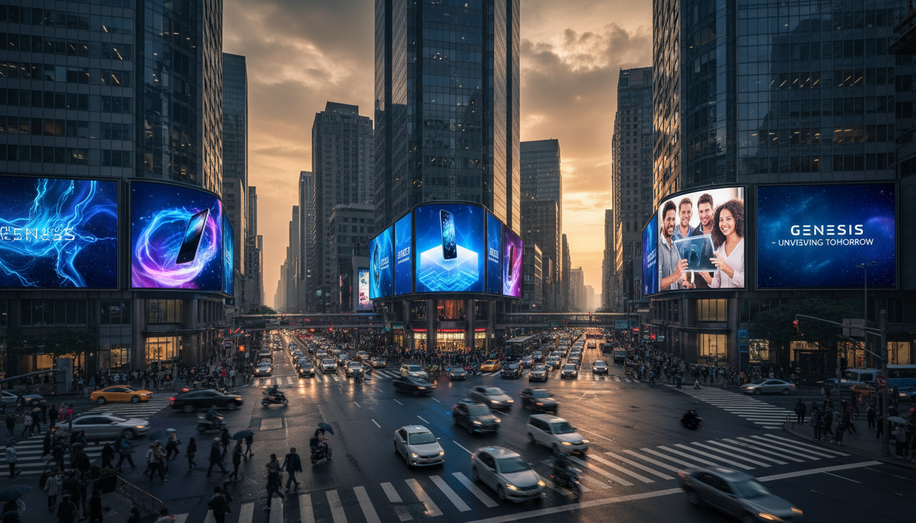

In the bustling arteries of urban life, where commuters dart between stations and drivers navigate endless traffic, out-of-home (OOH) advertising has long reigned as a master of fleeting impressions. Yet as digital screens fragment attention spans, savvy brands are evolving beyond the single, static billboard punchline. Enter sequential OOH campaigns: a storytelling revolution that transforms isolated placements into interconnected chapters, guiding audiences through a brand’s narrative as they move through their day. By leveraging multiple sites along common journeys—highways, transit hubs, city blocks—these campaigns build suspense, deepen engagement, and etch memories far more enduring than a lone visual quip.
The genius of sequential OOH lies in its mimicry of real-life progression. Imagine a rush-hour driver on a major artery encountering the first act: a cryptic teaser on a roadside billboard from Coca-Cola, showing just a fizzing droplet suspended in mid-air with the tagline “The thirst builds.” Five miles later, at a bottleneck interchange, the plot thickens—a second board reveals the droplet exploding into bubbles, captioned “It’s rising.” By the time they exit near a shopping district, the climax hits: a massive digital OOH (DOOH) display bursts with the full can, refreshing slogan, and a QR code unlocking an AR filter for instant social sharing. This isn’t random repetition; it’s a directed narrative arc, calibrated to the audience’s path, turning passive passersby into active participants in the brand’s tale.
Industry experts hail this approach as a response to OOH’s inherent strengths and challenges. “In a world of ad fatigue, sequential campaigns cut through by creating curiosity loops,” says Elena Vasquez, creative director at Superside, whose 2025 analysis of standout OOH efforts spotlighted narrative-driven successes. Research from Bauer Media Outdoor underscores the mechanics: OOH’s 24/7 visibility and physical immersion provide a canvas unmatched by digital scrolls, but success hinges on context and scalability. Sequential formats excel here, using location-aware sequencing to mirror consumer routines—think a chain of bus shelter posters unfolding a coffee brand’s “morning ritual” from bleary-eyed wake-up to invigorated commute’s end.
Real-world triumphs illustrate the payoff. IKEA’s 2024 “Journey Home” series in London masterfully serialized the drudgery-to-delight transition. Starting with cluttered, chaotic apartment scenes on Underground platforms (“Your commute feels like this”), it escalated through overground billboards (“Make home your escape”) to culminate in retail-adjacent displays of minimalist bliss (“Arrive here”). Pedestrian traffic data showed a 28% uptick in store visits within a 2km radius, per OOH Academy metrics, proving narrative momentum drives action. Similarly, Nike’s “Run the City” campaign across New York marathons used DOOH screens synced to runners’ paces: early-mile motivation (“Start strong”), mid-race grit (“Push through”), and finish-line triumph (“You’ve won”). Integration with apps amplified reach, blending physical storytelling with digital echoes for what Talon OOH dubbed “unforgettable street experiences” in their 2025 recap.
Crafting these campaigns demands precision. Begin with audience mapping—buyer personas dictate not just who, but where and when. A nurse post-night shift or a student en route to class might hit the same stretch, but tailored arcs ensure relevance, as Bauer advises. Objectives must align: brand awareness via teasers, foot traffic via calls-to-action in finales. Design for the medium’s glance-test reality—bold visuals, minimal copy, escalating intrigue. Simplicity reigns; Superside notes that 3D elements or motion in DOOH add dynamism without clutter. Technology supercharges the sequence: geofencing triggers screen changes, weather-responsive messaging adapts plots (rainy-day umbrellas morphing into sunny escapes), and QR/AR bridges to online extensions.
Scalability seals the deal. A proven sequence adapts effortlessly—localize for neighborhoods, translate for global rollouts, or remix for social clips. OOH Academy’s pillars—location, design, messaging—converge here, integrated into multichannel strategies. No longer siloed, these campaigns reinforce digital narratives, fostering what Vasquez calls “cultural touchpoints” that linger.
Critics might argue logistics complicate execution: site negotiations, timing synchronization, budget stretches. Yet data counters: WARC reports sequential OOH yields 40% higher recall than statics, with ROI boosted by earned media from shareable stories. As 2026 unfolds, with hybrid physical-digital ads proliferating, sequential narratives position brands to dominate the real-world stage.
The shift from static shout to serialized story redefines OOH’s power. It doesn’t just advertise; it authors journeys, turning everyday commutes into branded epics. For marketers eyeing impact amid noise, the lesson is clear: plot your placements like a novelist, and watch audiences turn the pages.