
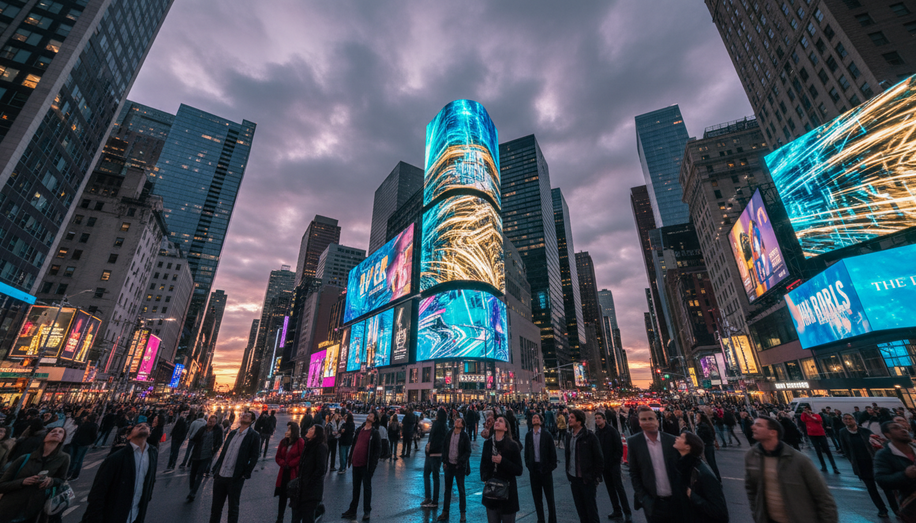

In the sprawling urban landscapes where commuters rush and shoppers weave, out-of-home advertising asserts itself with unapologetic dominance. A towering 14-by-48-foot billboard doesn’t whisper; it roars, leveraging its colossal scale to pierce the veil of daily distraction. This isn’t mere spectacle—it’s rooted in the psychology of perception, where size triggers an instinctive response in the human brain. Neuroscience research from Ocean NeuroScience underscores this, revealing that consumers are 2.5 times more aware of OOH media compared to digital ads. The brain, wired for survival, prioritizes large, novel stimuli in the environment, mistaking them for potential threats or opportunities. As drivers grip their steering wheels or pedestrians glance skyward, these massive formats hijack the attention system, creating fleeting but potent moments of undivided focus that static online banners can only dream of.
Scale alone, however, is amplified by motion and context, particularly in digital out-of-home (DOOH) formats. When a digital billboard pulses with changing visuals or unexpected animations, it exploits the brain’s dopamine pathways. Studies from the Outdoor Media Association in Australia demonstrate that DOOH delivers 63% more impact than static signs, often in just a one- or two-second glance. This neurological edge stems from the alerting response: sensory cues that demand interpretation—think shifting colors or bold typography—override mental filters, especially in high-traffic zones where predictability reigns. Nielsen’s data bolsters the case, showing OOH achieving a 47% brand recall rate, eclipsing digital media’s 35%. Viewers don’t just see the ad; they encode it with contextual richness—the snarl of rush-hour traffic, the hum of a bustling sidewalk—forging memories laced with sensory detail that digital impressions lack.
Strategic placement elevates this psychological prowess, transforming OOH from passive backdrop to active influencer. Positioned at busy intersections, transit hubs, or retail corridors, these ads infiltrate the viewer’s physical journey, capitalizing on dwell time. Stuck in gridlock or awaiting a bus, consumers have no escape, their gaze drawn inexorably to the behemoth before them. PML Group’s IMPACT Attention study found OOH capturing 83% of consumers’ focus, a feat attributed to its integration into real-world navigation. Psychologically, this placement invokes priming: subtle cues like vibrant hues or symbolic imagery seep into the subconscious, predisposing viewers to favorable brand associations. A luxury watch ad looming over an upscale shopping district doesn’t just advertise; it mirrors the prestige of its surroundings, leveraging the halo effect where environmental cues enhance perceived value.
This interplay of size and site also conveys brand prestige, tapping into social proof and the mere-exposure effect. Enormous formats signal investment and confidence, implying a brand substantial enough to claim public space. In high-visibility locales, OOH becomes a status symbol, akin to a corporate skyscraper piercing the skyline. Research from OUTFRONT Media reveals 68% of U.S. adults notice OOH en route to stores, with 42% reporting it sways in-store purchases—a direct pipeline from perception to action. The psychology here is primal: humans equate scale with authority, much like ancient monuments that awed tribes. A supersized campaign for a premium automotive brand on a freeway overpass doesn’t sell cars; it sells aspiration, embedding the marque in the viewer’s mental hierarchy of desirability.
Yet, the true alchemy occurs when boldness meets brevity. OOH’s vast canvas demands simplicity—striking visuals, minimal text, emotional hooks—that align with how the brain processes information under duress. Cognitive load is low during passive exposure, allowing rapid absorption. Add a QR code or hashtag, and the passive glance morphs into active engagement, bridging physical impact with digital measurability. Critics might dismiss OOH as relics in a mobile-first era, but data tells otherwise: Ocean Outdoor reports premium large-format DOOH garners five times more attention than online formats, with longer viewing durations.
As advertising evolves, the psychology of scale reaffirms OOH’s enduring edge. In an attention economy starved by endless scrolls, these physical giants command the gaze, shape perceptions, and elevate brands from noise to necessity. Marketers who master size and placement don’t just advertise—they architect moments of influence, turning everyday commutes into corridors of prestige and persuasion. The lesson is clear: in a world of pixels, the tangible triumph endures.