
In the high-stakes world of out-of-home (OOH) advertising, where billboards flash by at 60 miles per hour and transit wraps vie for fleeting glances, creative optimization has long relied on the simplicity of A/B testing. Swap one image for another, tweak a headline, and measure which version drives more foot traffic or brand lift. But as audiences grow savvier and media fragmentation accelerates, this binary approach falls short. Enter multivariate testing—a sophisticated methodology borrowed from digital realms and now reshaping OOH campaigns by dissecting how multiple design elements interact in real-world chaos.
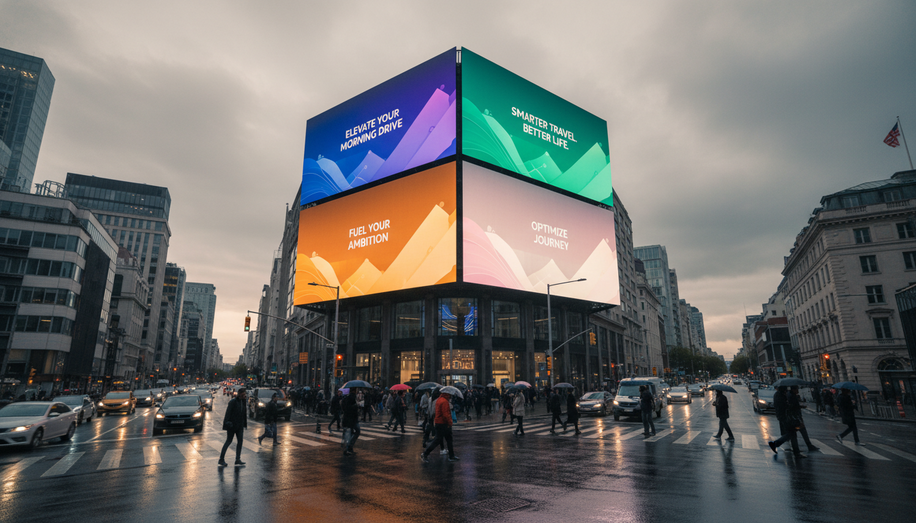
Multivariate testing, or MVT, diverges sharply from A/B’s isolationist tactics. Rather than pitting two variants against each other, MVT deploys dozens of combinations simultaneously, exposing traffic to permutations of headlines, colors, imagery, typography, and calls-to-action. Imagine a highway billboard series testing three taglines (“Drive the Future,” “Unleash Power,” “Unleash Power”) paired with two vehicle angles (frontal dynamic shot versus lifestyle scene), three background hues (vibrant sunset, urban grit, sleek black), and two font styles (bold sans-serif or elegant script). That’s 36 unique creatives in play, each vying for eyeballs across a geo-fenced rotation. The result? Not just a winner, but revelations about synergies—like how the “Unleash Power” line soars with gritty urban backdrops but flops against sunsets.
This power stems from MVT’s ability to capture interactions that A/B misses. In OOH, where dwell time averages mere seconds, elements don’t perform in silos. A punchy headline might excel with contrasting colors that pop against a subway car’s metallic sheen, yet tank on a sun-drenched digital billboard. Pioneering agencies like Tinuiti and Pathlabs have adapted MVT for OOH by leveraging advanced measurement tools: ethnographic eye-tracking studies, mobile geofencing for recall surveys, and AI-driven facial recognition at high-traffic nodes. A recent campaign for a luxury automaker, for instance, rotated 48 variants across 200 digital OOH faces in Los Angeles. Post-exposure surveys via app intercepts revealed that a specific combo—lifestyle imagery with benefit-focused copy and high-contrast CTA—boosted message recall by 28% over the control, while uncovering that red accents inadvertently fatigued urban commuters.
Efficiency is another MVT hallmark, especially vital in OOH’s budget-intensive landscape. Traditional A/B requires sequential runs, eating weeks and inflating production costs for custom vinyls or LED renders. MVT consolidates this into one blitz, often powered by dynamic creative optimization (DCO) platforms like those from Marpipe or AdStellar. These tools algorithmically generate and serve variants based on real-time data—weather, time of day, even pedestrian demographics inferred from connected vehicle signals. For a national beverage brand’s transit dominance in New York, MVT slashed testing timelines from three months to three weeks, identifying a winning triad of playful copy, effervescent visuals, and urgent CTAs that lifted engagement scores by 35% across buses and stations.
Yet MVT demands rigor to avoid pitfalls. It guzzles traffic volume—far more impressions than A/B—to achieve statistical significance, a challenge in OOH’s variable audiences. Experts at Adventure PPC emphasize allocating 20-30% of campaign budget upfront, with minimum exposures per variant hitting 50,000 for robust insights. Over-testing micro-elements like subtle gradients risks diluting results, so focus on high-impact levers: visuals (proven to snag 70% of OOH attention), messaging hierarchy, and spatial composition. Tools like Behavio’s predictive testing layer in pre-launch AI to cull underperformers, ensuring only primed combos hit the streets.
The payoff extends beyond metrics. MVT fosters a testing culture that outpaces gut instinct, as noted in Rise’s guides. Brands like those partnering with Amplitude have used it to decode audience psychographics—revealing, say, how younger demographics respond to interactive QR elements paired with aspirational imagery on mall totems. In one Chicago study, multivariate rotations on expressway boards showed emotional tones (joy versus urgency) interacting with cultural motifs to double dwell time among diverse commuters.
As OOH evolves with programmatic buying and AR overlays, multivariate testing isn’t a luxury—it’s table stakes. It transforms guesswork into granular intelligence, pinpointing combos that not only recall messages but ignite engagement in an attention economy more crowded than ever. For advertisers ready to graduate from A/B basics, MVT offers the holistic lens to dominate the visual frontier, one optimized impression at a time.