
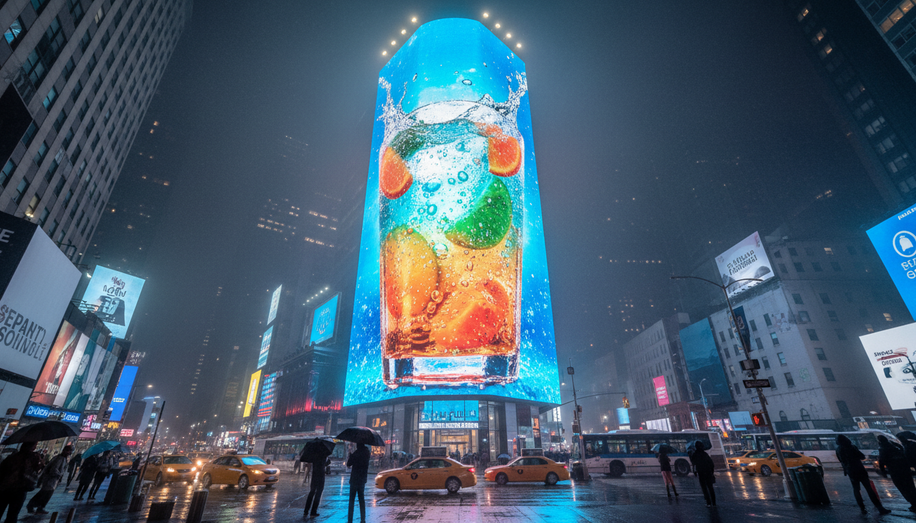

Our brains process the world around us in milliseconds, making split-second judgments about what deserves our attention and what we can safely ignore. In the crowded landscape of modern advertising, out-of-home media exploits a fundamental neurological truth: size and strategic placement bypass our mental filters in ways that smaller, more intimate advertising channels simply cannot achieve.
The psychology of scale begins with a simple neurological fact. A 14 by 48-foot billboard cannot be avoided. It remains in view the entire time a consumer passes by, commanding attention through sheer physical presence. This isn’t accidental positioning—it’s rooted in how human perception actually works. When confronted with large-format displays, our brains allocate disproportionate cognitive resources to processing them. We cannot look away without conscious effort, a phenomenon far different from scrolling past a digital ad on a mobile device.
Research from Ocean Outdoor reveals that premium large-format digital out-of-home advertising attracts five times more attention than online digital formats, with significantly longer viewing time. This disparity isn’t merely about bigger being better. Rather, scale fundamentally alters how our nervous systems respond to visual stimuli. The dopamine system, which plays a crucial role in attention capture, responds more robustly to sensory experiences that occupy our visual field substantially. A billboard doesn’t compete for our attention in the way a digital ad does—it dominates our immediate environment.
Strategic placement amplifies the psychological impact of scale. High-traffic locations ensure that size translates directly into frequency of exposure, yet the most effective placements often aren’t simply those with the highest foot traffic. Locations where consumers naturally move slowly or remain stationary—transit hubs, traffic intersections, waiting areas—offer what researchers call “dwell time advantage.” When someone is stuck in traffic or waiting for public transport, they have little choice but to engage with their surrounding environment. That extended exposure window, combined with the billboard’s inescapable scale, creates conditions for deep cognitive processing that typically occurs in just three to seven seconds.
The location’s prestige also influences perception in subtle but measurable ways. A billboard in a premium area like Oxford Street or Canary Wharf doesn’t just reach more people—it changes how those people perceive the advertised brand. Consumers subconsciously link the credibility of the location to the brand itself, a psychological phenomenon known as environmental priming. The prestige of a location becomes inseparable from the perceived legitimacy of the advertisement.
Size and scale also enable creative boldness that would be impossible to execute effectively in smaller formats. Bold colors, striking visuals, and innovative installations capture attention by stimulating sensory responses more intensely than their scaled-down equivalents. Research demonstrates that high-contrast color combinations can improve recall by up to 38 percent, a benefit that scales with the advertisement’s physical dimensions. A vibrant image on a massive display creates a stronger emotional reaction than the same image would on a personal device.
Crucially, OOH environments typically feature fewer competing messages than digital spaces. While a single webpage might contain dozens of advertising elements vying for attention, a billboard stands alone in its physical space. This isolation is psychologically powerful. Our brains evolved to process one dominant visual stimulus at a time. When faced with multiple competing messages, we become fatigued and retention plummets. A well-placed billboard offers undivided visual attention—a rare commodity in today’s fragmented media landscape.
The most effective OOH campaigns recognize that design simplicity amplifies scale’s psychological impact. Limited text of seven words or fewer, combined with uncluttered layouts, ensures that the advertisement’s size translates into maximum cognitive processing rather than overwhelming the viewer. Scale without clarity becomes visual noise.
As digital channels become increasingly saturated and consumers grow more sophisticated at filtering out intrusive advertising, OOH’s fundamental advantages become more pronounced. The psychology of scale reveals a truth that no algorithm can replicate: in a world drowning in digital distractions, sometimes the most effective advertising is simply unavoidable.
Leveraging these inherent psychological advantages in out-of-home advertising requires precision, ensuring every large-format display truly commands attention. Blindspot empowers advertisers with location intelligence and audience measurement tools to pinpoint optimal sites with maximum dwell time and prestige, while real-time performance tracking and ROI measurement validate their unavoidable impact. This ensures OOH campaigns cut through digital noise, delivering deep cognitive processing and undivided visual attention where it matters most: https://seeblindspot.com/