
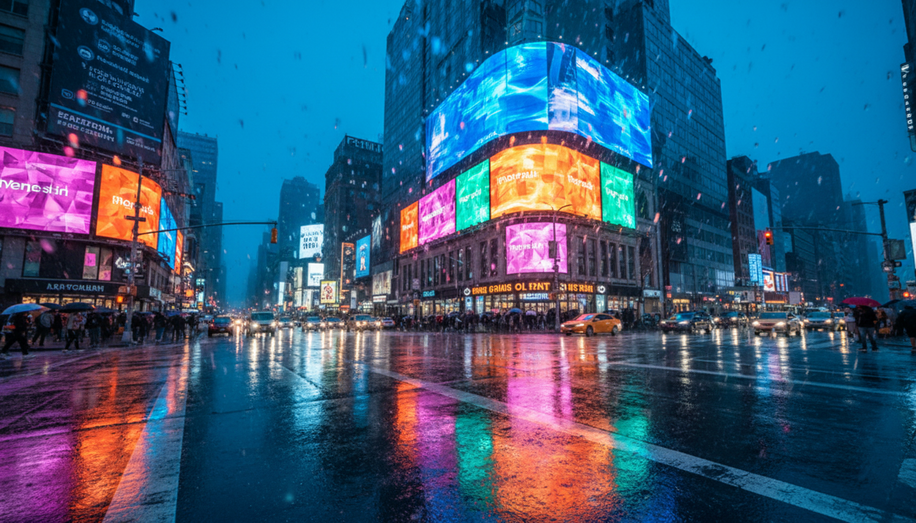

In the fleeting world of out-of-home (OOH) advertising, where commuters glance at billboards for mere seconds and pedestrians absorb messages amid urban chaos, color emerges as the silent powerhouse dictating perception and memory. Far beyond mere aesthetics, color psychology shapes how viewers emotionally process ads, forging instant connections that linger long after the glance has passed. Strategic palettes don’t just catch the eye—they embed brands in the subconscious, boosting recall by triggering universal emotional responses rooted in human evolution and culture.
At its core, color influences viewer perception well before words or logos register, often within the critical first three seconds of exposure. Warm hues like red command immediate attention by elevating heart rates and evoking urgency, passion, and excitement, making them ideal for sales promotions or calls to action in OOH campaigns. Fast-food giants such as McDonald’s harness red alongside yellow to stimulate appetite and happiness, a combo that grabs drivers’ focus on highways and cements brand hunger cues in memory. This physiological jolt—red’s ability to accelerate reactions—proves especially potent in high-speed OOH environments, where static or digital displays must compete with motion blur.
Cool colors, by contrast, soothe and build trust, countering the overstimulation of outdoor settings. Blue, synonymous with calm, reliability, and professionalism, dominates finance and tech billboards, from PayPal’s serene interfaces to Facebook’s reassuring feeds transposed onto urban screens. Its calming effect reassures viewers, enhancing message retention by associating the brand with stability amid daily stress. Yet, color’s impact extends to memory consolidation: consistent schemes across OOH assets can lift brand recognition by up to 80%, as neural pathways link hues to emotional narratives.
Emotional resonance amplifies this further. Yellow and orange inject optimism, energy, and youthful joy, spurring quick reactions in nonprofits or startups aiming for innovation vibes—think Nickelodeon’s citrus bursts on city posters that scream fun and approachability. Green signals growth, health, and sustainability, as Whole Foods demonstrates by blanketing OOH with verdant tones that subconsciously promise organic purity. These associations aren’t arbitrary; they’re wired into psychology, where green evokes nature’s tranquility, fostering positive recall for eco-brands even in polluted cityscapes.
Purple, the hue of royalty, conveys luxury and excellence, perfect for beauty or wealth management campaigns where exclusivity drives desire. Its rarity in nature heightens perceived value, making purple-clad billboards stand out as premium invitations rather than everyday pitches. However, success demands harmony: clashing palettes dilute impact, while thoughtful combinations—like red’s punch tempered by blue’s trust—create visual flow that aids memory encoding.
Cultural nuances add layers of complexity, demanding tailored selections for global OOH reach. In Western markets, white symbolizes purity and simplicity, clearing mental space for messaging, but in parts of Asia, it mourns loss, potentially repelling audiences. Emotional palettes must thus resonate locally: a vibrant orange might energize Latin American commuters, while muted earth tones soothe Scandinavian sensibilities. Data-driven testing, including A/B variations on digital OOH (DOOH), reveals these subtleties, with dynamic color shifts personalizing impact based on time, weather, or demographics.
Memory maximization hinges on contrast and context too. High-contrast combos—yellow text on deep blue, for instance—cut through daylight glare, ensuring legibility and embedding visuals deeper into long-term recall. Motion in DOOH amplifies this, as pulsing reds or transitioning greens mimic emotional rhythms, overcoming attention fatigue in video-like formats. Brands ignoring these principles risk invisibility; one study notes color alone sways purchasing intent by evoking subconscious motivations before rational evaluation kicks in.
Ultimately, masterful OOH design treats color as a psychological architect, selecting palettes that align with brand ethos while culturally and emotionally priming audiences for action. Coca-Cola’s bold red pulses with energy across generations, not by accident but by exploiting color’s primal pull on perception and memory. As urban landscapes densify and DOOH evolves, advertisers who decode these cues—testing rigorously, harmonizing intuitively—don’t just advertise; they imprint indelibly, turning split-second sightings into lasting loyalty. In an era of sensory overload, color remains the unerring guide to campaign triumph.