
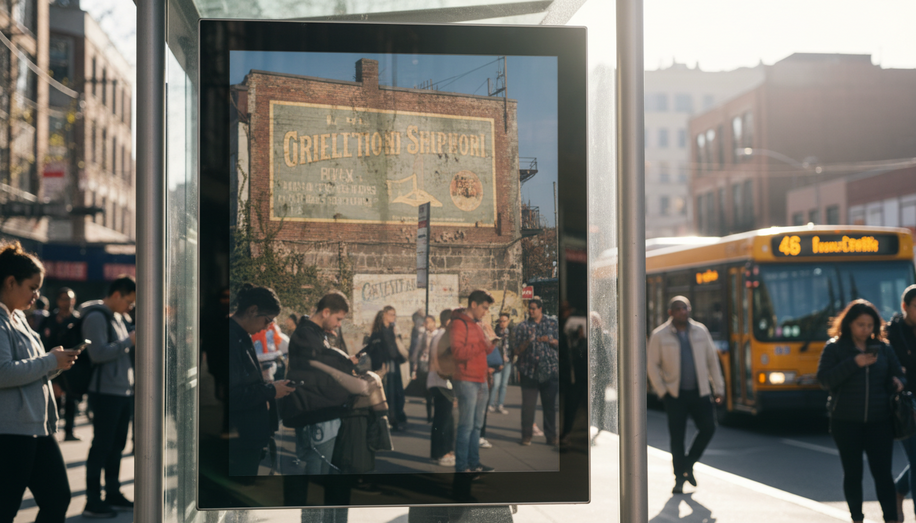

In the shadowed alleys of ancient Egypt around 3000 B.C., towering stone obelisks carved with hieroglyphics announced laws and treaties to passersby, marking the humble genesis of out-of-home advertising as a public communicator. This primal form of messaging evolved through Greek and Roman eras, where inscriptions on walls and monuments hawked goods and events, embedding OOH into the fabric of daily life long before digital screens or data analytics. Fast-forward to the 1400s, when the printing press birthed handbills, and by the late 1700s, vibrant illustrations plastered urban surfaces, captivating illiterate crowds with bold visuals.
The 19th century ignited OOH’s modern ascent, fueled by the Industrial Revolution’s urban sprawl and technological leaps. In 1835, Jared Bell, an enterprising printer, unveiled the first oversized posters—50-square-foot lithographed marvels promoting Barnum & Bailey’s circus spectacles, pasted across New York walls. These hand-painted and glued behemoths directed throngs to local shops during rush hours, blending artistry with strategic timing. By 1867, the landmark leasing of billboard space transformed advertising from opportunistic postings to a structured business, enabling landowners to monetize walls and sparking purpose-built structures. Standardization followed: the 1889 Paris Exposition introduced the iconic 2:1 poster format, stitched from 24 sheets into seamless giants.
The early 20th century cemented OOH’s cultural dominance amid America’s roadway boom. As automobiles proliferated, billboards sprouted along highways, their standardized sizes—pioneered by emerging agencies—turning landscapes into branded canvases. The 1891 formation of the Associated Bill Posters’ Association, now the Out of Home Advertising Association of America (OAAA), professionalized the industry with regulations and best practices. Governments co-opted the medium too: during World War II, mobile billboards—motorized trucks retrofitted with massive panels in the 1920s—rolled out war bond drives and recruitment calls, penetrating remote areas where radio faltered. Formats diversified into transit shelters, street furniture, and airport signage, while 1910s Times Square ignited with the first electric billboards, hinting at illumination’s allure.
Yet OOH’s true resilience shone through societal upheavals. The 1971 tobacco ad ban on broadcast media funneled budgets to print and outdoor, with brands like cigarette makers flooding billboards. In 1972, the OAAA’s ingenuity peaked with a measurement campaign featuring Miss America Shirley Cochran; her national name recognition surged 940 percent post-exposure, proving OOH’s measurable clout. Regulations in the 1990s refined content standards, filtering messages amid growing scrutiny, but failed to dim the medium’s glow.
The early 2000s heralded the digital revolution, birthing digital out-of-home (DOOH) as static billboards yielded to LED screens capable of real-time updates. Times Square’s dazzling arrays epitomized this shift, cycling multiple messages by daypart, weather, or audience data for hyper-relevant impact. DOOH exploded into transit screens on buses and trains, retail networks, airport hubs, office lobbies, and immersive 3D installations—formats blending visual spectacle with dynamic adaptability. Programmatic OOH (pOOH) further elevated it, automating buys with data-driven precision, mirroring online ad tech while anchoring brands in physical spaces.
Through pandemics, economic crashes, and media fragmentations, OOH endured by pivoting. Hand-painted posters weathered wars and depressions when radio and TV flickered; digital iterations thrived amid streaming’s rise, offering unskippable, location-based reach immune to ad blockers. Today, AI-infused analytics track impressions and conversions, transforming OOH from artful guesswork to a data powerhouse in integrated campaigns. Its evolution—from Egyptian obelisks to AI-orchestrated screens—underscores a timeless truth: in an ever-shifting world, OOH’s physical presence commands attention, adapts seamlessly, and drives real-world action, proving its indelible place in advertising’s pantheon.