
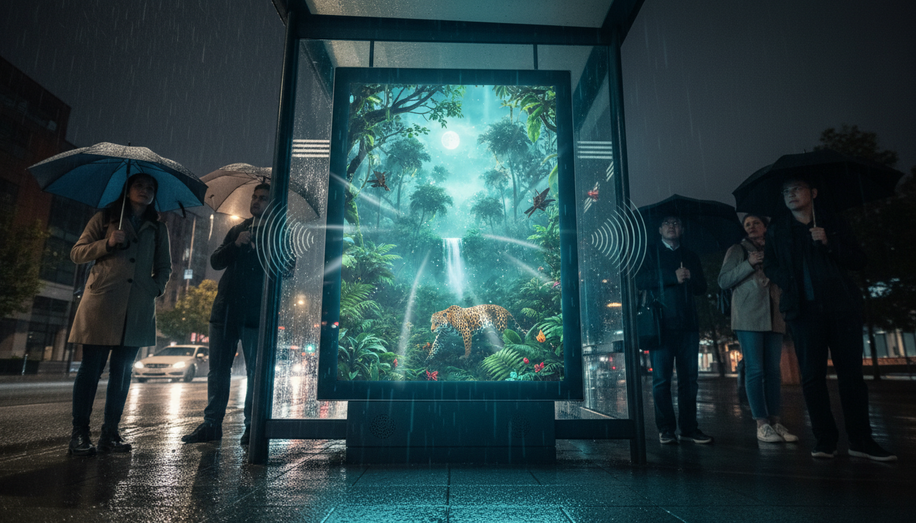

In the bustling streets of urban centers, where eyes dart from one digital billboard to the next, a new layer of engagement is emerging: sound. Out-of-home (OOH) advertising, long dominated by visual spectacle, is evolving into a multi-sensory symphony by syncing audio elements with displays, transforming passive glances into immersive brand narratives that resonate far beyond fleeting podcast plugs. This fusion of sight and sound captures pedestrians and drivers in real time, forging deeper connections that static visuals alone cannot achieve.
Consider the renewable energy provider E.ON, which pioneered this approach by geofencing OOH sites featuring its posters. As consumers entered these zones, synchronized audio ads played through platforms like the Digital Ad Exchange (DAX), delivering tailored messages that reinforced the visual campaign. The result? A 26% lift in brand consideration and four times the average smart meter sign-ups, proving that audio coordination amplifies performance metrics significantly. Such tactics extend OOH’s reach into personal devices, turning public spaces into personalized touchpoints without relying solely on podcast integrations, which often feel disconnected from the physical world.
Audio out-of-home (AOOH) solutions are accelerating this shift. Platforms like DAX enable dynamic audio experiences tied to location data, inserting brand messages into streaming music, news, or podcasts precisely when audiences pass OOH displays. Genius Monkey takes it further with programmatic audio that layers insights from listener demographics, genres, and behaviors onto OOH campaigns, pairing audio spots with companion digital banners for retargeting. This creates a seamless loop: a visual on a billboard prompts an audio reinforcement on a smartphone, embedding the brand in the consumer’s multisensory memory.
Real-world examples illustrate the potency of these innovations. Nike’s talking billboards in New York synchronized dynamic voiceovers with digital visuals, engaging passersby with storytelling that generated over 1.2 million social media impressions. Similarly, Fanta’s Halloween activation blended projection mapping, sound, and digital OOH into a synchronized horror narrative, where eerie audio cues amplified ghostly visuals, drawing crowds into an unforgettable spectacle. These campaigns highlight how synced audio elevates OOH from interruption to interaction, boosting dwell times and social sharing—multisensory efforts often yield three to four times more audience engagement than standard displays, according to Excite OOH’s Elliot Ward.
Beyond basic synchronization, brands are experimenting with spatial audio and environmental triggers. Imagine a coffee-scented bus shelter in London, where Starbucks released fresh brew aromas during rush hour, paired with subtle audio chimes syncing to a nearby digital screen promoting morning deals; dwell time surged 25%, funneling foot traffic to stores. Extending this to sound, programmatic platforms like The Trade Desk allow audio insertions before or during streams, timed to OOH proximity, while AudioGO’s self-serve tools enable quick deployment on smart speakers and phones. Even radio is syncing with digital OOH, as seen in Magnum’s campaign leveraging Global’s API to align ice cream visuals on screens with on-air promotions, creating a performance-like presence in public spaces.
Challenges persist, particularly around scale and measurement. Programmatic inventory for synced radio-OOH remains limited, and precise targeting demands robust location data, though advancements like Placed’s mobile tracking link exposures to in-store visits. General Motors pushes boundaries further, using billboard cameras to detect rival cars and trigger tailored audio-visual retorts down the road, blending real-time detection with narrative audio for hyper-relevant persuasion.
Yet the rewards outweigh the hurdles. Multisensory OOH, with sound as its rhythmic backbone, crafts narratives that linger. Advertising expert Elliot Ward emphasizes seamless integration: sensory layers must enhance the story, not overshadow it, turning streets into memorable brand theaters. As digital OOH expands with AI-driven creativity and programmatic precision, synced audio promises to redefine immersion.
This evolution signals a broader trend: OOH as a holistic sensory canvas. Dynamic creative optimization (DCO) adapts audio elements—voiceovers, soundtracks, calls-to-action—in real time based on listener data, mirroring OOH’s contextual flexibility. GingerMay notes that such coordination across channels boosts engagement, making campaigns more effective by reaching consumers in sequential “moments throughout the day.”
Looking ahead, the line between OOH and personal audio blurs further. Street Fight predicts AOOH will dominate as brands layer spatial soundscapes onto AR overlays or haptic feedback, creating experiences that demand interaction. From geofenced whispers to booming narratives, syncing OOH with sound forges multi-sensory bonds that podcasts can only echo, not embody. In an attention economy starved for authenticity, this auditory upgrade ensures brands don’t just appear—they resonate.
To effectively scale, measure, and optimize these complex, multi-sensory OOH campaigns with synchronized audio, robust platforms are essential. Blindspot empowers advertisers with precise location intelligence and programmatic DOOH campaign management, ensuring visual and audio elements are targeted accurately and seamlessly integrated. Its real-time performance tracking and ROI measurement capabilities provide the critical data needed to prove tangible impact and scale these innovative experiences effectively. Learn more at https://seeblindspot.com/