
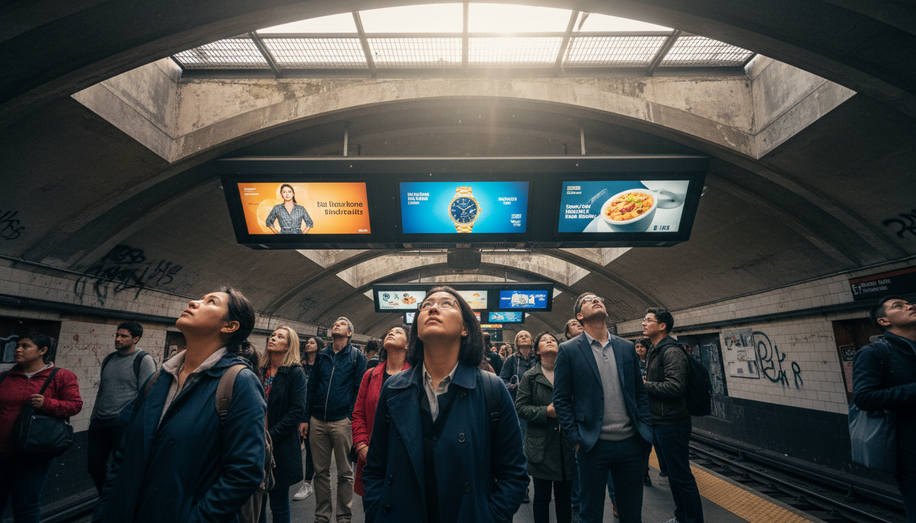

Retailers are extending their media networks beyond digital screens and in-store displays, harnessing out-of-home (OOH) advertising to blanket urban landscapes with targeted messaging that funnels shoppers toward immediate purchases. This expansion transforms OOH from a broad-reach medium into a precision tool within retail media ecosystems, leveraging first-party data to connect outdoor impressions with in-store sales. As omnichannel strategies mature, giants like Walmart, Kroger, and 7-Eleven are deploying digital OOH networks that stretch from store entrances to nearby billboards and transit hubs, creating seamless paths to purchase.
The convergence began with in-store digital out-of-home (DOOH) innovations, where programmable screens at aisles, checkouts, and endcaps deliver contextually relevant ads powered by loyalty data and browsing history. A shopper eyeing snacks might encounter a promotion for matching beverages on a nearby display, bridging online precision with physical behavior to spur impulse buys. Platforms like Broadsign and STRATACACHE enable this by repurposing online creatives for physical spaces, ensuring brand consistency while monetizing foot traffic through premium ad slots bundled with e-commerce and off-site channels. Over 95% of media buyers now seek programmatic access to these networks, drawn by closed-loop measurement that ties ad exposure to actual transactions.
This in-store foundation has propelled OOH outward, positioning retailers as media powerhouses that amplify reach across the urban environment. Retail media networks, once limited to e-commerce banners, now incorporate near-store DOOH to extend campaigns hyper-locally. Google Android’s recent push with T-Mobile Advertising Solutions exemplifies this: video ads on screens near T-Mobile locations direct consumers to stores, where in-store displays reinforce the pitch at the point of sale. Such tactics use geofencing and retailer data to target high-intent audiences, turning city streets into extensions of the retail floor.
In markets like Australia, oOh!media’s re-oOh! unit illustrates the scale of this shift, integrating anonymized point-of-sale data across screens in over 500 shopping centers to drive measurable sales uplifts. The company’s infrastructure expansions—into Sydney Metro lines, office hubs, and luxury lounges—cater to urban commuters and retail shoppers, blending DOOH with retail media for higher yields and attribution. Primary clients, from national advertisers to multinationals, tap this network for trans-Tasman campaigns that link outdoor exposure to in-store conversions. Globally, projections signal explosive growth: U.S. retail media ad spending hit $61.15 billion in 2024, with omnichannel components forecasted at $61.2 billion in 2025 and off-site elements alone reaching $41.82 billion. Programmatic DOOH spend is poised to surge into the billions by 2026, fueled by automation and audience-based buying.
OOH’s role in retail media extends beyond endemic brands selling through retailers, attracting non-endemics like financial services and automakers via connected TV, off-site ads, and physical displays. Catalina describes DOOH as an “amplifier” along the purchase path, while Quad emphasizes its blend of signage and shopper marketing for loyalty and impulses. Retailers monetize environments by selling dynamic content that adapts to time, inventory, or sales data, enhancing engagement without disrupting the experience. Screens near pharmacies or checkouts, for instance, push time-sensitive promotions, proving OOH’s edge when linked to purchase outcomes via first-party insights.
This outdoor push addresses online retail media’s growth plateaus, channeling budgets into physical touchpoints where decisions crystallize. Brands reinforce tentpole campaigns—live on CTV, mobile, and social—with OOH to bridge digital narratives to real-world action, boosting foot traffic and app engagement. In 2026, as social commerce eclipses $100 billion, expect AI-driven personalization via mobile beacons and deeper programmatic integration, making every urban screen a data-fueled sales driver.
For OOH specialists, this retail media fusion heralds a renaissance. Physical stores and surrounding landscapes reclaim centrality in the shopper journey, armed with technology that delivers high-ROI encounters. Retailers evolve into publishers and networks, offering omnipresent reach with robust attribution. Media buyers, once skeptical of OOH’s measurability, now prioritize it for its proximity to purchase, reshaping urban advertising into a closed-loop powerhouse that turns passersby into patrons. As networks proliferate—from mall screens to metro billboards—the line between retail media and traditional OOH blurs, promising a future where brand messaging permeates every step of the city-to-cart journey.