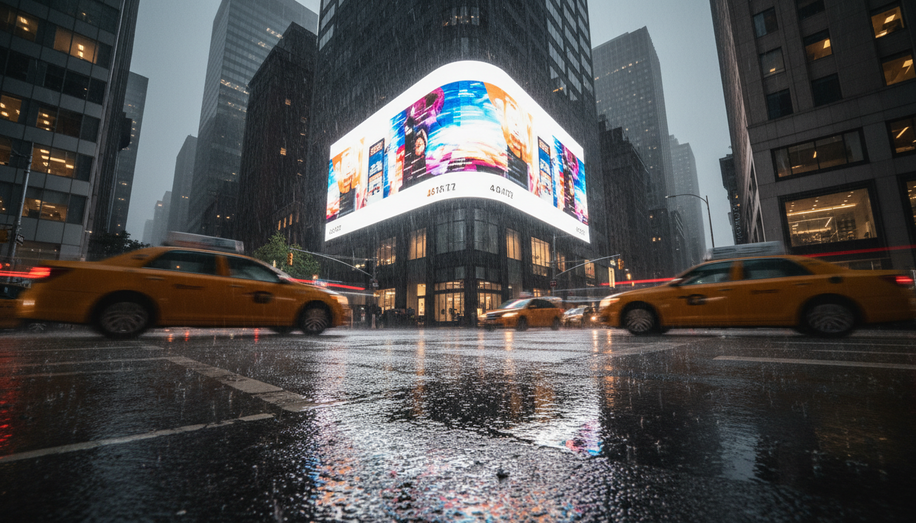
In the fast-evolving landscape of out-of-home advertising, A/B testing has emerged as a powerful tool for marketers seeking to move beyond intuition and harness real-world data to refine campaigns. Once limited by the static nature of printed billboards, this methodology now thrives in digital out-of-home (DOOH) environments, where screens can dynamically rotate creatives, enabling rapid iteration on elements like messaging, imagery, and placement. By comparing variants in live conditions, advertisers can pinpoint what drives engagement, foot traffic, or conversions, turning OOH into a responsive, data-driven medium akin to digital platforms.\n\nThe process begins with clear objectives, a cornerstone emphasized across industry practices. Whether the goal is boosting brand awareness, increasing store visits, or spiking QR code scans, success hinges on predefined metrics such as website traffic, search volume lifts, or in-store sales data. Tools like web analytics, geofencing, and attribution software track these outcomes, bridging the gap between billboard exposure and consumer action. For instance, a retailer might aim to drive online searches; here, Google Analytics captures surges tied to specific ad runs, providing quantifiable proof of impact.\n\nIsolating one variable at a time ensures reliable insights, a principle borrowed from digital testing but adapted for OOH’s physical constraints. Test headlines, color schemes, calls-to-action, or layouts—never multiple changes simultaneously—to attribute performance differences accurately. Variant A could feature a bold \”50% Off Clearance\” headline in blue, while Variant B swaps to \”Buy One, Get One Free\” in red. These are deployed on comparable DOOH screens in similar demographics, shown for equivalent durations to comparable audience segments, minimizing external biases like traffic patterns or weather.\n\nDOOH’s flexibility supercharges this approach, allowing real-time rotation on the same inventory. Unlike static billboards, which required printing and swapping physical assets—a costly, logistically nightmarish endeavor—digital screens enable seamless swaps by time of day, weather, or even audience composition via programmatic buying. A campaign for a retail chain, for example, alternated these discount messages across urban digital billboards. Regional tracking revealed Variant B yielding 20% more QR scans and higher footfall, prompting a mid-campaign pivot to scale the winner network-wide. Such agility transforms OOH from a \”set-it-and-forget-it\” tactic into a living experiment.\n\nPlacement optimization follows a parallel path, treating locations as testable variables. Advertisers select demographically matched sites—say, two high-traffic highways with overlapping commuter profiles—and alternate creatives or full ad sets. Data collection draws from lift studies: geofenced mobile tracking for proximity visits, branded search queries, or direct response codes unique to each site. Statistical analysis then compares key performance indicators, determining statistical significance to declare a winner. If Variant A at Location X outperforms on conversions but lags in engagement, insights refine future buys, prioritizing high-response zones.\n\nChallenges persist, particularly in measurement. Traditional OOH skeptics cite attribution difficulties, yet modern tools like cross-device tracking and AI-driven analytics mitigate this, quantifying incremental lift with precision. For smaller budgets, alternatives simulate real-world exposure: online panels view static mockups of billboards, rating clarity or recall under controlled conditions, though they lack true environmental context. Still, live DOOH testing reigns supreme for its authenticity—drivers glance at screens amid real distractions, revealing genuine resonance.\n\nIteration is the true payoff. Winners inform subsequent rounds: refine messaging from high-engagement creatives, scale top placements, or layer in dynamic triggers like weather-responsive copy (\”Rainy Day Deals\” on stormy screens). Successive tests compound gains; one brand iteratively pitted product images against lifestyle shots, then headlines against CTAs, uncovering preferences for contextual visuals that boosted engagement across platforms. This systematic refinement maximizes ROI, with studies showing optimized OOH campaigns delivering measurable uplifts in conversions and reduced cost-per-lead.\n\nCritics once dismissed A/B testing as cost-prohibitive for OOH, but DOOH’s scalability has democratized it. Programmatic platforms now automate variant distribution and performance monitoring, lowering barriers for mid-tier advertisers. Early movers report campaigns two to three times more effective post-optimization, proving the method’s worth in a fragmented media world.\n\nAs DOOH inventory proliferates—projected to blanket more urban landscapes—expect A/B testing to evolve further, incorporating multivariate trials (A/B/C) for faster multi-element insights, provided traffic volumes support it. Machine learning could soon predict winners pre-launch, blending simulation with live data. For now, the wild proves the laboratory: real streets, real eyes, real results. Advertisers embracing this forge not just better ads, but smarter strategies, ensuring OOH remains a vital force in the attention economy.
Untitled Article