
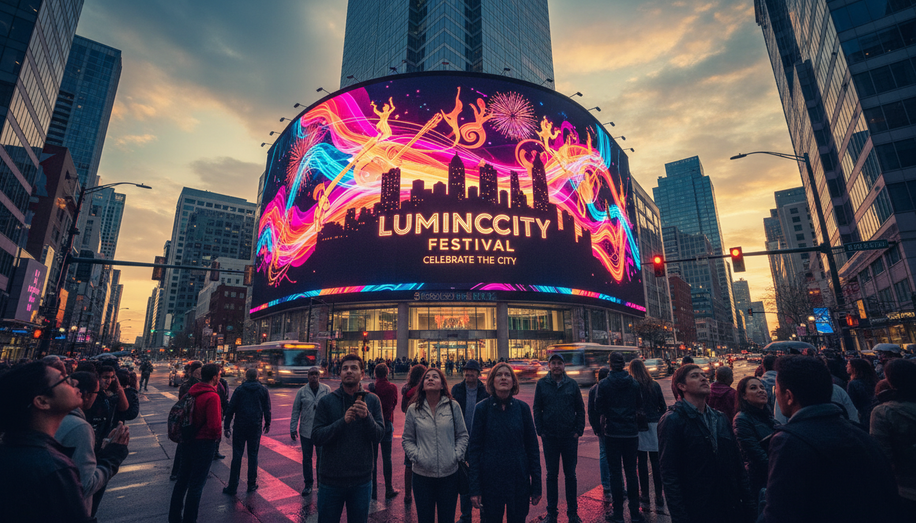

In the bustling lead-up to a major music festival, towering billboards along highways and digital screens in subway stations pulse with vibrant imagery of electrifying performances, flashing ticket links via QR codes that draw commuters straight to the box office. This is out-of-home (OOH) advertising in action for event marketing, where organizers harness the medium’s omnipresence to ignite excitement, deliver critical details, and funnel crowds to festivals, concerts, and conferences. Far from static posters of the past, modern OOH deploys an arsenal of formats—billboards, transit wraps, building takeovers, and dynamic digital out-of-home (DOOH) displays—to blanket target zones with unmissable messages, turning passive passersby into eager attendees.
Event planners have rediscovered OOH’s potency as live gatherings rebound, especially amid the “event marketing season” when cities swell with visitors. For conferences, where B2B booths represent massive budget lines, surrounding OOH amplifies investment by driving foot traffic with pinpointed calls-to-action. Imagine ads in airport terminals, hotel lobbies, and en route to the convention center, repeating booth locations and QR codes that lead straight to demos or sign-ups. These placements cut through the “noise” of packed agendas—speaking slots, networking mixers, swag hunts—reaching audiences during downtime, like rideshares to the venue, when minds are more receptive.
Festivals and concerts thrive on buzz, and OOH excels at building it through sheer visibility in high-traffic corridors. Strategically placed near music venues, universities, or youth hotspots, ads for a rock festival might feature countdown timers on DOOH screens, syncing with social feeds or live artist teasers to stoke anticipation. Building wraps on structures flanking event entrances create Instagram-worthy spectacles, wrapping entire facades in immersive graphics that halt pedestrian flows and spark organic shares. During large-scale events like sports games or community fests, OOH impressions skyrocket as foot traffic surges, boosting engagement rates and recall—more eyes mean stronger memory of event names, dates, and venues.
Data-driven precision elevates OOH from broad blasts to surgical strikes. Intelligent event intelligence—pinpointing predicted attendance, exact timings, and venues—allows agencies to swarm high-impact spots. For a conference expo, ads target commuter paths to the center; for a concert, they hug arena perimeters or fan gathering points. Transit ads on buses and trains loop messages to captive riders, while mobile formats like wrapped vehicles or LED trucks prowl festival grounds, offering experiential hooks such as product samples at entrances. These “street teams on wheels” extend reach beyond fixed spots, creating face-to-face interactions that static digital can’t match.
Interactive and dynamic elements supercharge attendance-driving power. DOOH screens adapt in real-time: live scores for sports-tied conferences, event updates, or social media walls that pull user content, fostering immersion. QR codes bridge physical to digital, scanning to tickets or apps with geofenced perks like priority entry. At food festivals, OOH might spotlight photo ops or tasting calls; at music bashes, wild graphics sync with the vibe, handing out freebies that align with the crowd’s energy. Such tactics not only inform—date, location, lineup—but direct: “Swipe for seats now” amid throngs en route.
Yet OOH shines brightest in omnichannel synergy, never as a silo. Pairing venue-surround ads with social blasts, email reminders, and PR amplifies a unified message, multiplying ROI. For a tech conference, OOH echoes online campaigns, reinforcing booth visits across touchpoints from airport arrival to post-event recap. During peak events, this integration leverages heightened urban density—neighborhoods teeming beyond norms—for outsized value, with portable formats like Soofa Signs popping up anywhere to maximize exposures.
Challenges persist, from creative brevity to measurement, but best practices mitigate them. Messaging stays simple: bold fonts, vivid colors, key facts readable at speed—who, what, when, where, how to buy. High-quality designs grab fleeting glances, while location intel ensures relevance—music ads dodge family zones, conference pitches hit business districts. Planners track scans, traffic lifts, and attribution via unique codes, proving OOH’s lift on sellouts.
Real-world wins abound. Conference organizers report doubled booth traffic from lobby and transit dominance; festival promoters credit building wraps for viral chatter and sold-out nights. As the 2026 OOH Media Conference looms in Dallas, underscoring the medium’s evolution, event marketers increasingly bet on its ubiquity to not just fill seats, but electrify them. In an era of fragmented attention, OOH’s bold, unavoidable presence remains the ultimate hype machine, directing masses to the magic of live moments.