
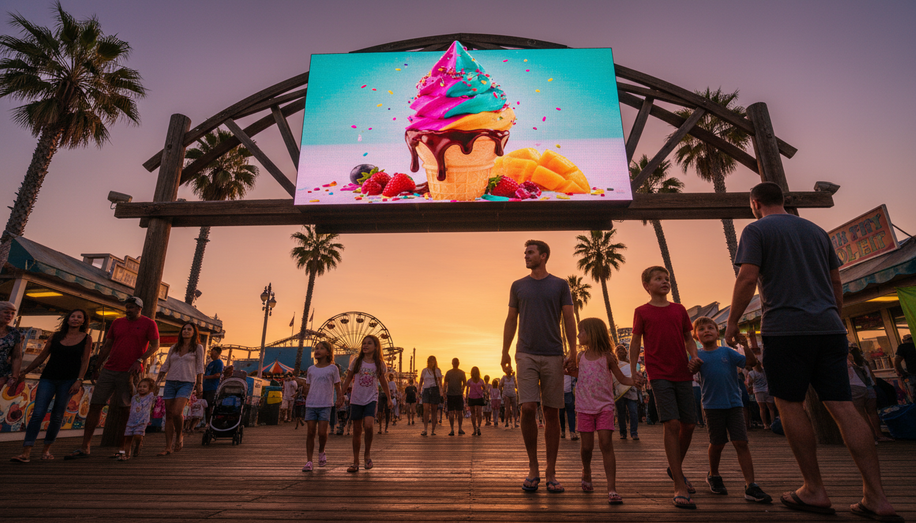

Out-of-home advertising has fundamentally shifted from a volume game to a precision operation. Rather than chasing maximum impressions across sprawling cityscapes, forward-thinking brands are now winning by placing messages directly within the psychological and physical moment when consumers are primed to act. This evolution represents not merely a tactical adjustment but a strategic reimagining of how outdoor advertising can drive immediate conversion rather than deferred brand recall.
The traditional OOH playbook emphasized reach and frequency—the logic being that more eyeballs guaranteed more sales. That assumption has proven incomplete. What matters far more is *where* those eyeballs are directed and *what mental state* the viewer occupies when they encounter the message. A fitness-focused watch advertisement placed inside a gym generates fundamentally different consumer response than the same creative on a generic billboard along a commuter corridor. The difference lies not in creative quality but in contextual alignment.
Purchase intent zones represent the frontier of this targeting precision. Retail clusters positioned near points-of-purchase decisions capture consumers in their moment of highest susceptibility to persuasion. This “last-mile intent” phenomenon—when a shopper is already mentally prepared to spend—creates an asymmetrical advantage for advertisers who can position themselves at the intersection of location and psychological readiness. A dealership offering employee pricing directly adjacent to a grocery store, or a dental practice advertising teeth whitening services near a coffee vendor, leverages immediate behavioral context to drive action within hours rather than weeks.
The technological infrastructure enabling this precision has matured dramatically. Smart billboards equipped with sensors, GPS data, and artificial intelligence now serve dynamically optimized creative based on real-time variables including traffic flow, weather conditions, and foot traffic patterns. Programmatic digital out-of-home (DOOH) buying grants marketers access to location-specific audience movement data, allowing them to trigger advertisements at precisely the moment when consumers are most receptive. This represents a fundamental departure from static placements that broadcast identical messages regardless of temporal context or environmental conditions.
Yet technology alone cannot explain the effectiveness of proximity-based placement. The most successful hyper-local strategies begin with rigorous audience understanding and behavioral mapping. Before selecting specific locations, media buyers must answer foundational questions: What route does the target audience repeat weekly? Are they moving through a high-speed commuter corridor or a high-dwell transit station? What single message must they retain after one glance? These answers determine whether a campaign should pursue dominance through roadblock tactics or precision through hyperlocal placement.
The strategic environments that consistently deliver measurable results each serve distinct purposes. Transit dwell locations like stations and shelters provide genuine viewing time rather than fleeting impressions. Airports combine premium attention with high spending power. Downtown pedestrian zones amplify foot traffic and social shareability. Neighborhood microzones deliver hyperlocal relevance alongside repeated community exposure. When combined into coherent systems rather than scattered placements, these environments create what amounts to a targeted ecosystem for consumer engagement.
Real-world validation confirms the power of this approach. Campaigns that pair foot traffic measurement with geofenced OOH targeting have demonstrated purchase intent increases as high as 37 percent in store visits. One technology brand, targeting high-intent decision-makers across specific fitness centers and vegan cafes in a major APAC city, achieved a 17 percent visit lift among its core demographic by prioritizing location quality over inventory quantity. These outcomes emerge not from exceptional creative alone but from strategic alignment: the right message reaching the right micro-audience in the right environment at the right moment.
The competitive advantage of proximity-based placement ultimately rests on a recognition that context transforms everything. As DOOH inventory expands into gyms, healthcare facilities, movie theaters, and transit vehicles, the surface area for meaningful proximity placement multiplies. Brands that master neighborhood-level personalization—using local cultural symbols and behavioral insights to craft genuinely resonant messages—discover that precision targeting builds authentic connections between lifestyle, location, and brand experience that broader campaigns cannot achieve. In an era of tightening media budgets and heightened demand for measurable returns, relevance has conclusively replaced reach as the fundamental metric of advertising success.
This evolution underscores the necessity for advanced platforms that can orchestrate such precise, proximity-based strategies and quantify their impact. Blindspot empowers brands to move beyond broad reach, leveraging its location intelligence and audience analytics to pinpoint optimal purchase intent zones and execute hyper-local DOOH campaigns with unparalleled precision, ensuring every placement is strategically aligned for measurable conversions and authentic customer engagement. With real-time performance tracking and robust ROI measurement capabilities, Blindspot transforms OOH into a data-driven powerhouse for immediate results. Discover more at https://seeblindspot.com/