

In the bustling streets of 19th-century America, out-of-home (OOH) advertising emerged from humble beginnings as vibrant hand-painted posters plastered on walls and fences, capturing the imagination of passersby with bold circus promotions. Jared Bell is credited with creating some of the earliest billboards in the 1830s, designing 50-square-foot lithographic posters to advertise spectacles like Barnum & Bailey’s circus acts, where colorful illustrations emphasized exotic performers and thrilling feats to draw crowds. These rudimentary displays marked the aesthetic genesis of OOH: simple, eye-catching visuals crafted by hand, relying on lithography—a revolutionary printing technique that allowed for larger, more detailed reproductions than previous methods.
By the 1860s, as new laws permitted businesses to lease outdoor spaces, billboards proliferated, transforming from sporadic postings into a structured medium. Hand-drawn or meticulously hand-painted by skilled artists, these signs demanded immense labor, often featuring exaggerated imagery and persuasive text to compete in the visual chaos of growing urban centers. Aesthetics evolved toward greater drama, with vivid colors and larger scales to stand out amid industrial expansion and rising foot traffic. The late 19th century brought standardization: associations like the International Bill Posters Association and the Associated Bill Posters’ Association (formed in 1891, later evolving into the Out of Home Advertising Association of America) regulated practices, fostering professionalism. A pivotal moment arrived at the 1889 Paris Exposition, where the 24-sheet billboard format debuted—lithographers stitching together panels into a cohesive 2:1 aspect ratio that became the global standard, enabling expansive, unified artwork that balanced bold typography with illustrative storytelling.
The early 20th century accelerated technological leaps, intertwining with America’s automotive boom. The Model T’s popularity spurred highway development, including the Interstate Highway System, prompting advertisers to target motorists with strategically placed bulletins designed for high-speed glances—prioritizing simplicity, large lettering, and memorable icons over intricate details. Illumination arrived around 1916, with Foster & Kleiser introducing electric lights on San Francisco’s Market Street, extending OOH’s reach into the night and enhancing dramatic effect through glowing hues. By the 1920s, mergers like the Poster Advertising Association and Outdoor Advertising Association formed the Outdoor Advertising Association of America, solidifying industry standards. Aesthetic refinements included the “Blentone” process in 1946, which perfected color blending for smoother gradients and photorealistic tones, while reflective Scotchlite materials in the late 1940s added nighttime shimmer to highway signs, captivating drivers with iridescent effects.
Post-World War II innovations built on these foundations. Power-driven boom trucks in 1946 streamlined installation of massive panels, allowing for supersized murals on drive-in theaters, painted with industrial precision. Studies by A.C. Nielsen in the 1960s quantified reach and frequency, validating OOH’s efficacy and spurring data-driven design. Multivision bulletins emerged, using rotating triangular sections to cycle three designs on one structure, introducing rudimentary dynamism to static canvases. Printing advanced with pre-pasted posters and four-color processes by the 1990s, enabling photorealistic vinyl wraps on “Premiere Plus” panels spanning 600 square feet, where aesthetics shifted toward hyper-detailed photography and brand immersion.
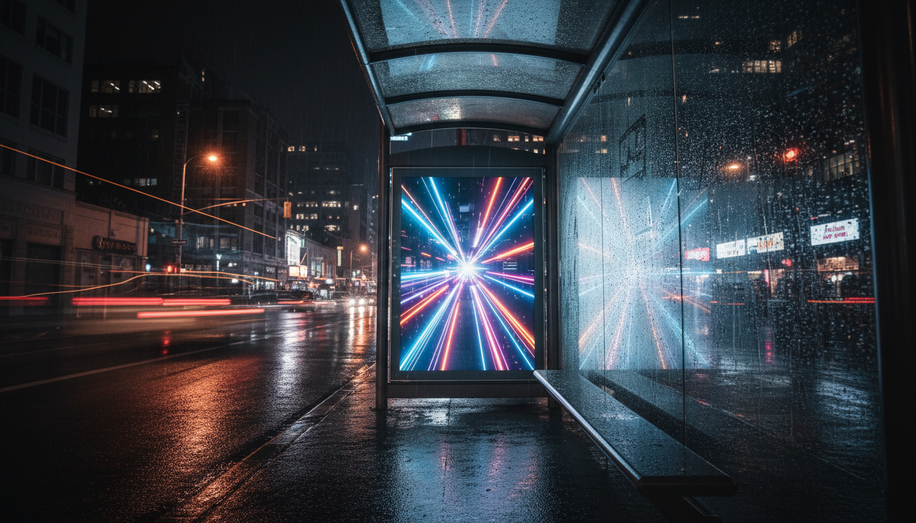
The digital revolution, gathering steam in the late 20th century, redefined OOH entirely. Clear Channel Outdoor’s 2004 initiatives converted 80 Manhattan street displays into the first “Digital Street Network,” harnessing LEDs for remotely changeable static signage—a precursor to full interactivity. By the 2000s, programmatic digital out-of-home (pDOOH) platforms automated content updates, blending OOH with data analytics for real-time relevance. Aesthetics exploded into motion: dynamic digital canvases now feature high-resolution videos, 3D animations, and augmented reality triggers, where sensors detect passersby to deliver personalized messages—think weather-responsive ads or pedestrian-activated narratives.
Today’s OOH creative pinnacle lies in interactive displays, fusing AI, IoT, and interactivity. Giant LED walls in Times Square pulse with synchronized spectacles, while touchless gesture controls and facial recognition tailor content on the fly, turning passive viewers into engaged participants. Transit hubs boast dynamic street furniture with QR codes linking to immersive digital experiences, evolving hand-painted simplicity into multifaceted storytelling canvases. Technologically, cloud-based programmatic buying ensures hyper-targeted campaigns, with sustainability enhancements like energy-efficient LEDs reducing footprints.
This journey from labor-intensive posters to intelligent digital ecosystems underscores OOH’s enduring adaptability. Early designs prioritized raw visual punch; modern ones leverage data and interactivity for deeper connections, proving that as technology advances, so does the art of capturing attention in public spaces.