

In the bustling heart of London, commuters hurrying past a Starbucks bus shelter during morning rush hour suddenly catch a whiff of freshly brewed coffee wafting through the air, pulling them to a temporary halt as the aroma evokes their daily ritual. This isn’t mere coincidence; it’s a deliberate multisensory out-of-home (OOH) campaign that layers scent onto visual advertising, boosting dwell time by 25% and funneling foot traffic straight to nearby stores. Across the Atlantic in New York, Nike’s talking billboards spring to life with dynamic voiceovers synced to vivid digital visuals, narrating tales of athletic triumph that generate over 1.2 million social media impressions as pedestrians pause to listen and share. These examples herald a seismic shift in urban advertising, where OOH transcends static visuals to orchestrate sound, haptics, and even scent, crafting immersive experiences that linger in the city’s soundtrack long after the glance fades.
The trend toward multi-sensory OOH reflects a broader evolution in 2026, as the industry surges to a projected $9.89 billion valuation amid digital fatigue and ad saturation online. Traditional billboards and street furniture, once reliant on bold imagery alone, now integrate smart technologies like sensors, AI, and haptic feedback to engage passersby on multiple levels. In Stockholm, Absolut Vodka deployed touch-sensitive posters allowing users to mix virtual cocktails via interactive screens, resulting in a 40% spike in brand recall. Meanwhile, Disney’s AR-enhanced street panels in Paris brought movie characters to life in 3D, prompting selfies and viral shares that amplified organic reach exponentially. These activations turn passive urban spaces into participatory brand moments, where sound cues draw attention, tactile interactions invite engagement, and olfactory triggers forge emotional bonds.
What makes this multisensory approach so potent? In a sensory-overloaded cityscape, layering stimuli creates a richer neural signal that combats banner blindness and fleeting attention spans. Research underscores that engaging multiple senses enhances memory retention, with scents and sounds triggering deeper emotional connections than visuals alone. “Brands that tap into all five senses can create experiences that stick,” notes Elliot Ward, advertising expert at Excite OOH. “We’ve observed that multisensory activations often generate 3–4x more audience interaction compared with standard digital or static boards.” Haptic elements, such as vibrating panels or textured surfaces, add a physical dimension, making ads impossible to ignore—literally felt underfoot or in hand. This isn’t gimmickry; analytics from embedded sensors track dwell time, interactions, and even social shares in real-time, enabling optimizations that prove ROI through metrics like footfall and purchase intent lifts of up to 1.3x.
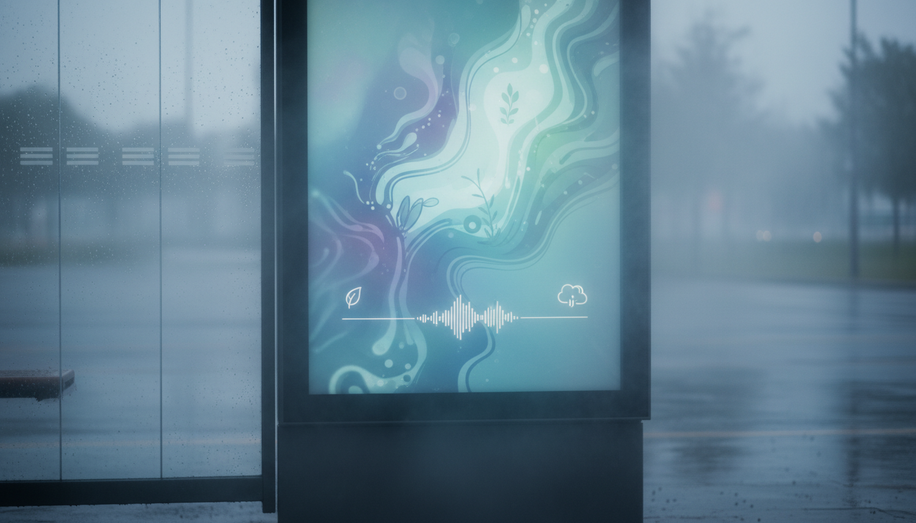
Urban environments amplify these innovations, transforming streets into dynamic canvases. Hyperlocal smart billboards, equipped with GPS and weather-responsive AI, now pulse with context-aware content: a rain-soaked display might emit the soothing sound of crackling fire for a hot chocolate brand, or release a citrus burst to invigorate afternoon crowds. Sustainability weaves in seamlessly, with solar-powered screens and eco-materials ensuring these sensory spectacles align with consumer values—72% of whom favor green brands. In Paris and New York, haptic bus stops vibrate in rhythm with promotional music, syncing physical sensation to auditory hooks for commuters trapped in traffic. Even scent diffusers, calibrated to wind patterns, create invisible “zones of influence” around high-traffic nodes, subtly steering behaviors without intrusion.
Yet challenges persist in scaling this sensory symphony. Privacy concerns loom over data-driven personalization, demanding “helpful, not intrusive” executions that rely on aggregate traffic data rather than individual tracking. Technical hurdles, like weatherproofing scent emitters or syncing audio in noisy streets, require seamless integration to avoid distraction. Still, the payoff is evident: multisensory OOH fosters viral potential, with novel experiences begging for TikTok videos and Instagram reels, extending reach far beyond the physical site. As cities densify, these campaigns capitalize on omnichannel synergy, bridging digital narratives to real-world actions—reinforcing app downloads or store visits at peak intent moments.
Looking ahead, 2026 cements multisensory OOH as the future of urban storytelling. Forecasts predict a rise in sensory marketing over the next 25 years, igniting awe through combined appeals that deepen consumer relationships. Guerrilla tactics, like projection-mapped scents during events or haptic sidewalk art, blur lines between ad and environment, turning sidewalks into interactive playlists of brand essence. For marketers, the lesson is clear: in a world craving authenticity amid algorithmic noise, the most memorable ads aren’t seen—they’re heard, touched, smelled, and woven into the city’s pulse. As billboards evolve into sensory hubs, OOH reclaims its role not just as visibility, but as visceral connection, ensuring brands resonate in the collective memory of the metropolis.
To truly master this sensory symphony and ensure investments yield tangible results, marketers need robust platforms capable of measuring the nuanced impact of these experiences. Blindspot offers the precise audience measurement, real-time campaign performance tracking, and ROI attribution necessary to optimize complex multisensory campaigns, allowing brands to confidently scale initiatives that captivate audiences and drive measurable shifts in footfall and purchase intent. Discover how at https://seeblindspot.com/