
In the vast landscape of advertising, out-of-home (OOH) stands out as a uniquely public force for change, transforming billboards, transit shelters, and digital displays into beacons for social good. Unlike digital ads that vanish with a scroll, OOH commands attention from millions daily, embedding messages of awareness and action into the fabric of everyday commutes and urban routines. This power has long been harnessed for public service announcements (PSAs) and non-profit campaigns, where simplicity meets scale to drive community response on issues from public health to environmental protection.
Consider the raw immediacy of digital billboards in crisis. In Florida, a pioneering partnership between the Florida Outdoor Advertising Association (FOAA) and the state Division of Emergency Management deploys over 50 digital billboards—spanning from Pensacola to Pompano—to broadcast urgent alerts. Within four hours of notification, these screens flash weather warnings, evacuation routes, shelter locations, and detours, reaching drivers on highways like I-95 and US-441. During the annual statewide hurricane exercise, this public-private collaboration proved its mettle, turning private inventory into a lifeline for public safety. Such initiatives underscore OOH’s role not just in peacetime persuasion but in life-saving dissemination, where high-visibility formats like bulletins—up to 14 feet high and 48 feet wide—deliver maximum impact to vehicular traffic.
This emergency prowess extends to broader social causes, where OOH’s unskippable presence amplifies non-profit missions. Iconic campaigns like Smokey Bear’s enduring call to prevent wildfires have evolved over eight decades, using OOH to instill “Only You Can Prevent Forest Fires” into collective consciousness. More recently, the World Wildlife Fund’s “Nature Needs Us Now” leverages striking visuals across billboards and transit ads, pairing compelling stories with clear calls to action for conservation. These efforts thrive on OOH’s environmental reach: posters in bus shelters and mall kiosks target locals and tourists alike, while bulletins on expressways capture high-speed audiences with bold, memorable imagery.
Yet the magic lies in crafting messages that resonate amid the noise. Successful PSAs distill complex issues into visceral punches. The Partnership for a Drug-Free America’s “This Is Your Brain on Drugs”—famously frying an egg in a pan—cut through 1980s clutter with shocking simplicity, a tactic echoed in OOH’s visual-first ethos. Anti-smoking efforts, like the “Smoking Kid” campaign where children hand out cigarettes to adults, earned global media buzz by flipping expectations, proving provocative reversals spur reflection and quits. PETA’s celebrity-driven PSAs, featuring stars like Paul McCartney, deploy similar emotional hooks on billboards to advocate for animal rights. The American Foundation for Suicide Prevention’s “Talk Away the Dark” models intimate conversations—”Have you been thinking about suicide?”—in dim, real-feeling visuals that translate powerfully to static OOH panels, urging bystander intervention.
Non-profits amplify this through inclusivity and invitation. The Peace Corps’ volunteer recruitment PSAs build heartwarming narratives in 30 seconds, showcasing diverse global service that begs to be scaled on transit shelters and urban posters. Canine Companions for Independence pairs images of service dogs with wheelchair users in poignant scenes—”Together We Dream”—fostering empathy and donations via OOH’s community-embedded formats. The Red Cross offers pre-approved PSAs for radio, web, and OOH, channeling public goodwill into aid with messages of hope amid disaster.
What sets OOH apart for good is its democratic scale and serendipity. Unlike targeted online ads, it interrupts indifferently, reaching the unaware driver or pedestrian at pivotal moments—rushing to work, fleeing a storm, or simply strolling. Florida’s 52 digital billboards, with 61 faces from Tampa to Tallahassee, exemplify this: strategically placed at intersections like I-4 near Fairbanks Avenue or US-98 in Panama City, they ensure no one misses the call. Yet success demands precision. Overly simplistic efforts, like the President’s Council’s “Gopher Cakes” parody shaming sedentary lifestyles, falter by alienating viewers; Goodwill’s “Donate Stuff. Create Jobs.” diluted its job-training link with vague visuals. Effective campaigns, by contrast, hit with clarity: bold visuals, emotional stakes, and direct actions like “Donate Now” or “Call 1-800-QUIT-NOW.”
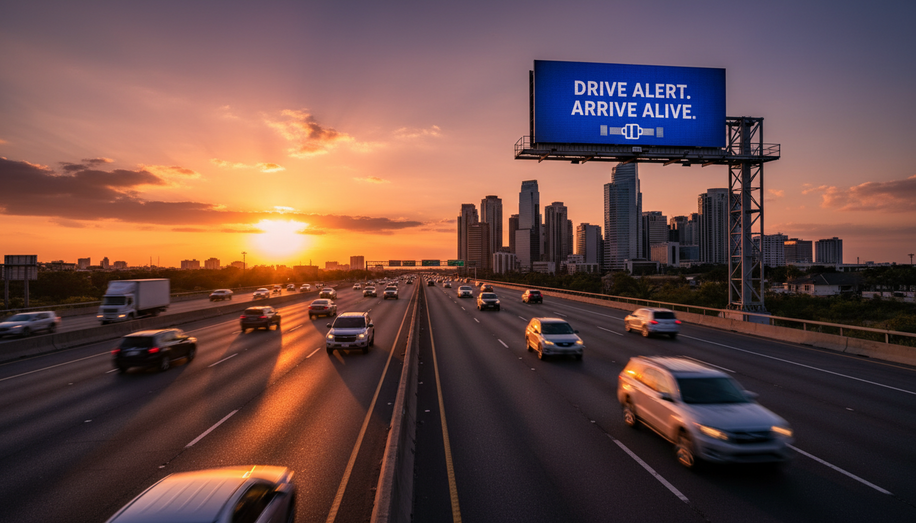
Data backs the impact. OOH PSAs have influenced behaviors from seatbelt use to recycling, with studies showing high recall rates due to repetition and context—seeing an anti-plastic bag ad amid littered streets cements the message. Non-profits like the Ad Council layer live-event drama into OOH, uniting diverse audiences around unity themes. As digital OOH evolves with real-time capabilities, partnerships multiply: imagine hurricane alerts morphing into post-storm donation drives on the same screens.
Ultimately, OOH for good thrives on collaboration—agencies donating space, governments providing content, communities responding. From Florida’s emergency network to global icons like Smokey, it proves advertising’s highest calling: not selling products, but saving lives, shifting norms, and sparking action. In a fragmented media world, these unignorable spaces remind us that public advertising can, and does, build better societies.