
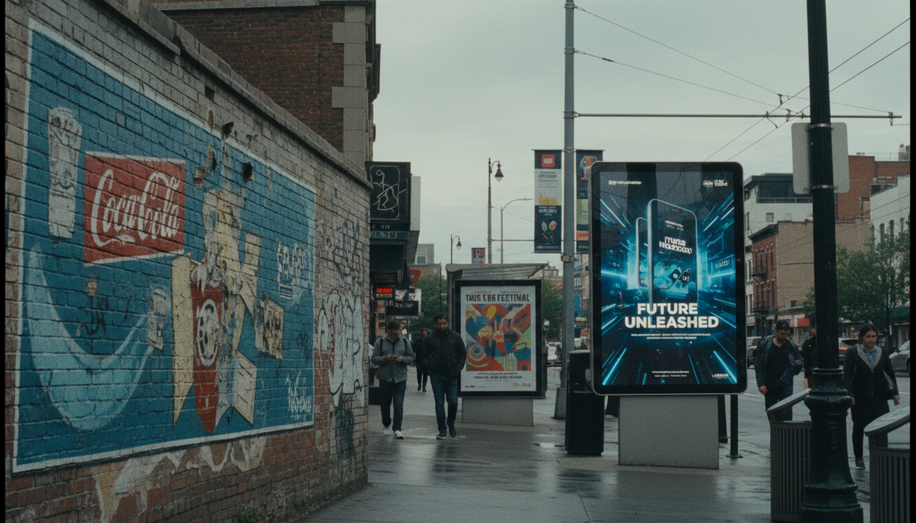

In the bustling streets of 19th-century New York, out-of-home (OOH) advertising took its first bold steps into the public eye, marking the dawn of a medium that would transform urban landscapes worldwide. Jared Bell’s 1835 circus poster, plastered across the city, stands as the earliest recorded example of large-format outdoor promotion in the United States, a simple yet revolutionary act that capitalized on the growing literacy enabled by Gutenberg’s movable type centuries earlier and the lithographic printing perfected in 1796. These hand-painted and printed posters quickly proliferated, appearing on street railways by 1850 and evolving into leased billboard spaces by 1867, as nearly 300 posting companies sprang up by 1870 to meet demand.
The late 1800s solidified OOH’s place in commerce and culture. Major brands like Palmolive, Kellogg, and Coca-Cola pioneered mass-produced national billboard campaigns, their vibrant messages dominating highways and cityscapes. Industry consolidation followed swiftly: the International Bill Posters’ Association formed in 1872, laying groundwork for standardization, while the 1891 creation of the Associated Bill Posters’ Association—later rebranded as the Outdoor Advertising Association of America (OAAA) in 1925—brought regulation and advocacy to a fragmented field. Mergers like the 1925 union of the Fulton Group and Cusack Co. into General Outdoor Advertising Company signaled the shift toward corporate scale, even as hand-painted murals remained the artisanal backbone of the craft.
Public service and innovation defined the early 20th century. In 1913, an educational committee urged OOH firms to donate space for societal messages, a tradition persisting today, while the 1915 National Outdoor Advertising Bureau assisted agencies in navigating the medium’s reach. Illumination emerged as a game-changer, with electric lights turning night into prime advertising real estate, and traffic audits via the 1934 Traffic Audit Bureau (TAB) began quantifying audiences for the first time. Yet challenges loomed: the 1965 Highway Beautification Act restricted billboards on interstates, confining them to commercial zones and imposing standards on size, lighting, and spacing. War eras saw OOH pivot to patriotic appeals, underscoring its adaptability.
The postwar decades brought material revolutions. Vinyl skins replaced labor-intensive hand-painted boards in the 1970s, slashing production time and costs while enabling sharper graphics. Transit expanded with the 1962 invention of ad-funded bus shelters, free to cities and sustained by revenue. Effectiveness was dramatically proven in 1975, when Outdoor Advertising Inc. blanketed billboards with images of newly crowned Miss America Shirley Cochran; her name recognition skyrocketed 940 percent, validating OOH’s mass-impact potential. Regulatory hurdles persisted—1972’s tobacco broadcast ban funneled ad dollars to print and OOH, only for a 1999 settlement to prohibit tobacco billboards entirely—but the industry pressed on.
Digital innovation ignited in the 1990s, as computing and LED technology infiltrated the sector, teasing a future beyond static displays. By 2002, Arbitron and Nielsen tested outdoor ratings systems, paving the way for data-driven precision. The true pivot arrived in 2005 with the installation of the first digital OOH (DOOH) networks, supplanting traditional posters with screens capable of rotating multiple ads, dayparting content by time of day, and enabling real-time updates. The 2010 shift to ecoflex posters on many structures further greened the medium, reducing paper waste and installation labor.
Today, DOOH dominates with sophistication undreamt by early poster makers. Digital billboards, transit screens in buses and stations, retail networks, airport displays, and immersive 3D LED installations adapt messaging to weather, location, or audience data via programmatic buying. Street furniture and alternative formats—like wrapped vehicles and wallscapes—complement core categories of billboards, transit, and urban amenities. From Egyptian obelisks publicizing laws millennia ago to AI-optimized screens beaming hyper-targeted campaigns, OOH has evolved from hand-crafted announcements to a dynamic, measurable powerhouse.
This journey reflects not just technological leaps but OOH’s enduring genius: capturing attention amid motion. Hand-painted murals demanded skilled artists and weeks of labor; digital networks deploy global campaigns in hours. Yet the core promise endures—visibility at scale, turning passersby into prospects. As networks integrate with mobile and social data, OOH stands poised for its next chapter, blending physical presence with virtual intelligence in an always-connected world.