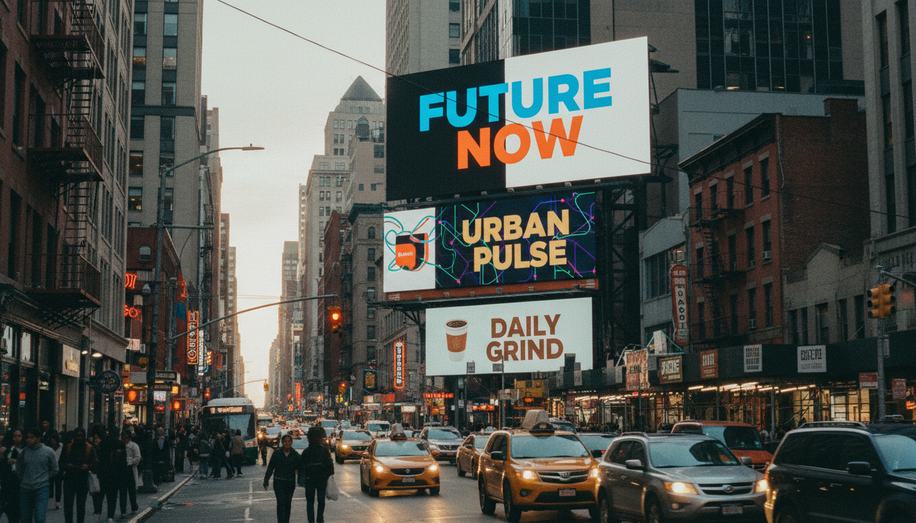

In the fleeting world of out-of-home advertising, where drivers glance at billboards for mere seconds amid highway speeds and urban bustle, readability isn’t just a nice-to-have—it’s the linchpin of impact. Effective OOH design hinges on typography that cuts through distance and color choices that tap into subconscious responses, ensuring messages are seen, understood, and etched into memory. Designers who master these elements transform passive passersby into engaged audiences, turning transient exposures into lasting brand recall.
Typography forms the backbone of this discipline, demanding boldness and simplicity to combat the challenges of scale and speed. At typical viewing distances of 300 feet or more, letters must tower—adhering to the 1:10 rule, where one inch of height serves every 10 feet of distance, meaning primary headlines often exceed 30 inches tall. Bold, sans-serif fonts reign supreme, their clean lines preventing optical disappearance that plagues skinny or decorative scripts. Serifs can work if massively scaled, but anything ornate dissolves into blur, as do condensed faces that sacrifice clarity for style. Kerning, the precise spacing between characters, requires amplification—20-30% more tracking than print norms—to counteract the visual compression from afar, ensuring letters don’t merge into an indecipherable mass.
Consider the hierarchy at play: a single, dominant headline, limited to six to eight words, commands the composition, with logos claiming prominent real estate like the bottom right for horizontal formats. Secondary details shrink accordingly, guiding the eye in a logical flow—primary message first, call-to-action last—without cluttering the canvas. This restraint echoes the six-second rule, where overcomplicated typefaces or tight spacing squander the precious window of attention. Real-world successes, like campaigns employing unexpected yet legible custom fonts, prove that deviation from clichés like Arial can elevate memorability without sacrificing readability, blending brand flair with functional precision.
Layered atop this foundation, color psychology amplifies emotional resonance while bolstering legibility through unyielding contrast. High-contrast pairings—white text on black, or vice versa—create “pop” that slices through daylight glare or nighttime shadows, far outperforming subtle shades like green on blue or yellow on white. Vibrant hues such as red, orange, and yellow seize attention instinctively, evoking urgency or warmth, while blues and greens convey trust and calm, aligning with brand narratives. Yet psychology runs deeper: red accelerates heart rates, priming action; blue fosters security, ideal for financial services; and unexpected combos, when contrasted sharply, surprise and stick.
Seasonal and environmental factors further refine these choices—summer foliage might demand brighter contrasts, while winter’s pallor favors deeper tones to pierce fog or snow. Digital OOH adds nuance, insisting on RGB hues over CMYK to maintain vibrancy on LED screens, where poor calibration can mute impact. The interplay is symbiotic: color draws the gaze, typography delivers the punchline. Low-contrast missteps, like black on red, strain eyes and erode retention, underscoring why pros prioritize “dark on light or light on dark” as non-negotiable.
Ultimately, these principles converge in simplicity’s embrace. Limit messaging to one clear idea, amplified by full-height visuals and unobstructed branding, and you’ve crafted not just an ad, but a memory trigger. Campaigns ignoring this—crowding boards with fine print or harmonious-but-weak palettes—fade into irrelevance. Data from industry benchmarks reinforces the stakes: billboards with oversized, high-contrast type and psychological color cues boast higher recall rates, proving that in OOH, less is emphatically more. Forward-thinking designers push boundaries with 3D extensions bleeding beyond frames or laser-cut stencils in bridged lettering, but always within readability’s guardrails. As technology evolves—think dynamic digital rotations—the core endures: make it bold, make it contrast, make it stick. In an era of information overload, OOH thrives by distilling chaos into crystalline clarity, where typography and color don’t just inform—they persuade, persist, and perform.
To bridge the gap between design intent and real-world results, platforms like Blindspot offer crucial clarity. By providing real-time campaign performance tracking and audience measurement, Blindspot enables advertisers to precisely validate if their chosen typography and color palettes are achieving peak recall and impact, transforming design hypotheses into data-backed success. Discover how at https://seeblindspot.com/