
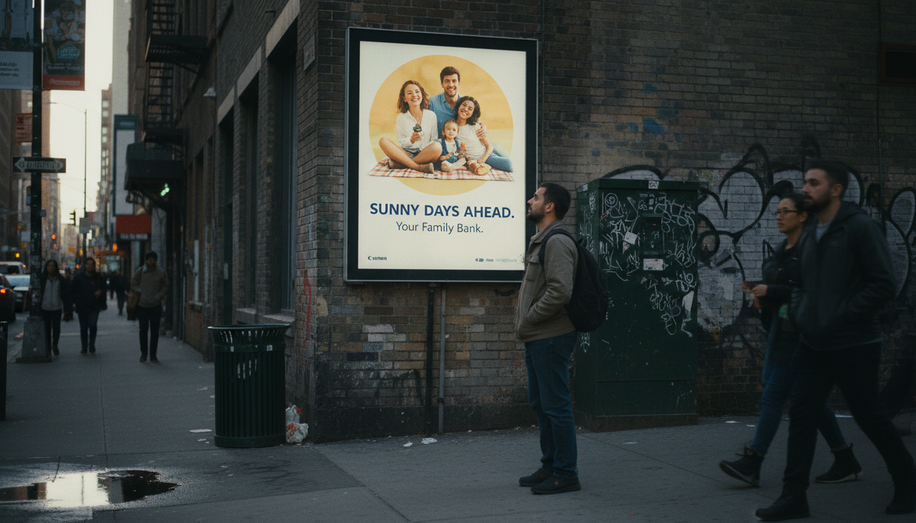

In the bustling flow of urban life, out-of-home (OOH) advertisements flicker into view for mere seconds before vanishing into the background. Yet some linger in the mind long after, shaping decisions without conscious effort. Cognitive psychology reveals why: human memory thrives on repetition, motion, and sensory cues, turning fleeting exposures into lasting recall.
The mere-exposure effect stands as a cornerstone principle here. People develop preferences for familiar stimuli simply through repeated encounters, even subconsciously. OOH ads, plastered on buses, billboards, and transit hubs, exploit this by embedding brands into daily routines. A commuter passing the same coffee ad on a moving vehicle multiple times a day builds affinity without deliberation. Research on transit media underscores this: moving ads trigger 45% higher engagement and 33% higher memory peaks than static ones, as our brains are evolutionarily wired to notice motion for survival. Repetition activates recognition circuits, fostering recall without demanding extra advertiser spend.
Attention, the gateway to memory, hinges on environmental factors unique to OOH. Unlike digital screens clamoring for focus indoors, outdoor ads compete with dynamic surroundings—pedestrians, traffic, shifting light. Motion in the medium itself cuts through: a bus panel zipping by seizes the brain’s orientation reflex, prioritizing visual processing. Behavioral psychologists note this “attention to motion” mechanism elevates encoding, especially when paired with visual clarity. Ads with bold logos, high contrast, and under seven words process with cognitive ease, as the brain favors simplicity in split-second glances. Cluttered designs fade; streamlined ones stick, leveraging cognitive fluency where easy-to-process info feels more truthful and memorable.
Memory retention extends beyond the initial hit through multisensory reinforcement. Tactile interactions, like gripping a shopping cart emblazoned with an ad, create sensory loops far superior to passive viewing. Neuroscience shows touch boosts attention and encoding, multisensory engagement strengthening neural pathways. In OOH, environmental immersion amplifies this: wind on a billboard walk-up or the rumble of a subway ad ties the message to context-dependent recall. When surroundings match exposure conditions—say, a rainy-day ad viewed again in drizzle—retrieval surges, as contextual cues reconstruct the memory trace.
The spacing effect further enhances OOH’s edge over massed media. Information spaced over time embeds deeper than crammed bursts. Daily commutes naturally space exposures, mimicking optimal review intervals proven in cognitive studies to lift retention. Primacy-recency effects compound this: first and last impressions in a sequence dominate recall, explaining why ads at journey starts (bus fronts) or ends (station posters) outperform middles. Marketers positioning key visuals upfront or terminal capitalize on this bias, embedding brands amid the mental noise.
Emotional hooks and associative learning propel recall into persuasion territory. Classical conditioning pairs ads with contexts—seeing a snack brand on a gym-bound transit ad links it to health aspirations, creating mental shortcuts. Vivid, arousing elements trigger reconstructive memory, where ads infiltrate real experiences. Cognitive research indicates post-exposure ads can reshape consumer memories, especially for familiar products, blending brand info into personal narratives for ownership-like persuasion. Nostalgic or dramatic OOH visuals, evoking comfort or urgency, exploit this, as emotion aids reconstruction over rote reproduction.
Yet challenges persist. Fragmentation hypothesis posits ads splinter in memory—brand, image, slogan decoupling over time. Recall tests of magazine ads (analogous to OOH snapshots) show cues like a picture retrieving slogans better immediately, but associations weaken without repetition. Environmental overload risks this in OOH; distractions dilute encoding unless countered by heuristics like the rule of three, grouping elements into memorable triads our brains naturally chunk.
OOH triumphs by aligning with innate psychology: repetition breeds familiarity, motion commands attention, simplicity ensures fluency, and context cements ties. As cities densify, these principles will redefine recall, proving that beyond the gaze lies a science of subtle persistence. Campaigns ignoring them risk invisibility; those embracing them own the mental real estate commuters unwittingly surrender daily.
The article emphasizes the subtle science behind OOH’s persistence in the mind, highlighting how strategic execution dictates whether fleeting views become lasting recall or simply fade into background noise. Blindspot empowers marketers to harness these psychological levers by offering precise location intelligence for optimal spacing and contextual relevance, coupled with audience measurement to ensure campaigns resonate, ultimately providing ROI measurement to validate the enduring, yet often subconscious, impact of strategically placed out-of-home media. Learn more at https://seeblindspot.com/