
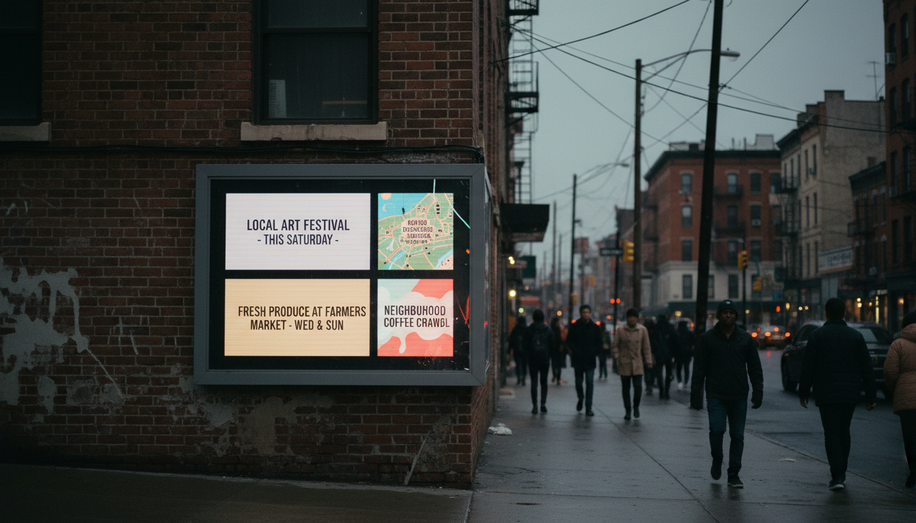

In the bustling streets of New York’s Chelsea neighborhood, a digital billboard flickered to life one crisp morning, displaying not a generic national ad but a tailored promotion for a local coffee chain’s seasonal pumpkin spice latte, timed perfectly with peak commuter foot traffic and a forecast of chilly winds. This is the essence of hyper-local out-of-home (OOH) advertising: harnessing granular local data to transform static billboards into dynamic storytellers that resonate with passersby on their own turf. Brands leveraging such proximity-based insights are achieving unprecedented relevance, turning fleeting glances into lasting connections and measurable lifts in foot traffic—sometimes as high as 37 percent for nearby stores.
The shift toward hyper-local OOH campaigns marks a pivotal evolution in 2026, propelled by advancements in data analytics, IoT-connected screens, and AI-driven content optimization. Gone are the days of broad-brush messaging blanketing entire cities; today’s marketers dissect neighborhoods with surgical precision. Mobility data, heatmaps, and real-time foot traffic patterns reveal where audiences linger—be it retail clusters in Los Angeles’ Silver Lake or transit dwell zones near Chicago’s Loop—and align campaigns accordingly. For instance, a fitness brand might deploy AR-enabled bus shelter ads in gym-heavy microzones, overlaying interactive workout challenges that boost dwell time by 20 to 40 percent while capturing user data for retargeting.
Granular local insights begin with audience and location analysis, the bedrock of effective OOH strategy. Brands start by mapping core customer segments—demographics like age and psychographics such as commuting habits—then overlay them with environmental data. Tools like geo-fencing and proximity targeting pinpoint high-traffic corridors, shopping districts, and even neighborhood-specific events, ensuring ads speak directly to the surroundings. A retail chain targeting last-mile purchase intent could prioritize screens near points of purchase in pedestrian-heavy downtown zones, where foot traffic data shows sustained exposure during lunch rushes. This data-driven placement not only maximizes visibility amid rapid urbanization but also refines campaigns iteratively: real-time analytics track dwell times and engagement, allowing adjustments for weather, traffic surges, or local happenings.
Personalization amplifies this power, with dynamic content adapting on the fly to hyper-local contexts. Imagine a screen in Miami’s Wynwood arts district switching from sunny beachwear promotions to rain gear offers as clouds gather, or a London high street billboard promoting event tickets during a nearby festival. Weather-triggered messaging, time-of-day scheduling, and demographic tweaks via AI ensure every impression feels bespoke, fostering stronger audience connections. Programmatic DOOH buying streamlines this, enabling automated creative optimization based on foot traffic or GPS-derived patterns, minimizing wasted impressions and mirroring the precision of digital platforms.
Integration with mobile and social channels extends hyper-local OOH’s reach exponentially. QR codes on neighborhood kiosks drive instant app downloads or geo-fenced retargeting, while beacons notify nearby phones of exclusive offers post-exposure. A campaign in San Francisco’s Mission District, for example, might pair street furniture ads with Instagram challenges, encouraging shares that amplify organic spread. This cross-channel synergy provides rich data loops: brands geofence OOH sites to measure store visits, refining future placements for higher ROI—Nielsen research underscores how such long-term strategies yield 42 to 76 percent better returns.
Yet, success demands more than tech; it requires strategic environmental choices tailored to objectives. For brand awareness, commuter corridors offer repetition along daily routes; performance-driven goals favor dwell-time venues like airports or entertainment districts. Coverage maps—visual systems blending arrival points with decision zones—outperform scattered lists, ensuring consistent presence over novelty. Emerging venues like gyms, waterways, or movie theaters further embed OOH into lifestyles, with vehicle-mounted screens swarming events for flexible, high-impact takeovers.
Challenges persist, from navigating local regulations to ensuring data privacy, but the rewards are clear: hyper-local campaigns cut through urban noise, delivering relevance that static ads can’t match. Guerrilla tactics, like pop-up AR installations in community microzones, surprise and engage, boosting recall by up to 30 percent. As smart cities evolve, OOH’s future lies in this proximity-powered intimacy—where a billboard knows its neighborhood better than the residents themselves.
Brands ignoring this granularity risk irrelevance in a landscape craving personalization. Those embracing it, however, don’t just advertise; they infiltrate daily routines, turning public spaces into private conversations. In 2026, proximity isn’t just power—it’s the key to OOH dominance.