
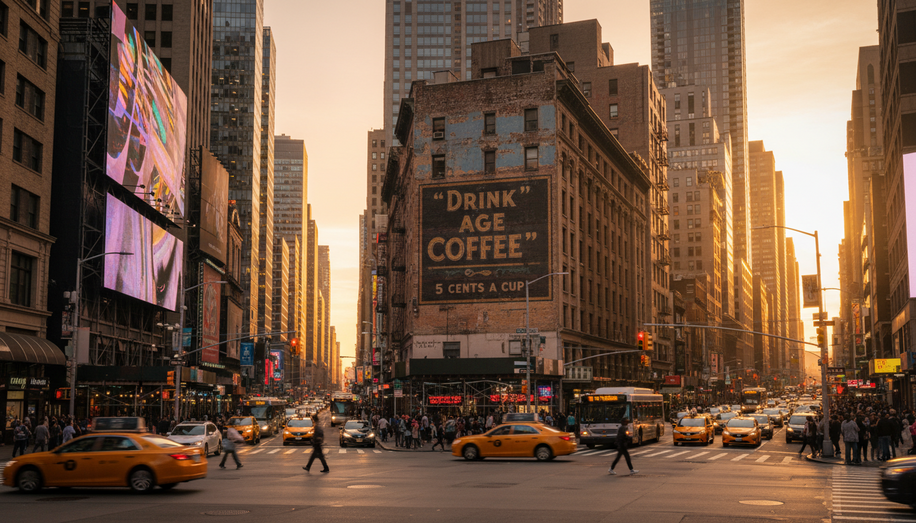

Long before neon lights flickered across cityscapes or digital screens pulsed with dynamic messages, out-of-home advertising whispered its pitches from the stone obelisks of ancient Egypt. Thousands of years ago, Egyptians carved tall monuments to publicize laws and proclamations, while vendors in bustling markets hung simple signs and symbols to lure traders with promises of goods. These rudimentary displays marked the dawn of a medium that would evolve into one of the most enduring forms of mass communication, reaching audiences wherever they ventured beyond their homes.
The true revolution ignited in the 15th century with Johannes Gutenberg’s invention of movable type printing around 1450, which democratized the production of printed materials and set the stage for widespread visual messaging. By 1796, the perfection of lithography—using smooth limestone or metal plates—birthed the illustrated poster, enabling vibrant, detailed images that could captivate from afar. This technological leap transformed advertising from crude etchings into artistic announcements, paving the way for outdoor proliferation.
America’s OOH story took root in the 19th century amid rapid urbanization and industrialization. In 1835, Jared Bell printed the first outdoor poster in New York to promote the circus, a bold spectacle that plastered fences and walls with colorful promises of wonder. By the mid-1800s, entrepreneurs painted signs on fences to hawk local wares, and exterior ads appeared on street railways as early as 1850, turning public transit into rolling canvases. John Donnelly launched his billposting business that same year, formalizing the trade and earning OOH its unofficial “birthday.” Demand exploded: by 1870, nearly 300 posting companies dotted the landscape, leasing boards as early as 1867 to ensure prime visibility.
Professionalization followed swiftly. In 1872, the International Bill Posters’ Association of North America emerged, evolving into the Associated Bill Posters’ Association of the US and Canada by 1891—today’s Outdoor Advertising Association of America (OAAA). These groups championed ethical standards, nationwide coordination, and poster advocacy amid a Wild West of postings. National structures boomed around 1900, luring giants like Palmolive, Kellogg, and Coca-Cola into mass billboard campaigns that blanketed highways and urban arteries.
The early 20th century brought standardization and innovation. In 1913, an educational committee urged public service ads, a tradition persisting today. The 1915 formation of the National Outdoor Advertising Bureau assisted agencies, while 1925 saw mergers like the Poster Advertising Association and Painted Outdoor Advertising Association fusing into the OAAA, and the Fulton Group and Cusack Co. creating General Outdoor Advertising Company—the industry’s first major consolidation. Illumination debuted in 1916 on San Francisco’s Market Street, banishing darkness from displays. The 1934 Traffic Audit Bureau (TAB) introduced audience measurement, lending credibility with third-party data. Amid the Great Depression and wars, billboards rallied support, with Coca-Cola’s “Yes Girl” snagging the first OBIE Award in 1942.
Regulation tempered unchecked growth. The 1965 Highway Beautification Act, championed by Lady Bird Johnson, restricted billboards on interstates to commercial zones, enforcing size, lighting, and spacing rules—a societal pushback against visual clutter that reshaped rural landscapes. Yet OOH proved resilient. The 1970s vinyl revolution replaced labor-intensive painted boards, slashing costs and boosting durability. In 1975, a landmark campaign plastered newly crowned Miss America Shirley Cochran on billboards nationwide; her name recognition skyrocketed 940%, vindicating the medium’s impact and funding further studies.
Digital frontiers beckoned in the 1990s, infusing OOH with technology. Bus stop shelters, invented in 1962 and sustained by ad revenue, proliferated. By 2002, Arbitron and Nielsen tested outdoor ratings; 2005 saw the first digital networks light up. The 2010 shift to ecoflex posters cut environmental footprints and installation times. Tobacco bans in 1972 from broadcast media funneled dollars to OOH, only for a 1999 agreement to prohibit it on outdoor structures.
Today, OOH stands as a modern marvel, blending AI-driven targeting, programmatic buying, and immersive formats like street furniture, transit wraps, and alternative media. From Egypt’s obelisks to augmented reality walls, its evolution mirrors society’s pulse: technological leaps expanded reach, mergers scaled operations, regulations honed ethics, and measurements built trust. Societally, it has fueled commerce, sparked debates on aesthetics, and amplified voices—from war bonds to public health pleas. As urban mobility surges and data refines precision, OOH endures, proving that in a digital deluge, the physical world still commands attention.