
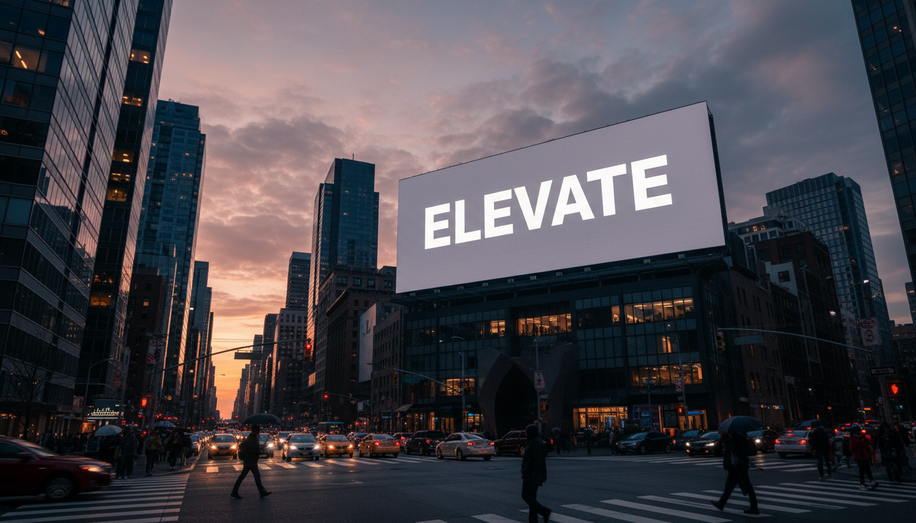

In the fleeting glance of a driver zipping by at highway speeds or a pedestrian weaving through city streets, out-of-home (OOH) advertising demands instant impact. Minimalism has emerged as the ultimate strategy, stripping away excess to deliver messages that cut through the visual noise with precision and power. This “less is more” philosophy not only aligns with the average 5-7 seconds viewers have to absorb a billboard but also boosts recall, engagement, and brand resonance in an era overloaded with information.
At its core, minimalist OOH leverages simplicity to enhance readability and memorability. Studies confirm that audiences process billboards in mere moments, making cluttered designs ineffective; instead, designs with short text—ideally seven words or fewer—paired with bold visuals and ample negative space dominate the landscape. High-contrast colors, limited palettes of two or three hues, and a single focal image direct attention unerringly to the core message or call to action (CTA), such as “Visit Today” or “Shop Now.” This approach reduces cognitive overload, allowing viewers to engage longer with the ad rather than struggling to parse details. Brands embracing minimalism tap into universal appeal, transcending demographics while adapting seamlessly to digital OOH formats and social media extensions.
Apple exemplifies this mastery repeatedly. Their “Shot on iPhone” campaign featured stunning user-generated photographs with nothing more than a simple tagline, letting the imagery speak volumes about camera quality and sparking global conversations. Similarly, the iPhone X launch displayed the device face-down on a vast white expanse, accompanied solely by the product name, release date, and logo—no hype, just elegant confidence that reinforced Apple’s premium ethos. Another triumph came with the iPad Mini promotion, where high-quality product photography stood alone, proving the device needed no embellishment to captivate. These efforts not only halted passersby but also amplified online buzz, demonstrating how minimalism drives deeper consumer engagement beyond the street.
McDonald’s “Follow the Arches” campaign took austerity to brilliant extremes in 2018. Fragmented golden arches doubled as directional arrows on otherwise empty billboards, with terse directives like “On your left,” “Next exit,” or “Just missed us”—no logo, no menu images, no persuasion required. The genius lay in contextual cleverness: the familiar arches guided hungry drivers to the nearest outlet, turning a billboard into a navigational tool. Recognition of the brand’s iconography was so instinctive that minimalism amplified urgency and foot traffic, proving simplicity can transform passive viewing into action.
Coca-Cola’s 2020 Italian “The Sign” pushed boundaries further, filling a billboard with signature red save for the subtly curved logo evoking bottle shapes and the whisper of “Feel it” hovering above. This near-silent invitation evoked sensory pleasure without a single product shot, relying on emotional shorthand to stir desire. In skincare, The Ordinary’s word-driven campaign by Uncommon Creative Studio opted for stark white backgrounds, minimalist illustrations, and plain text to tout formulations—eschewing celebrity gloss for “ordinary” authenticity that resonated virally. Chipotle mirrored this with text-only contrasts highlighting fresh ingredients, while Snapchat’s 2016 billboards brandished just their ghostly logo, banking on cultural ubiquity.
Even innovative uses of environment elevate minimalism. Sharp Dentistry’s Miami activation appeared as a blank canvas by day—logo and URL only—but ignited at night with yellow teeth-shaped lights framing one stark white standout, vividly signaling whitening services without a word. Such creativity proves minimalism needn’t be static; it thrives on smart execution, often going viral on shoestring budgets.
The impact on consumer engagement is quantifiable and profound. Simplified designs foster longer dwell times, as viewers digest less but remember more, with enhanced recall stemming from focused messaging. In motion-heavy contexts like driving or commuting, this clarity outperforms clutter, aligning with digital aesthetics for omnichannel synergy. Nike’s enduring “Just Do It” thrives on three words alone, inspiring action across billboards worldwide. Brands like these report stronger CTAs and brand lift, as minimalism builds intrigue, prompting searches or visits post-exposure.
Critically, implementation hinges on discipline: distill to the core message, prioritize bold hierarchy, and contextualize for surroundings—vibrant in rural expanses, subtle in urban grit. Negative space isn’t void; it’s the canvas amplifying essence. As OOH evolves with digital integration, minimalism’s rise reflects broader cultural shifts toward authenticity amid information saturation.
Ultimately, these campaigns reveal minimalism’s power: it doesn’t just advertise—it imprints. By saying less, OOH commands more attention, emotion, and results, redefining engagement one glance at a time.