
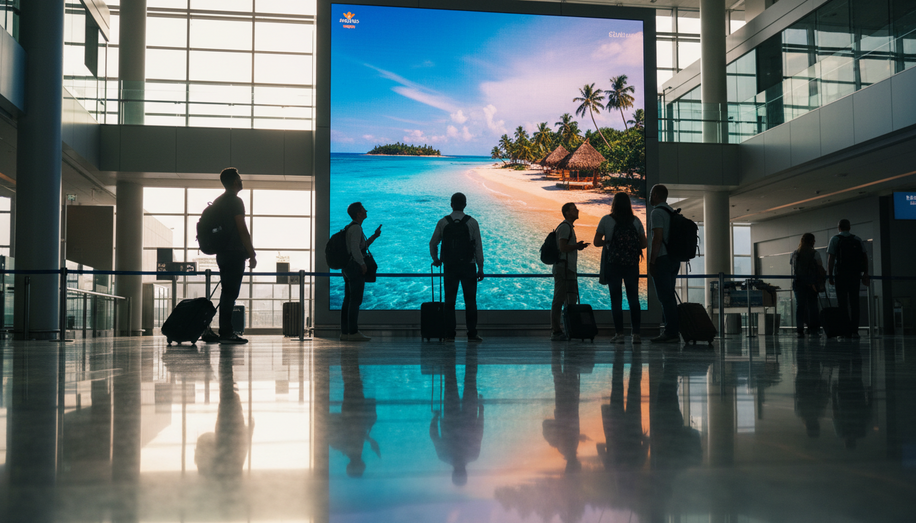

Airport environments have fundamentally transformed into premium brand experience zones, reshaping how advertisers approach this uniquely valuable medium. As passenger volumes reach record levels and airports continue modernizing their infrastructure, the strategies for capturing transient audiences have evolved dramatically from static displays to immersive, data-driven campaigns that engage travelers at critical moments of high purchase intent.
The shift from traditional static advertising to digital formats represents the most significant evolution in airport media. High-resolution digital screens now dominate departure halls, arrival zones, lounges, and retail corridors, offering advertisers unprecedented flexibility compared to their predecessors. This transition is driven by practical advantages: digital installations enable real-time content updates, dynamic messaging tailored to passenger flow patterns, and time-based communication that adjusts according to flight schedules and traveler demographics. Airport authorities increasingly prefer these formats because they reduce visual clutter while maintaining better control over terminal aesthetics, creating an environment where advertising enhances rather than detracts from the traveler experience.
The measurable impact of airport advertising on traveler behavior validates this strategic pivot. According to recent Nielsen research, 82 percent of frequent flyers read airport advertisements, while 61 percent recall seeing them. More compelling still, 45 percent of travelers scanned QR codes following airport ad exposure—a 6 percent increase from 2022—demonstrating how digital integration drives meaningful engagement and conversion. These metrics underscore that airport audiences are not passive observers but active, motivated consumers capable of immediate action.
Experiential media has emerged as a defining trend reshaping airport branding for 2026. Rather than pursuing visibility alone, brands increasingly seek to create memorable interactions that resonate emotionally with travelers. Interactive installations, motion-triggered displays, immersive walkthrough tunnels, and augmented reality-enabled zones are gaining traction across premium airport locations. These experiences extend campaign impact beyond the terminal itself, encouraging social sharing that amplifies reach into digital platforms and transforming individual airport encounters into broader marketing narratives.
Arrival zones and baggage claim areas have become unexpected engagement hotspots. Passengers experience lower stress levels after landing, making them more receptive to brand messaging during what was once overlooked as a purely functional space. Baggage claim areas now feature digital screens and interactive displays, with circular conveyor belt visuals ensuring repeated exposure during waiting periods. This strategic repositioning has made arrival-zone branding one of the most sought-after advertising formats, particularly for premium and lifestyle brands seeking to establish innovative positioning.
Data-driven messaging represents another critical evolution in airport advertising strategy. Digital screens enable contextual personalization based on passenger demographics, flight destinations, and travel purpose, allowing brands to deliver corporate messaging to business travelers during weekday mornings while targeting leisure travelers with lifestyle campaigns during holiday seasons. This precision approach ensures higher relevance, improved campaign efficiency, and the premium brand credibility that airport environments uniquely deliver.
Technological innovation continues accelerating airport advertising capabilities. Three-dimensional anamorphic and holographic displays are redefining audience experience at high-traffic premium locations, creating dramatic “stop-and-stare” effects that drive both organic engagement and social media amplification. The focus in 2026 is shifting toward sensor-based engagement and gesture control, transforming advertisements into interactive experiences that audiences can manipulate in real time.
Sustainability considerations are also influencing airport media evolution. Digital screens consume less material waste compared to repeated print installations, while smart energy systems and scheduled screen usage reduce power consumption. This alignment between environmental responsibility and advertising effectiveness creates mutual benefit for airports pursuing sustainability goals and brands seeking premium positioning through responsible media choices.
As air travel continues surging with record-setting traveler volumes and airports expand their infrastructure, airport advertising offers an uncluttered, high-impact environment connecting brands with captive, motivated audiences during moments of elevated purchase intent. The convergence of digital technology, experiential design, and data-driven targeting has positioned airport media as a uniquely powerful channel for brands willing to move beyond traditional approaches and embrace the full spectrum of immersive storytelling opportunities this premium environment now affords.