
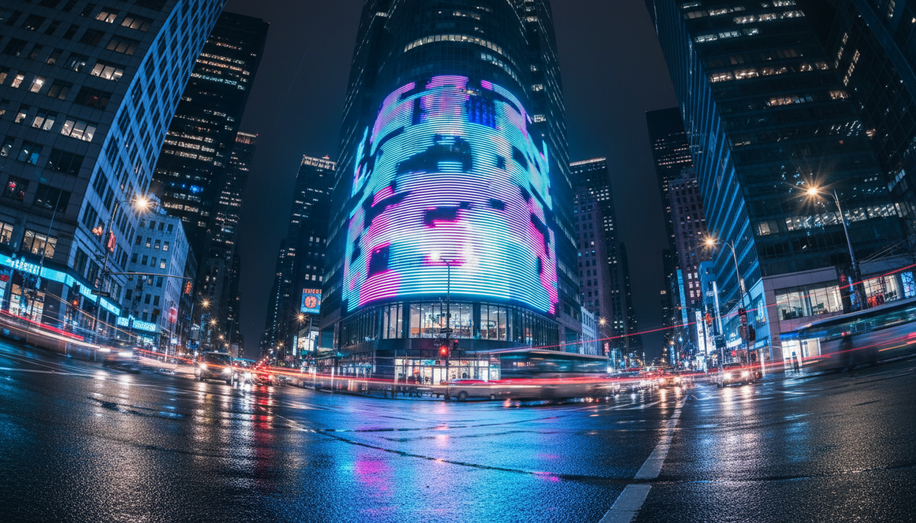

In the fleeting seconds it takes for a driver to pass a billboard or a pedestrian to glance at a transit ad, the human brain makes snap judgments that can make or break an advertising campaign. Outdoor advertising, or OOH, thrives on these micro-moments, leveraging deep-seated psychological principles to seize attention amid urban visual chaos. What elevates a forgettable poster to an unforgettable icon isn’t mere aesthetics—it’s a calculated interplay of cognition, emotion, and instinct, honed by how our brains process the world at high speed.
The foundation of eye-catching OOH lies in the brain’s rapid scanning mechanism, often called “thin-slice” processing, where first impressions form in milliseconds based on visual cues like color, clarity, and simplicity. High-contrast schemes—think black on yellow or white on blue—cut through competing stimuli, ensuring readability from afar in bright sunlight or rainy haze. Psychologists note that the brain processes images 60,000 times faster than text, recognizing a scene in as little as 13 milliseconds, which explains why bold visuals trump verbose copy every time. A cluttered design overwhelms working memory, limited to just a few seconds of focus during a commute; simplicity, by contrast, reduces cognitive load and boosts retention.
Movement and novelty amplify this effect, triggering the brain’s orienting response—a primal alert to anything dynamic or unexpected. Digital OOH screens exploit this with animations or shifting displays, but even static ads can mimic it through surprising elements, like an optical illusion or a face staring directly at the viewer. Humans are hardwired to prioritize faces, especially those making eye contact, as they activate mirror neurons and foster instant connection. Ben Parr, author of *Captivology*, emphasizes violating expectations to spark curiosity—ads that catch people off-guard without alarming them linger longer in memory.
Repetition seals the deal via the mere-exposure effect, where familiarity breeds preference and trust. A commuter encountering the same bold tagline daily shifts it from short-term working memory to long-term storage, building subconscious brand loyalty. Consistency in colors, fonts, and motifs across locations reinforces this, turning passive glances into active recall. Placement matters profoundly: ads near retail spots or decision points nudge impulse buys through proximity bias, while commute routes maximize exposures.
Emotion is the true powerhouse, outpacing rational appeals in memory formation. Neuroscience shows emotional content—humor, nostalgia, FOMO, or inspiration—creates stronger neural pathways, making a heartfelt image of a family eclipse a data-packed chart. Red evokes urgency, blue trust; humor disarms skepticism; scarcity phrases like “Limited Time Only” tap scarcity bias for immediate action. Associative learning, akin to classical conditioning, pairs a mascot or jingle with positive feelings, creating mental shortcuts that trigger recall in stores.
Yet, mastery demands balance. Cognitive fluency favors minimal text—one clear message, a punchy headline, and a call-to-action like “Visit Today.” Overloading with details invites dismissal; instead, evoke feeling first, justify logically later. Positive moods enhance decision-making speed, so uplifting imagery—cute animals or aspirational scenes—spreads emotional contagion, prompting quicker, consistent responses.
As cities densify and attention fragments further with smartphones, OOH’s edge sharpens through psychological savvy. Smart integrations like location data or AR overlays promise even greater personalization, but the core endures: stand out instantly, connect emotionally, repeat relentlessly. Brands ignoring these principles risk blending into the background; those embracing them turn streets into canvases of influence, proving OOH isn’t just visible—it’s viscerally compelling.